Question
Explain Electro static potential energy.

Answer

→Electro static potential energy :

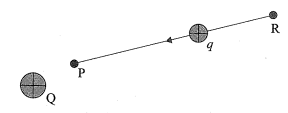
Image
→As shown in the fig. electric charge $Q$ is placed on the origin. Electric field created by it is $\vec{E}$.
→In this electric field, a test charge $q$ is to be taken from R to P , against the repulsive force acting on $q$ by Q .
→The repulsive force between electric charges $q$ and $Q$ can act only when both the charges are either positive or negative. Suppose, both the electric charges are positive.
→Here, test charge $q$ is so small that it doesn't disturb electric charge Q .
→Test charge $q$ is to be taken from point R to P , at a very small and constant velocity. This can become possible only when the external force exerted on charge $q$ is equal and opposite to the electric force exerted on charge $q$ by charge Q . Which means,
$\overrightarrow{ F }_e=-\overrightarrow{ F }_{e xt }$
→In this situation, the work done by the external force on $q$ is stored in the form of potential energy.
→If the external force is removed after taking the charge $q$ at point P , the electric force of repulsion takes the charge $q$ away from Q . Charge $q$ gains kinetic energy.
→We can say that the potential energy stored in charge $q$ at point P , is converted into kinetic energy. In this process, the sum of kinetic energy and potential energy remains constant.
→For the sake of ease, the test charge is taken at infinite distance, initially. (Point - R is at infinite distance)
→The work done by the external force in bringing the test charge from infinity to the point P in the given electric field
$W _{\infty \rightarrow P }=\int_{\infty}^{ P } \overrightarrow{ F }_{e x t} \cdot \overrightarrow{d r}$ →Where the direction of $\overrightarrow{d r}$ will be from $\infty$ towards P .
$\therefore W _{\infty \rightarrow P }=-\int_{\infty}^{ P } \overrightarrow{ F }_e \cdot \overrightarrow{d r}\left(\because \overrightarrow{ F }_e=-\overrightarrow{ F }_{\text {ext }}\right)$
This work is done against the electrostatic repulsion force, which is stored in charge q in the form of potential energy.
Static electric energy (electro static potential energy) : "The work required to be done against the electric field in bringing a given test charge(q), from infinite distance to the given point in the electric field is called the electric potential energy of that charge at that point."

Need a full question paper?

Generate a complete, print-ready paper with questions like this in minutes — across 16+ boards, with answer keys.
Start Generating Free

Similar questions

A body of mass 2kg suspended through a vertical spring executes simple harmonic motion of period 4s. If the oscillations are stopped and the body hangs in equilibrium, find the potential energy stored in the spring.
Obtain the magnification by lens after giving the definition.
The fission properties of $^{239}_{94}\text{Pu}$ are very similar to those of $^{235}_{92}\text{U}.$ The average energy released per fission is 180 MeV. How much energy, in MeV, is released if all the atoms in 1 kg of pure $^{239}_{94}\text{Pu}$ undergo fission?
Calculate the binding energy per $^{40}_{20}\text{CA}$ nucleon nucleus.
[Given: m $\big(^{40}_{20}\text{Ca}\big)=39.962589\text{u}$
mn(mass od a neutron) = 1.008665u
mp(mass of a proton) =1.007825u
1u = 931 MeV/c2]
  1. Derive the expression for the torque acting on a current carrying loop placed in a magnetic field.
  2. Explain the significance of a radial magnetic field when a current carrying coil is kept in it.
The first excited energy of a He+ ion is the same as the ground state energy of hydrogen. Is it always true that one of the energies of any hydrogen-like ion will be the same as the ground state energy of a hydrogen atom?
Describe the working principle of a moving coil galvanometer. Why is it necessary to use (i) a radial magnetic field and (ii) a cylindrical soft iron core in a galvanometer? Write the expression for current sensitivity of the galvanometer.
Can a galvanometer as such be used for measuring the current? Explain.
  1. Draw a schematic diagram of a reflecting telescope.
  2. State the advantages of reflecting telescope over refracting telescope.
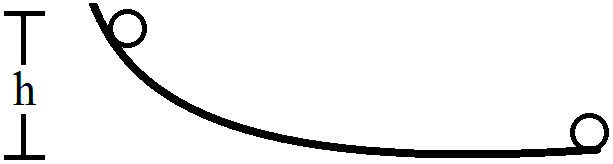
A small spherical ball is released from a point at a height h on a rough track shown in figure. Assuming that it does not slip anywhere, find its linear speed when it rolls on the horizontal part of the track.

Explain how the scattering experiment can be analyzed in detail from Rutherford's nuclear model.