Question
Explain electrostatic potential.

Answer

The work done in taking the test charge from one point to the other point in the electric field created by an electric charge distribution is stored in the form of potential energy and is proportional to charge $q$.
If this work is divided by $q$, then the resulting quantity does not depend on $q$. In this way, work done per unit charge is the characteristic of electric field, which can be defined as static electric potential.
The work done by external force in taking unit positive charge from $R$ to P ,
$\frac{ W _{ RP }}{q}=\frac{ U _{ P }- U _{ R }}{q}= V _{ P }- V _{ R }=\Delta V$ Where, $V _{ P }$ and $V _{ R }$ are electrostatic potential at points $P$ and $R$ respectively.
There is no importance of absolute value of electric potential. It is only the difference of electric potential between two points, which is important.
If electric potential at infinite distance is taken zero then,
"Work done in bringing unit positive charge from infinity to the given point in the electric field, against the electric field is called electro static potential (V) at that point".
OR
→"In the region of static electric field, electric potential at any point, means work done by external force in bringing unit positive charge from infinity to that point, without acceleration."
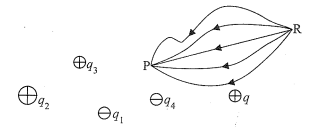
The work done in taking the test charge $q$ in the given electric field, does not depend on path. It depends only on the initial position and final position.

Image

As shown in the fig., in the resultant (net) electric field of electric charges $q_1, q_2, q_3$, $q_4$, the work done in taking the test charge $q$ from point R to P , on different paths, is found same which indicates that the work done is independent of path.

Need a full question paper?

Generate a complete, print-ready paper with questions like this in minutes — across 16+ boards, with answer keys.
Start Generating Free

Similar questions

Red light, however bright it is, cannot produce the emission of electrons from a clean zinc surface. But even weak ultraviolet radiation can do so. Why?
Electrons are emitted from the cathode of negligible work function, when photons of wavelength $\lambda$ are incident on it. Derive the expression for the de Broglie wavelength of the electrons emitted in terms of the wavelength of the incident light.
Explain the construction of compound microscope with the help of figure and derive the equation of magnification.
Find the charge appearing on each of the three capacitors shown in figure.
A rod is inserted as the core in the current-carrying solenoid of the previous problem.
  1. What is the magnetic intensity H at the centre?
  2. If the magnetization I of the core is found to be 0.12Nm, find the susceptibility of the material of the rod.
  3. Is the material paramagnetic, diamagnetic or ferromagnetic?
  1. Derive the expression for the capacitance of a parallel plate area A and plate separation d.
  2. Two charged spherical conductors of radii $R_1$ and $R_2$ when conducting wire acquire charges $q_1$ and $q_2$ respectively. surface charge densities in terms of their radii.
  1. Show using a proper diagram how unpolarised light can be linearly polarised by reflection from a transparent glass surface.
  2. The figure shows a ray of light falling normally on the face AB of an equilateral glass prism having refractive index $\frac{3}{2},$ placed in water of refractive index $\frac{4}{3}.$ Will this ray suffer total internal reflection on striking the face AC? Justify your answer.
A ceiling fan has a diameter (of the circle through the outer edges of the three blades) of 120cm and rpm 1500 at full speed. Consider a particle of mass 1g sticking at the outer end of a blade. How much force does it experience when the fan runs at full speed? Who exerts this force on the particle? How much force does the particle exert on the blade along its surface?
Write the two processes that take place in the formation of a p-n junction. Explain with the help of a diagram, the formation of depletion region and barrier potential in a p-n junction.
The conductivity of a pure semiconductor is roughly proportional to $\text{T}^\frac{3}{2}\text{e}^{\frac{-\Delta\text{E}}{2\text{kT}}}$ where $\Delta\text{E}$ is the band gap. The band gap for germanium is 0.74eV at 4K and 0.67eV at 300K. By what factor does the conductivity of pure germanium increase as the temperature is raised from 4K to 300K?
A uniformly moving train passes by a long platform. Consider the events' engine crossing the beginning of the platform' and 'engine crossing the end of the platform'. Which frame (train frame or the platform frame) is the proper frame for the pair of events?