Question
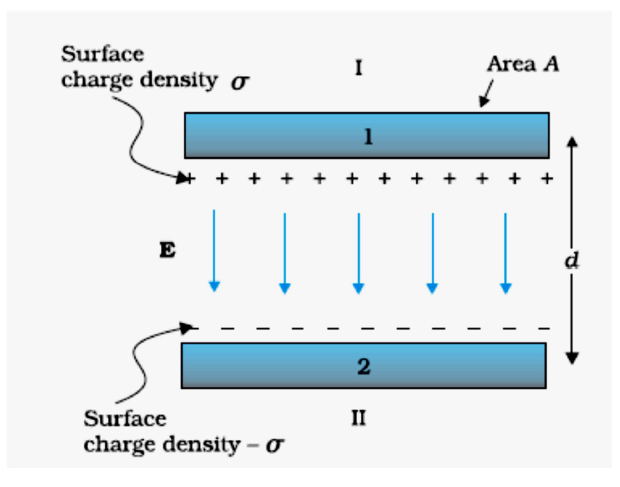
  1. Derive the expression for the capacitance of a parallel plate area A and plate separation d.
  2. Two charged spherical conductors of radii $R_1$ and $R_2$ when conducting wire acquire charges $q_1$ and $q_2$ respectively. surface charge densities in terms of their radii.
Answer

  1.  


Electric field between the plates of capacitor E = $\frac{\sigma}{\varepsilon_{0}} =\frac{\text{Q}}{\text{A}\varepsilon_{0}}$

$\therefore$ potential difference

$\text{V} = \text{Ed} = \frac{\text{Qd}}{\text{A}\varepsilon_{0}}$

Capacitance

$\text{C} = \frac{\text{Q}}{\text{V}} = \frac{\varepsilon_{0}\text{A}}{\text{d}}$
  1. When the two charged spherical conductors are connected by a conducting wire , they acquire the same potential
i.e $\frac{\text{Kq}_{1}}{\text{R}_{1}} = \frac{\text{Kq}_{2}}{\text{R}_{2}}\Rightarrow\frac{\text{q}_{1}}{\text{q}_{2}} = \frac{\text{R}_{1}}{\text{R}_{2}}$

Hence, ratio of surface charge densities

$\frac{\sigma_{1}}{\sigma_{2}} = \frac{\text{q}_{1}/4\pi\text{R}_{1}^{2}}{\text{q}_{2}/4\pi\text{R}_{2}^{2}}$

$ = \frac{\text{q}_{1}\text{R}_{2}^{2}}{\text{q}_{2}\text{R}_{1}^{2}}$

$ = \frac{\text{R}_{1}}{\text{R}_{2}}\times\frac{\text{R}_{2}^{2}}{\text{R}_{1}^{2}} = \frac{\text{R}_{2}}{\text{R}_{1}}.$

Need a full question paper?

Generate a complete, print-ready paper with questions like this in minutes — across 16+ boards, with answer keys.

Start Generating Free

Similar questions

Explain what would happen if in the capacitor given in Exercise 2.8, a 3 mm thick mica sheet (of dielectric constant = 6) were inserted between the plates,
  1. While the voltage supply remained connected.
  2. After the supply was disconnected.
You have learnt in the text how Huygens’ principle leads to the laws of reflection and refraction. Use the same principle to deduce directly that a point object placed in front of a plane mirror produces a virtual image whose distance from the mirror is equal to the object distance from the mirror.
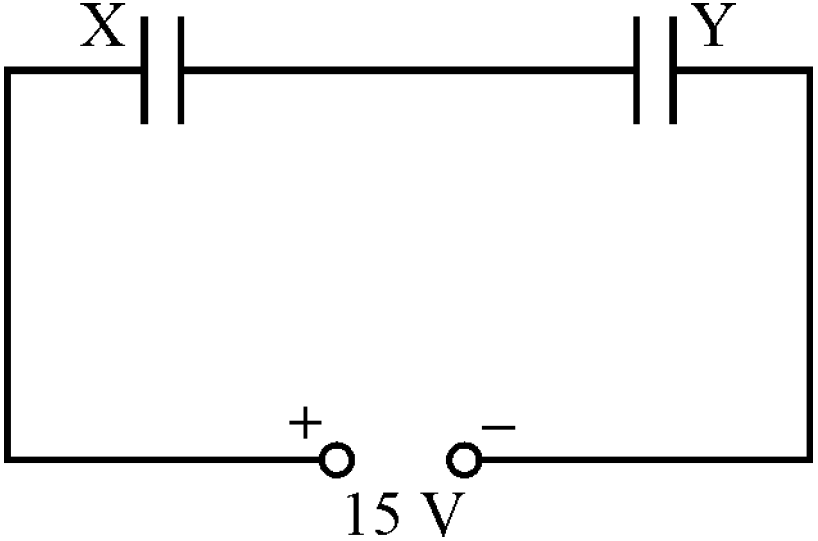
Two parallel plate capacitors X and Y have the same area of plates and same separation between them. X has air between the plates while Y contains a dielectric medium of $\varepsilon_{\text{r}} = 4.$
  1. Calculate capacitance of each capacitor if equivalent capacitance of the combination is $4\mu\text{f}.$
  2. Calculate the potential difference between the plates of X and Y.
  3. Estimate the ratio of electrostatic energy stored in X and Y.
Write any two distinguishing features between conductors, semiconductors and insulators on the basis of energy band diagrams.
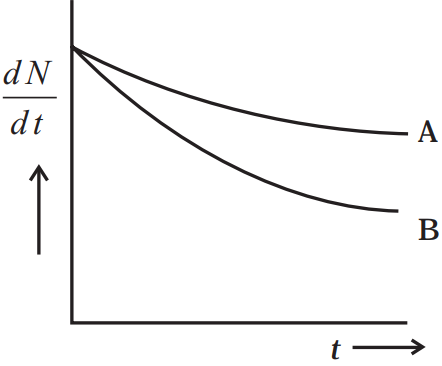
Which sample, A or B shown in Fig. has shorter mean-life?
Two parallel wires carry equal currents of 10A along the same direction and are separated by a distance of 2.0cm. Find the magnetic field at a point which is 2.0cm away from each of these wires
A proton and an $\alpha$-particle move perpendicular to a magnetic field. Find the ratio of radii of the circular paths described by them when both (i) have equal momenta, and (ii) were accelerated through the same potential difference.
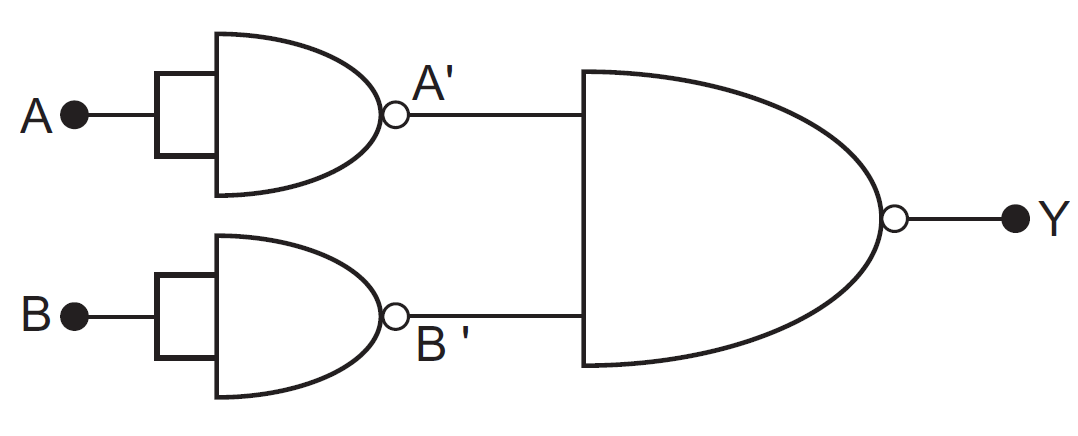
In the circuit shown in the figure, identify the equivalent gate of the circuit and make its truth table.
A charge of $+2.0 \times 10^{-8}C$ is placed on the positive plate and a charge of $-1.0 \times 10^{-8}C$ on the negative plate of a parallel-plate capacitor of capacitance $1.2\times10^{-3}\mu\text{F}.$ Calculate the potential difference developed between the plates.
The intensity of sound from a point source is $1.0 \times 10^{-6}W/m^2$ at a distance of 5.0m from the source. What will be the intensity at a distance of 25m from the source?