Gujarat BoardEnglish MediumSTD 12 SciencePhysicsELECTROSTATIC POTENTIAL AND CAPACITANCE3 Marks
Question
Explain electrostatic potential.
✓
Answer
→The work done in taking the test charge from one point to the other point in the electric field created by an electric charge distribution is stored in the form of potential energy and is proportional to charge $q$. →If this work is divided by $q$, then the resulting quantity does not depend on $q$. In this way, work done per unit charge is the characteristic of electric field, which can be defined as static electric potential. →The work done by external force in taking unit positive charge from $R$ to P , $\frac{ W _{ RP }}{q}=\frac{ U _{ P }- U _{ R }}{q}= V _{ P }- V _{ R }=\Delta V$ Where, $V _{ P }$ and $V _{ R }$ are electrostatic potential at points $P$ and $R$ respectively. →There is no importance of absolute value of electric potential. It is only the difference of electric potential between two points, which is important. →If electric potential at infinite distance is taken zero then, "Work done in bringing unit positive charge from infinity to the given point in the electric field, against the electric field is called electro static potential (V) at that point". OR →"In the region of static electric field, electric potential at any point, means work done by external force in bringing unit positive charge from infinity to that point, without acceleration." →The work done in taking the test charge $q$ in the given electric field, does not depend on path. It depends only on the initial position and final position.
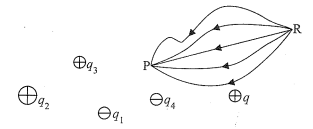
→As shown in the fig., in the resultant (net) electric field of electric charges $q_1, q_2, q_3$, $q_4$, the work done in taking the test charge $q$ from point R to P , on different paths, is found same which indicates that the work done is independent of path.
Need a full question paper?
Generate a complete, print-ready paper with questions like this in minutes — across 16+ boards, with answer keys.