Question
Explain emf, potential difference and internal resistance of cell and derive the relation between them. (or derive the relation between emf, potential difference and internal resistance of the cell.)
Answer

Image
Image
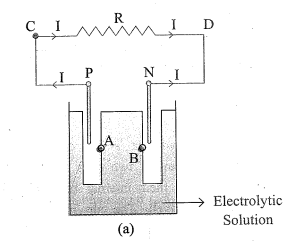
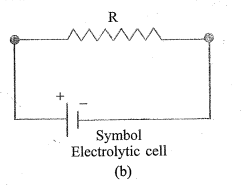
The figure shows the electrolytic cell. Electrolytic cell is used to maintain a steady current in an electric circuit.
As shown in the figure, two electrodes, positive (P) and negative (N) are immersed in an electrolytic solution.
Because of being dipped in the solution, the electrodes exchange charges with the electrolyte.
The potential difference between the positive electrode and the adjacent point A is $V _{+}$and the potential difference between negative electrode to the adjacent point B is $- V _{-}$.
So, the potential difference between P and N is $V_{+}-\left(-V_{-}\right)=V_{+}+V_{-}$
This potential difference is called the electromotive force (emf) of the cell and it is denoted by $\varepsilon$.
$\therefore \varepsilon= V _{+}+ V _{-}>0$
→Definition of emf : The potential difference between two electrodes when no current is flowing through the cell is called the emf of the cell.
As shown in the figure, consider a resistor R connected across the cell and current I flows across R from C to D and current in electrolyte current flows from N to P . clearly, across the electrolyte the same current flows through the electrolyte.
The electrolyte through which a current flows has a finite resistance $r \&$ it is called the internal resistance.
→Case I : $R =\infty$ (infinite)
According to ohm's law
$I =\frac{ V }{ R } \rightarrow I =0$
where V is the potential difference between P and N and it is called terminal voltage (or voltage) of the cell.
The potential difference between P and N , V (terminal voltage or voltage)
$=$ Potential difference between P and A
+ Potential difference between A and B
+ Potential difference between B and N
$\begin{aligned}
V & = V _{+}+ V _{-} \\
\therefore V & =\varepsilon
\end{aligned}$
Thus, emf $\varepsilon$ is the potential difference between the positive and negative electrodes in an open circuit i.e when no current is flowing through the cell.
→Case II : $R =$ Finite
when $R$ is finite, electric current flows through the cell. In that case the potential difference between P and N is
$\begin{aligned}
V & = V _{+}+ V _{-}- I r \\
\therefore \quad V & =\varepsilon- I r
\end{aligned}$
The negative sign in the expression (Ir) for the potential difference between A and B . This is because the current I flows from B to A in the electrolyte.

Need a full question paper?

Generate a complete, print-ready paper with questions like this in minutes — across 16+ boards, with answer keys.
Start Generating Free

Similar questions

State the principle of working of a galvanometer.
A galvanometer of resistance G is converted into a voltmeter to measure upto V volts by connecting a resistance R1 in series with the coil. If a resistance R2 is connected in series with it, then it can measure upto V/2 volts. Find the resistance, in terms of R1 and R2, required to be connected to convert it into a voltmeter that can read upto 2 V. Also find the resistance G of the galvanometer in terms of R1 and R2.
Write Huygen's principle and explain how a new spherical wave front is formed after a very small time interval.
Suppose an attractive nuclear force acts between two protons which may be written as $\text{F}=\text{Ce}^{-\text{kr}}/\text{r}^2.$
  1. Write down the dimensional formulae and appropriate SI units of C and k.
  2. Suppose that k = 1 fermi$^{-1}$ and that the repulsive electric force between the protons is just balanced by the attractive nuclear force when the separation is 5 fermi. Find the value of C.
Derive the equation for the torque acting on a current carrying loop placed at an angle $\theta$ with uniform magnetic field $(\vec{B})$.
Two cells of emf $2E$ and $E$ and internal resistances $2r$ and $r$ respectively, are connected in parallel. Obtain the expressions for the equivalent emf and the internal resistance of the combination.
Define the current sensitivity of a galvanometer. Write its S.I. unit.
Figure shows two circuits each having a galvanometer and a battery of 3 V. When the galvanometers in each arrangement do not show any deflection, obtain the ratio $R_1/ R_2.$​​​​​​​
A charge of $+2.0 \times 10^{-8}C$ is placed on the positive plate and a charge of $-1.0 \times 10^{-8}C$ on the negative plate of a parallel-plate capacitor of capacitance $1.2\times10^{-3}\mu\text{F}.$ Calculate the potential difference developed between the plates.
A charged capacitor of capacitance C is discharged through a resistance R. A radioactive sample decays with an average-life $\tau.$ Find the value of R for which the ratio of the electrostatic field energy stored in the capacitor to the activity of the radioactive sample remains constant in time.
  1. Show, with the help of a diagram, how unpolarised sunlight gets polarised due to scattering.
  2. Two polaroids $P_1$ and $P_2$ are placed with their pass axes perpendicular to each other. Unpolarised light of intensity $I_0$ is incident on $P_1$. A third polaroid $P_3$ is kept in between $P_1$ and $P_2$ such that its pass axis makes an angle of $45^{\circ}$ with that of P 1 . Determine the intensity of light transmitted through $\mathrm{P}_1, \mathrm{P}_2$ and $\mathrm{P}_3$.
A rectangular wire loop of width a is suspended from the insulated pan of a spring balance, as shown in A current i exists in the anti-clockwise direction in the loop. A magnetic field Bexists in the lower region. Find the change in the tension of the spring if the current in the loop is reversed.