Question
Derive the equation for the torque acting on a current carrying loop placed at an angle $\theta$ with uniform magnetic field $(\vec{B})$.
Answer

Image
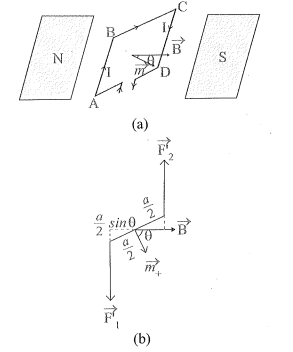
→As shown in the figure (a), the coil is placed in such a way that the magnetic field marks an angle $\theta$ with normal to the coil.
→The current passing through the coil is I. The length and width of the coil are $a$ and $b$ respectively.
→The force on the arm BC of the coil due to the current is $F _1= I a B \cos \theta$ and the force on the $\operatorname{arm} AD$ is $F _2= I a B \cos \theta$.
→Since, both these forces are equal, opposite and act along the axis of the coil, the resultant force and torque is zero.
→Similarly, the force acting perpendicular to the side AB and CD of the coil is $F _1{ }^{\prime}= F _2{ }^{\prime}= I b B$ respectively.
→Since, these two forces are equal in magnitude and opposite to each other the net force is zero. But they are non collinear, they form a couple, so a torque is exerted on the coil.
→From the figure (b) the torque acting on the coil.
$\begin{aligned}
\tau & =\left( F _1{ }^{\prime}\right) \frac{a}{2} \sin \theta+\left( F _2{ }^{\prime}\right)\left(\frac{a}{2}\right) \sin \theta \\
\therefore \tau & = I b B\left(\frac{a}{2}\right) \sin \theta+ I b B\left(\frac{a}{2}\right) \sin \theta \\
\therefore \quad \tau & =2 I b B \frac{a}{2} \sin \theta \\
\therefore \tau & = IB (a b) \sin \theta
\end{aligned}$
But $a b= A$ is the area of the rectangle.
$\therefore \tau= IAB \sin \theta$
→Vector form, $\vec{\tau}=I \vec{A} \times \vec{B}$
→But the magnetic dipole moment $\vec{m}= I \overrightarrow{ A }$
→The direction of the magnetic dipole moment is in the direction of area vector.
→Thus, torque acting on the coil $\vec{\tau}=\vec{m} \times \overrightarrow{ B } \ldots$
→If there are N turns in the coil then the torque is $\tau= NIAB \sin \theta$
Where, NIA $=m$ (magnetic moment)

Need a full question paper?

Generate a complete, print-ready paper with questions like this in minutes — across 16+ boards, with answer keys.
Start Generating Free

Similar questions

  1. Derive the expression for the capacitance of a parallel plate area A and plate separation d.
  2. Two charged spherical conductors of radii $R_1$ and $R_2$ when conducting wire acquire charges $q_1$ and $q_2$ respectively. surface charge densities in terms of their radii.
Explain the construction of compound microscope with the help of figure and derive the equation of magnification.
Figure. shows a cylindrical tube with adiabatic walls and fitted with a diathermic separator. The separator can be slid in the tube by an external mechanism. An ideal gas is injected into the two sides at equal pressures and equal temperatures. The separator remains in equilibrium at the middle. It is now slid to a position where it divides the tube in the ratio of 1 : 3. Find the ratio of the pressures in the two parts of the vessel.
A uranium reactor develops thermal energy at a rate of 300MW. Calculate the amount of $^{235}U$ being consumed every second. Average released per fission is 200MeV.
How are electromagnetic waves produced? What is the source of energy of these waves? Draw a schematic sketch of the electromagnetic waves propagating along the + x-axis. Indicate the directions of the electric and magnetic fields. Write the relation between the velocity of propagation and the magnitudes of electric and magnetic fields.
Explain electrostatic potential.
A 12.3 eV electron beam is used to bombard gaseous hydrogen at room temperature. Upto which energy level the hydrogen atoms would be excited?
Calculate the wavelengths of the second member of Lyman series and second member of Balmer series.
The given graph shows the variation of photo-electric currently) with the applied voltage(V) for two different materials and for two different intensities of the incident radiations. Identify and explain using Einstein's photo electric equation the pair of curves that correspond to (i) different materials but same intensity of incident radiation (ii) different intensities but same materials.
Draw a labelled ray diagram of a refracting telescope. Define its magnifying power and write the expression for it.
Write two important limitations of a refracting telescope over a reflecting type telescope.
Calculate the ratio of the angular momentum of the earth about its axis due to its spinning motion to that about the sun due to its orbital motion. Radius of the earth = 6400km and radius of the orbit of the earth about the sun $= 1.5 \times 10^8km.$