Question
Explain equations of Maxwell in detail.

Answer

SELF

Need a full question paper?

Generate a complete, print-ready paper with questions like this in minutes — across 16+ boards, with answer keys.

Start Generating Free

Similar questions

A long wire carries a current of 4.00A. Find the energy stored in the magnetic field inside a volume ot 1.00mm at a distance of 10.0cm from the wire.
Apply Gauss’s Theorem to find the electric field near a charged conductor.

OR

Show that the electric field at the surface of a charged conductor is $\vec{\text{E}}=\frac{\text{p}}{\in_0}\hat{\text{n}}$ where $\sigma$ is surface charge density and 
$\hat{\text{n}}$ is a unit vector normal to the surface in the outward direction.
In a Young's double slit interference experiment the fringe pattern is observed on a screen placed at a distance D from the slits. The slits are separated by a distance d and are illuminated by monochromatic light of wavelength $\lambda$. Find the distance from the central point where the intensity falls to,
  1. Half the maximum.
  2. One fourth of the maximum.
An object is placed at a distance of 30cm from a converging lens of focal length 15cm. A normal eye (near point 25cm, far point infinity) is placed close to the lens on the other side.
  1.  Can the eye see the object clearly?
  2.  What should be the minimum separation between the lens and the eye so that the eye can clearly see the object?
  3.  Can a diverging lens, placed in contact with the converging lens, help in seeing the object clearly when the eye is close to the lens?
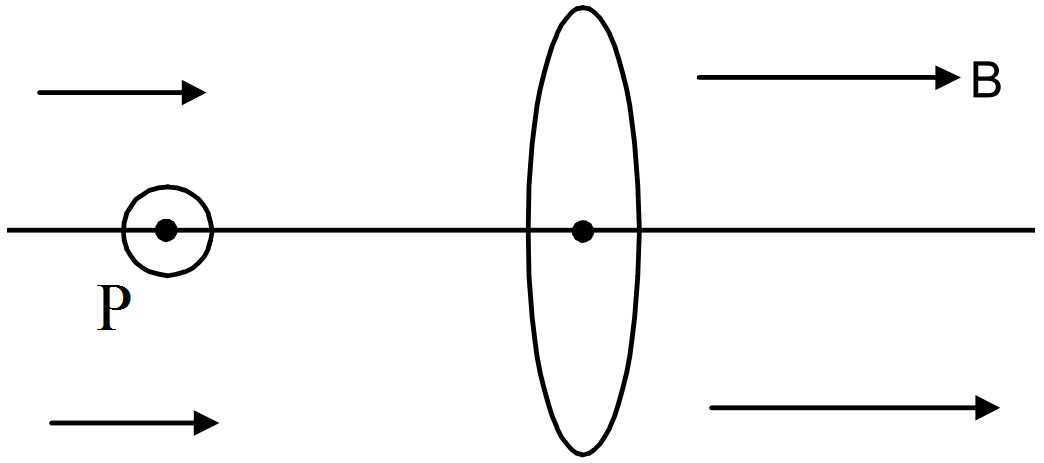
When a proton is released from rest in a room, it starts with an initial acceleration a0 towards west. When it is projected towards north with a speed v0, it moves with an initial acceleration 3a0 towards west. Find the electric field and the maximum possible magnetic field in the room.
Shows a convex lens of focal length 12cm lying in a uniform magnetic field B of magnitude 1.2T parallel to its principal axis. A particle with charge 2.0 × 10⁻³C and mass 2.0 × 10⁻⁵ kg is projected perpendicular to the plane of the diagram with a speed of 4.8 ms-1. The particle moves along a circle with its centre on the principal axis at a distance of 18cm from the lens. Show that the image of the particle moves along a circle and find the radius of that circle.

  1. Two insulated charged copper spheres A and B have their centres separated by a distance of 50 cm. What is the mutual force of electrostatic repulsion if the charge on each is 6.5 × 10⁻⁷ C? The radii of A and B are negligible compared to the distance of separation.
  2. What is the force of repulsion if each sphere is charged double the above amount, and the distance between them is halved?
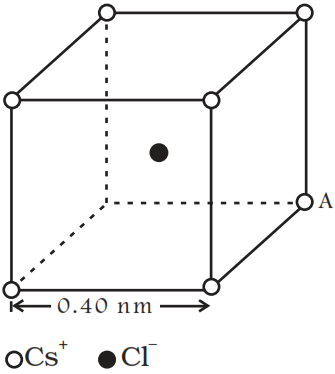
Fig. represents a crystal unit of cesium chloride, CsCl. The cesium atoms, represented by open circles are situated at the corners of a cube of side 0.40nm, whereas a Cl atom is situated at the centre of the cube. The Cs atoms are deficient in one electron while the Cl atom carries an excess electron.

  1. What is the net electric field on the Cl atom due to eight Cs atoms?
  2. Suppose that the Cs atom at the corner A is missing. What is the net force now on the Cl atom due to seven remaining Cs atoms?
An LR circuit having a time constant of 50ms is connected with an ideal battery of emf $\in.$ Find the time elapsed before:
  1. The current reaches half its maximum value.
  2. The power dissipated in heat reaches half its maximum value.
  3. The magnetic field energy stored in the circuit reaches half its maximum value.
Consider the situation of the previous problem. Suppose each of the blocks is pulled by a constant force F instead of any impulse. Find the maximum elongation that the spring will suffer and the distances moved by the two blocks in the process.