Question
Explain geminal and vicinal dihalide with examples.

Answer

→ When both the halogen atoms are present on the same carbon atom, it is known as geminal dihalide.
→ In common name system, gem-dihalides are named as alkylidene halides
→ When halogen atoms are present on adjacent carbon atoms, it is known as vicinal dihalides.
→ In common name system, vic-dihalides are named as alkylene dihalides.
Image

Need a full question paper?

Generate a complete, print-ready paper with questions like this in minutes — across 16+ boards, with answer keys.

Start Generating Free

Similar questions

Nitrogen exists as diatomic molecule and phosphorus as $P_4$. Why?
Write the reaction involved in the following:
  1. Etard reaction.
  2. Wolff-Kishner reduction.
Answer the following:
(a) The time required to decompose $SO _2 Cl _2$ to half of its initial amount is 60 min . If the decomposition is a first order reaction, calculate the rate constant of the reaction?
(b) The decomposition reaction of ammonia gas on platinum surface has a rate constant $k =2.5 \times 10^{-4}$ $mol L ^{-1} s^{-1}$. What is the order of the reaction?
In which of the following does adsorption take place and why?
  1. Silica gel placed in the atmosphere saturated with water.
  2. Anhydrous $CaCl_2$ placed in the atmosphere saturated with water.
On what factors do the products obtained from electrolysis a solution of an electrolyte depend?
Calculate the osmotic pressure in pascals exerted by a solution prepared by dissolving 1.0 g of polymer of molar mass 185,000 in 450 mL of water at 37°C.
Henry’s law constant for the molality of methane in benzene at $298\ K$ is $4.27 \times 10^5\ mm$ Hg. Calculate the solubility of methane in benzene at $298$ K under $760$ mm Hg.
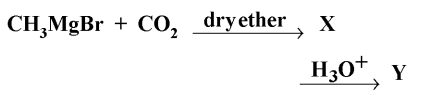
Image
In the above reaction sequence, write the chemical formula and name of X and Y.
Define the terms, ‘osmosis’ and ‘osmotic pressure’. What is the advantage of using osmotic pressure as compared to other colligative properties for the determination of molar masses of solutes in solutions?
The decomposition of A into product has value of k as $4.5 \times 10^3 \mathrm{~s}^{-1}$ at $10^{\circ} \mathrm{C}$ and energy of activation $60 \mathrm{~kJ} \mathrm{~mol}^{-1}$. At what temperature would k be $1.5 \times 10^4 \mathrm{~s}^{-1}$ ?