Question
Explain Gene Therapy

Answer

→ Gene therapy is a collection of methods that allows correction of a gene defect that has been diagnosed in a child/embryo.
→ Here by using DNA medicinal protein is produce which correct or treat the mutated Gene.
→ Here genes are inserted into a person's cells and tissues to treat a disease.
→ Correction of a genetic defect involves delivery of a normal gene in to the individual or embryo. to take over the function of and compensate for the non-functional gene.
→ Example- Adenosine deaminase deficiency
→ The first clinical gene therapy was given in 1990 to a 4-year old girl with adenosine deaminase (ADA) deficiency.
→ This enzyme is crucial for the immune system to function.
→ The disorder is caused due to the deletion of the gene for adenosine deaminase.
→ In some children ADA deficiency can be cured by bone marrow transplantation.
→ In others it can be treated by enzyme replacement therapy, in which functional ADA is given to the patient by injection.
→ But the problem with both of these approaches that they are not completely curative. As a first step towards gene therapy, lymphocytes from the blood of the patient are grown in a culture outside the body.
→ A functional ADA CDNA (using a retroviral vector) is then introduced into these lymphocytes, which are subsequently returned to the patient.
→ However, as these cells are not immortal, the patient requires periodic infusion of such genetically engineered lymphocytes.
→ However, if the gene isolate from marrow cells producing ADA is introduced into cells at early embryonic stages, it could be a permanent cure.
Need a full question paper?

Generate a complete, print-ready paper with questions like this in minutes — across 16+ boards, with answer keys.

Start Generating Free

Similar questions

  1. In plant breeding experiments, pistillate flowers are not emasculated, but are still bagged. Explain.
  2. Why are outbreeding devices developed by some flowering plants?
  1. Explain linkage and recombination as put forth by T.H. Morgan based on his observations with Drosophila melanogaster crossing experiment.
  2. Write the basis on which Alfred Sturtevant explained gene mapping.
Describe with an example the latitudinal gradients of biodiversity.
Define and design a test-cross###Explain the test cross by example.
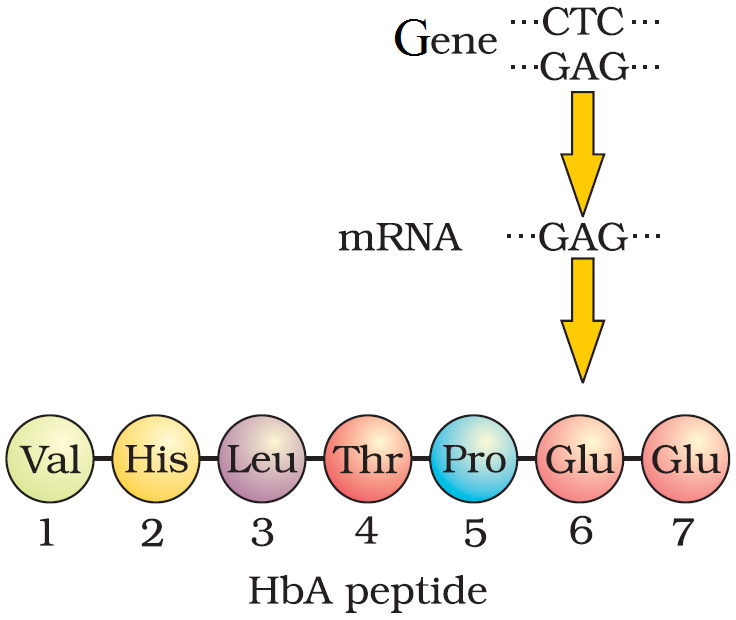
Given below is the representation of amino acid composition of the relevant translated portion of b-chain of haemoglobin, related to the shape of human red blood cells.

What difference would be noticed in the phenotype of the normal and the sufferer related to this gene?

Write the names of important microbes used in industries. Name any five products in which microbes are used for manufacturing purpose.
Discuss the factors which affect the rate of decomposition.
Given below are the events that are observed in an artificial hybridisation programme. Selection of parents → Emasculation → Bagging → Collection of pollen from other male plant → Dusting of pollen on stigma — Rebagging.
While, planning for crop improvement involving dioecious plants, which of the above mentioned steps would not be relevant?
Name the two different categories of microbes naturally occurring in sewage water. Explain their role in cleaning sewage water into usable water.
Explain the process of pollination in Vallisneria. How is it different in water-lily, which is also an aquatic plant?