Questions

3 Marks Question

Take a timed test

6 questions · self-marked practice — reveal the answer and mark yourself.

Question 13 Marks
Explain Gene Therapy
Answer
→ Gene therapy is a collection of methods that allows correction of a gene defect that has been diagnosed in a child/embryo.
→ Here by using DNA medicinal protein is produce which correct or treat the mutated Gene.
→ Here genes are inserted into a person's cells and tissues to treat a disease.
→ Correction of a genetic defect involves delivery of a normal gene in to the individual or embryo. to take over the function of and compensate for the non-functional gene.
→ Example- Adenosine deaminase deficiency
→ The first clinical gene therapy was given in 1990 to a 4-year old girl with adenosine deaminase (ADA) deficiency.
→ This enzyme is crucial for the immune system to function.
→ The disorder is caused due to the deletion of the gene for adenosine deaminase.
→ In some children ADA deficiency can be cured by bone marrow transplantation.
→ In others it can be treated by enzyme replacement therapy, in which functional ADA is given to the patient by injection.
→ But the problem with both of these approaches that they are not completely curative. As a first step towards gene therapy, lymphocytes from the blood of the patient are grown in a culture outside the body.
→ A functional ADA CDNA (using a retroviral vector) is then introduced into these lymphocytes, which are subsequently returned to the patient.
→ However, as these cells are not immortal, the patient requires periodic infusion of such genetically engineered lymphocytes.
→ However, if the gene isolate from marrow cells producing ADA is introduced into cells at early embryonic stages, it could be a permanent cure.
View full question & answer
Question 23 Marks
Explain the importance of biological production obtained from animal in which foreign gene is introduced.
Answer
→ Animals that have had their DNA manipulated to possess and express an extra (foreign) gene are known as transgenic animals.
→ Transgenic rats, rabbits, pigs, sheep, cows and fish have been produced, although over 95 per cent of all existing transgenic animals are mice.
(i) Normal physiology and development :
→ Transgenic animals can be specifically designed to allow the study of how genes are regulated, and how they affect the normal functions of the body and its development,
→ e.g., study of complex factors involved in growth such as insulin-like growth factor. By introducing genes from other species that alter the formation of this factor and studying the biological effects that result, information is obtained about the biological role of the factor in the body.
(ii) Study of disease :
→ Many transgenic animals are designed to increase our understanding of how genes contribute to the development of disease.
→ These are specially made to serve as models for human diseases so that investigation of new treatments for diseases is made possible.
→ Today transgenic models exist for many human diseases such as cancer cystic fibrosis. rheumatoid arthritis and Alzheimer's.
(iii) Biological products :
→ Medicines required to treat certain human diseases can contain biological products but such products are often expensive to make.
→ Transgenic animals that produce useful biological products can be created by the introduction of the portion of DNA (of genes) which codes for a particular product.
Examples :
→ human protein ($\alpha$ -1-antitrypsin) used to treat emphysema.
→ Similar attempts are being made for treatment of phenylketonuria (PKU) and cystic fibrosis.
→ In 1997, the first transgenic cow, Rosie, produced human protein-enriched milk (2.4 grams per litre). The milk contained the human a lactalbumin and was nutritionally a more balanced product for human babies than natural cow-milk.
(iv) Vaccine safety :
→ Transgenic mice are being developed for use intesting the safety of vaccines before they are used on humans.
→ Transgenic mice are being used to test the safety of the polio vaccine.
If successful and found to be reliable, they could replace the use of monkeys to test the safety of batches of the vaccine.
(v) Chemical safety testing :
→ This is known as toxicity/safety testing.
→ The procedure is the same as that used for testing toxicity of drugs.
→ Transgenic animals are made that carry genes which make them more sensitive to toxic substances than non-transgenic animals.
→ They are then exposed to the toxic substances and the effects studied.
→ Toxicity testing in such animals will allow us to obtain results in less time.
View full question & answer
Question 33 Marks
How tobacco plant is made pest resistance from nematodes?###Explain RNA interference with example.###Explain: Pest resistance Plants.
Answer
→ Several nematodes parasites a wide variety of plants and animals including human beings.
→ A nematode Meloidegyne incognitia infects the roots of tobacco plants and causes a great reduction in yield.
→ A novel strategy was adopted to prevent this infestation which was based on the process of RNA interference (RNAi).
→ RNAi takes place in all eukaryotic organisms as a method of cellular defense.
→ This method involves silencing of a specific mRNA due to a complementary dsRNA molecule that binds to and prevents translation of the mRNA (silencing).
→ The source of this complementary RNA could be from an infection by viruses having RNA genomes or mobile genetic elements (transposons) that replicate via an RNA intermediate.
→ Using Agrobacterium vectors, nematode-specific genes were introduced into the host plant.
→ The introduction of DNA was such that it produced both sense and anti-sense RNA in the hostcells.
→ These two RNA's being complementary to each other formed a double stranded (dsRNA) that initiated RNAi and thus, silenced the specific mRNA of then ematode.
→ The consequence was that the parasite could not survive in a transgenic host expressing specific interfering RNA.
→ The transgenic plant therefore got itself protected from the parasite.
View full question & answer
Question 43 Marks
What is Cry (crystal) protein? Give the name of organisms which produces it. How humans take benefit from this protein?###Explain in detail Bt- cotton.
Answer
→ In Bacillus thuringiensis, there is a bacterial gene which produce toxic crystal protein having insecticidal activity. This crystal protein is called Cry protein.
→ Bt toxin is produced by a bacterium called Bacillus thuringiensis.
→ Bt toxin gene has been cloned from the bacteria and been expressed in plants.
→ So plants become resistance to insects without the need for insecticides. This is how a biopesticide is created.
→ Some strains of Bacillus thuringiensis produce proteins that kill certain insects such as lepidopterans (tobacco budworm, armyworm), coleopterans (beetles) and dipterans (flies, mosquitoes).
→ B. thuringiensis forms protein crystals during a particular phase of their growth.
→ These crystals contain a toxic insecticidal protein.
→ Actually, the Bt toxin protein exist as inactive protoxins.
→ But once an insect ingest the inactive toxin, it is converted into an active form of toxin due to the alkaline pH of the gut which solubilise the crystals.
→ The activated toxin binds to the surface of midgut epithelial cells and create pores.
→ That cause cell swelling and lysis and eventually cause death of the insect.
→ Specific Bt toxin genes were isolated from Bacillus thuringiensis and incorporated into the several crop plants such as cotton.
→ The proteins encoded by the genes crylAc and cryllAb control the cotton bollworms.
→ CrylAb controls corn borer.
View full question & answer
Question 53 Marks
Explain artificial synthesis of the compound used by diabetic patients.
Answer
→ Insulin is produced by beta cells of pancreas.
→ Insulin plays important role in a sugar or carbohydrate metabolism.
→ Due to lack of insulin diabetes mellitus occurs in humans.
→ Insulin used for diabetes was earlier extracted from pancreas of slaughtered cattle and pigs.
→ Insulin from an animal source, though caused some patients to develop allergy or other types of reactions to the foreign protein.
Image
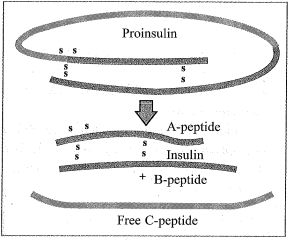
→ Insulin consists of two short polypeptide chains: chain A and chain B.
→ Polypeptide Chain A contains 21 amino acids and chain B contains 30 amino acids that are linked together by disulphide bridges.
→ In mammals, including humans, insulin is synthesised as a pro-hormone (like a pro-enzyme, the pro-hormone also needs to be processed before it becomes a fully mature and functional hormone) which contains an extra stretch called the C peptide.
→ This C peptide is not present in the mature insulin and is removed during maturation into insulin.
→ The main challenge for production of insulin using rDNA techniques was getting insulin assembled into a mature form.
→ In 1983, Eli Lilly an American company prepared two DNA sequences corresponding to A and B, chains of human insulin and introduced them in plasmids of E. coli to produce insulin chains.
→ Chains A and B were produced separately, extracted and combined by creating disulfide bonds to form human insulin.
View full question & answer
Question 63 Marks
Describe biopiracy.
Answer
→ Biopiracy is the term used to refer to the use of bio-resources by multinational companies and other organisations without proper authorisation from the countries and people concerned without compensatory payment.
→ Most of the industrialised nations are rich financially but poor in biodiversity and traditional knowledge.
→ In contrast the developing and the underdeveloped world is rich in biodiversity and traditional knowledge related to bio-resources.
→ Traditional knowledge related to bio-resources can be exploited to develop modern applications and can also be used to save time, effort and expenditure during their commercialisation.
→ There has been growing realisation of the injustice, inadequate compensation and benefit sharing between developed and developing countries.
→ Therefore, some nations are developing laws to prevent such unauthorised exploitation of their bio-resources and traditional knowledge.
→ The Indian Parliament has recently cleared the second amendment of the Indian Patents Bill, that takes such issues into consideration, including patent terms, emergency provisions and research and development initiative.
View full question & answer