Gujarat BoardEnglish MediumSTD 12 ScienceChemistryCoordination Compounds4 Marks
Question
Explain geometrical isomerism in octahedral Complex.
✓
Answer
$\rightarrow$ This type of isomerism arises in heteroleptic complexes due to different possible geometric arrangements of the ligands.
$\rightarrow$ Important examples of these behaviour are found with coordination numbers $4$ and $6.$
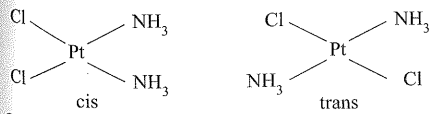
$\rightarrow$ In a square planar complex of formula $[MX_2L_2] (X$ and $L$ are unidentate$),$ the two ligands $X$ may be arranged adjacent to each other in a cis isomer, or opposite to each other in a trans isomer.
Geometrical isomers $($cis and trans$)$ of $Pt[(NH_3)_2Cl_2]$
$\rightarrow$ Other square planar complex of the type $ \text{MABXL} ($where $A, B, X, L$ are unidentates$)$ shows three isomers$-$two cis and one trans.
$\rightarrow$ Such isomerism is not possible for a tetrahedral geometry.
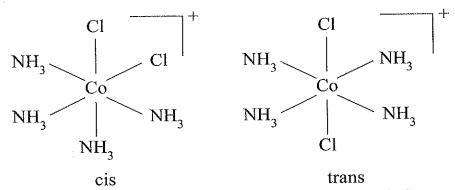
$\rightarrow$ In octahedral complexes of formula $[MX_2L_4]$ in which the two ligands $X$ may be oriented cis or trans to each other
Geometrical isomers $($cis and trans$)$ of $[Co(NH_3)_4Cl_2]^+$
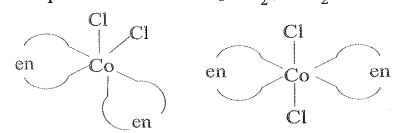
$\rightarrow$ This type of isomerism also arises when didentate ligands $L-L [$e.g., $en ]$ are present in complexes of formula $[MX_2(L-L)_2]$
Geometrical isomers $($cis and trans$)$ of $[CoCl_2(en)_2]$
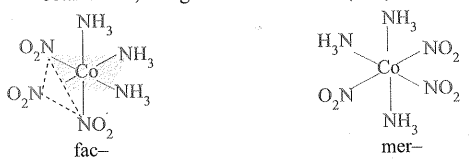
$\rightarrow$ Another type of geometrical isomerism occurs in octahedral coordination entities of the type $[Co(NH_3)_3(NO_2)_3].$
$\rightarrow$ If three donor atoms of the same ligands occupy adjacent positions at the corners of an octahedral face, it forms the facial $($fac$)$ isomer.
$\rightarrow$ When the positions are around the meridian of the octahedron, we get the meridional $($mer$)$ isomer.
The facial $($fac$)$ and meridional $($mer$)$ isomers of $[Co(NH_3)_3(NO_2)_3]$
Need a full question paper?
Generate a complete, print-ready paper with questions like this in minutes — across 16+ boards, with answer keys.