Question
Explain, giving reason, why carbon neither forms $C ^{4+}$ cations nor $C ^{4-}$ anions, but forms covalent compounds which are bad conductors of electricity and have low melting point and low boiling point.

Answer

Carbon cannot lose $4 e ^{-}$to form $C ^{+4}$ cations, as very high energy is required to remove $4 e ^{-}$ Carbon cannot gain $4 e ^{-}$to form $C ^{-4}$ anions as nucleus with 6 protons cannot hold 10 electrons. Carbon can share $4 e ^{-}$to form covalent compounds.
Carbon compounds do not conduct electricity being non-polar and do not form ions/charged particles.
Due to weak intermolecular forces of attraction, carbon compounds have low melting points and boiling points.

Need a full question paper?

Generate a complete, print-ready paper with questions like this in minutes — across 16+ boards, with answer keys.
Start Generating Free

Similar questions

Define reflex action.
Leaves of a healthy potted plant were coated with vaseline. Will this plant remain healthy for long? Give reason for your answer.
If the image formed by a mirror for all positions of the object placed in front of it is always erect and diminished, what type of mirror is it? Draw a ray diagram to justify your answer. Where and why do we generally use this type of mirror?
  1. Draw a ray diagram to show the refraction of light through a glass slab and mark angle of refraction and the lateral shift suffered by the ray of light while passing through the slab.
  2. If the refractive index of glass for light going from air to glass is 3/2, find the refractive index of air for light going from glass to air.
A convex lens of focal length 25cm and a concave lens of focal length 10cm are placed in close contact with each other. Calculate the lens power of this combination.
A combination of lenses for a camera contains two converging lenses of focal lengths 20cm and 40cm and a diverging lens of focal length 50cm. Find the power and focal length of the combination.
A man standing in front of a special mirror finds his image having a very small head, a fat body and legs of normal size. What is the shape of:
  1. Top part of the mirror?
  2. Middle part of the mirror?
  3. Bottom part of the mirror?
Give reasons for your choice.
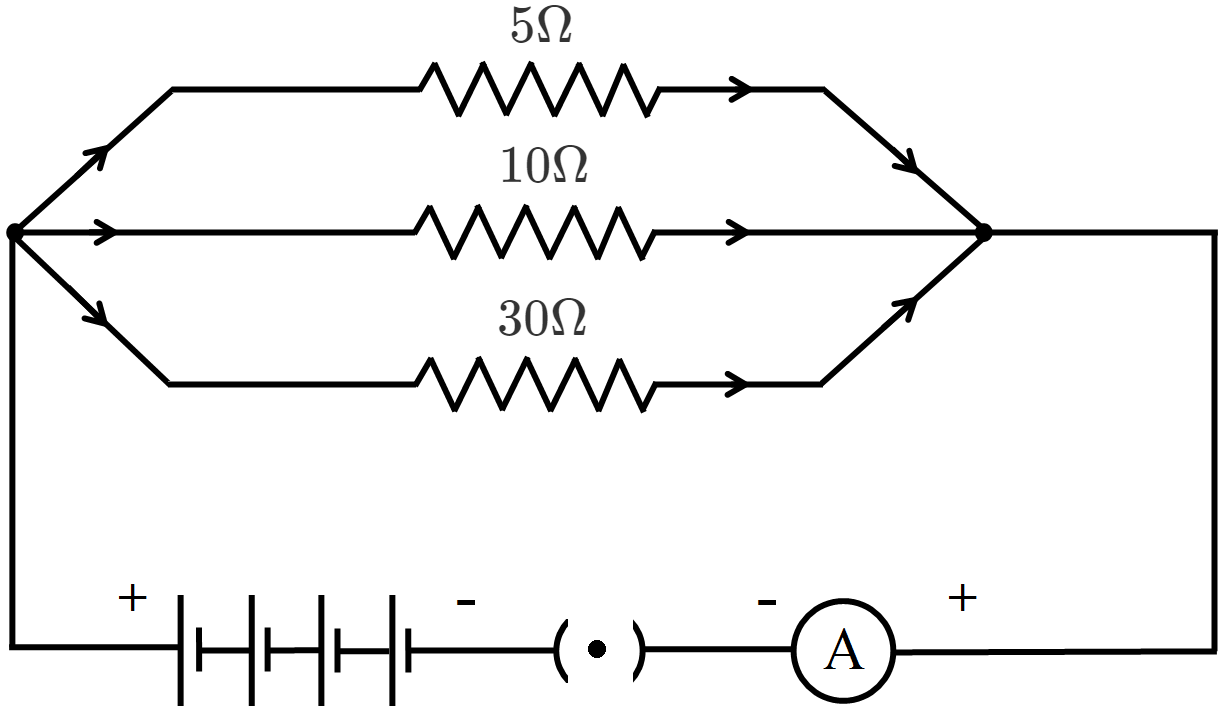
For the circuit shown in the diagram given below:
Calculate:
  1. The value of current through each resistor.
  2. The total current in the circuit.
  3. The total effective resistance of the circuit.
What is meant by denatured alcohol? What is the need to denature alcohol?
What are fossils? How do they act as an evidence for organic evolution?