If the image formed by a mirror for all positions of the object placed in front of it is always erect and diminished, what type of mirror is it? Draw a ray diagram to justify your answer. Where and why do we generally use this type of mirror?
CBSE OUTSIDE DELHI - SET 1 2015
Download our app for free and get started
The two rays chosen for the construction of ray diagram is:
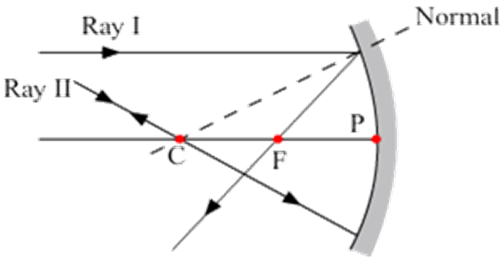
Ray 1: When the incident ray is parallel to the principal axis, the reflected ray will pass through the focus of concave mirror or it appears to pass through the focus of convex mirror.
Ray 2: When the incident ray passes through or appears to pass through the centre of curvature, the light, after reflection from the spherical mirror, reflects back along the same path.
The image formed is real, inverted, magnified and is formed beyond the centre of curvature.
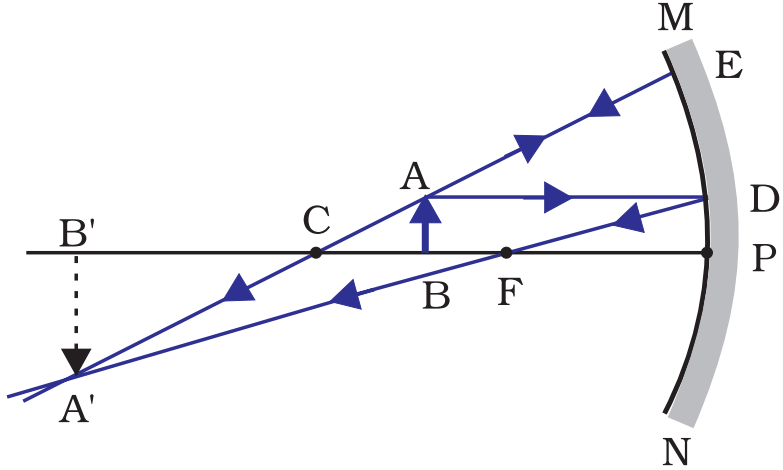
Ray 1: When the incident ray is parallel to the principal axis, the reflected ray will pass through the focus of concave mirror or it appears to pass through the focus of convex mirror.
Ray 2: When the incident ray passes through or appears to pass through the centre of curvature, the light, after reflection from the spherical mirror, reflects back along the same path.
The image formed is real, inverted, magnified and is formed beyond the centre of curvature.

Download our appand get started for free
Experience the future of education. Simply download our apps or reach out to us for more information. Let's shape the future of learning together!No signup needed.*
Similar Questions
- 1View SolutionHow would a pencil look like if you saw it through (a) a concave lens, and (b) a convex lens? (Assume the pencil is close to the lens). Is the image real or virtual?
- 2View SolutionWhich type of lens is:
- A converging lens, and which is.
- A diverging lens? Explain your answer with diagrams.
- 3View Solution
- Draw a ray diagram to show the refraction of light through a glass slab and mark angle of refraction and the lateral shift suffered by the ray of light while passing through the slab.
- If the refractive index of glass for light going from air to glass is 3/2, find the refractive index of air for light going from glass to air.
- 4View SolutionIf the image formed by a lens for all positions of the object placed in front of it is always virtual, erect and diminished, state the type of the lens. Draw a ray diagram in support of your answer. If the numerical value of focal length of such a lens is 20 cm, find its power in new cartesian sign conventions.
- 5The refractive index of glass with respect to air is $\frac{3}{2}$ and refractive index of water with respect to air is $\frac{4}{3}$ . What will be the refractive index of water with respect to glass?View Solution
- 6An image $\frac{2}{3}\text{rd}$ the size of object is formed by a convex lens at a distance of 12cm from Find the focal length of the lens.View Solution
- 7View SolutionHow are power and focal length of a lens related? You are provided with two lenses of focal length 20cm and 40cm respectively. Which lens will you use to obtain more convergent light?
- 8View SolutionCalculate the focal length of a convex lens which produces a virtual image at a distance of 50cm of an object placed 20cm in front of it.
- 9View SolutionDraw ray-diagrams to show the formation of images when the object is placed in front of a concave mirror (converging mirror):
- Between its pole and focus.
- Between its centre of curvature and focus Describe the nature, size and position of the image formed in each case.
- 10View SolutionHow far should an object be placed from a convex lens of focal length 20 cm to obtain its image at a distance of 30 cm from the lens? What will be the height of the image if the object is 6 cm tall?