Question
Explain ground state and ionisation energy of hydrogen atom.

Answer

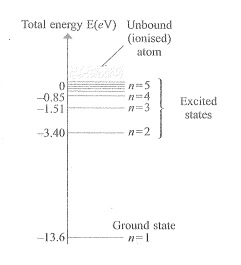
$\rightarrow$ The energy of an atom is the least when its electron is revolving in an orbit closest to the nucleus
i.e., for $n=1$.
$\rightarrow$ As the value of $n$ increases, the energy of the electron also increases.
$\rightarrow$ The lowest state of the atom is called the ground state, is that of lowest energy, with the electron revolving in the orbit of smallest radius, the Bohr radius $\left(a_0\right)$.

Image
The energy of this state
$E _n=-\frac{13.6}{n^2} e V$
$n=1$
$E _1=-13.6 eV$
$\rightarrow$ Therefore, the minimum energy required to free the electron from the ground state of the hydrogen atom is $13.6 eV$ .
It is called the ionisation energy of a the hydrogen atom.

Need a full question paper?

Generate a complete, print-ready paper with questions like this in minutes — across 16+ boards, with answer keys.
Start Generating Free

Similar questions

What is the reason, why the diameter of the objective of a telescope should be large for a good resolution?
A ray of light, incident on an equilateral glass prism$(\mu_{g} = \sqrt{3})$ moves parallel to the base line of the prism inside it. Find the angle of incidence for this ray.
By evaluating $\int\text{i}^2\text{Rdt},$ show that when a capacitor is charged by connecting it to a battery through a resistor, the energy dissipated as heat equals the energy stored in the capacitor.
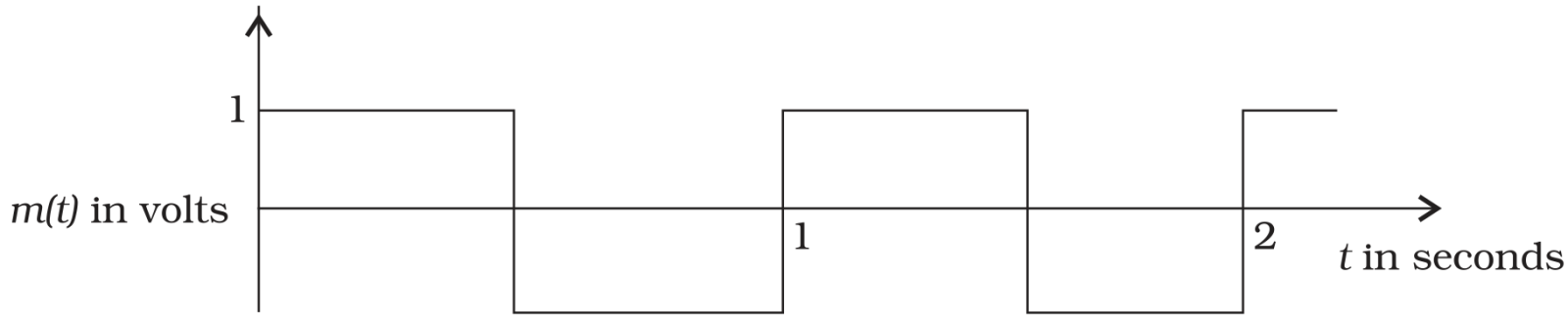
A modulating signal is a square wave, as shown in Fig.

The carrier wave is given by c(t) = 2sin (8$\pi$t) volts.
  1. Sketch the amplitude modulated waveform,
  2. What is the modulation index?
Write the law of conservation of electric charge
An electron beam projected along the positive X-axis deflects along the positive Y-axis. If this deflection is caused by a magnetic field, what is the direction of the field? Can we conclude that the field is parallel to the Z-axis?
At what rate should the earth rotate so that the apparent g at the equator becomes zero? What will be the length of the day in this situation?
The refractive index of the material of a convex lens is 1.5 and the radii of curvature of both its surfaces are equal. Prove that its focal length is equal to the radius of curvature.
A heavy particle of mass m falls freely near the earth's surface. What is the torque acting on this particle about a point 50cm east to the line of motion? Does this torque produce any angular acceleration in the particle?
It is said that the separation between the two charges forming an electric dipole should be small. Small compared to what?