Question 12 Marks
Using the formula for the radius of $n ^{\text {th }}$ orbit $r_n=\frac{n^2 h^2 \varepsilon_0}{\pi m e^2}$ derive an expression for the total energy of electron in $n^{\text {th }}$ Bohr's orbit.
Answer
View full question & answer→$\rightarrow$ From Bohr's second postulate, the formula for the radius of $n^{\text {th }}$ orbit for hydrogen atom is.
$r_n=\frac{n^2 h^2 \varepsilon_0}{\pi m e^2}$
$\rightarrow$ The total energy of the electron in the stationary states of the hydrogen atom is
$E _n=-\frac{1}{8 \pi \varepsilon_0} \frac{e^2}{r_n}$
$\rightarrow$ Using equation $(1)$ and equation $(2)$
$E _n=-\frac{1}{8 \pi \varepsilon_0} \frac{e^2}{\left(\frac{ n ^2 h^2 \kappa_0}{\pi m e^2}\right)}$
$\therefore E _n=-\frac{m e^4}{8 \varepsilon_0{ }^2 n^2 h^2}$
$\rightarrow$ Substituting $m=9.1 \times 10^{-31} \ kg$
$
e=1.6 \times 10^{-19} C$
$\varepsilon_0=8.85 \times 10^{-12} \frac{ C ^2}{ Nm ^2}$
$h=6.625 \times 10^{-34} Js
$
$\rightarrow$ Simplifying equation,
$E _n=-\frac{2.18 \times 10^{-18}}{n^2} J$
$\rightarrow$ Atomic energies are often expressed in electron volts $(e V)$.
$
\therefore E _n=-\frac{2.18 \times 10^{-18}}{n^2 \times 1.6 \times 10^{-19}} eV$
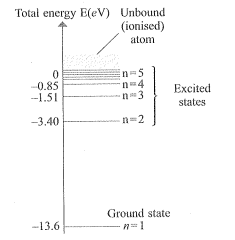
$\therefore E _n=-\frac{13.6}{n^2} eV
$
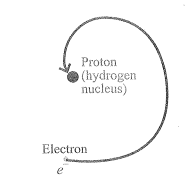
$\rightarrow$ The negative sign of the total energy of an electron moving in an orbit means that the electron is bound with the nucleus.
$\rightarrow$ Thus, energy will be required to remove the electron from the hydrogen atom to a distance infinitely far away from its nucleus.
$r_n=\frac{n^2 h^2 \varepsilon_0}{\pi m e^2}$
$\rightarrow$ The total energy of the electron in the stationary states of the hydrogen atom is
$E _n=-\frac{1}{8 \pi \varepsilon_0} \frac{e^2}{r_n}$
$\rightarrow$ Using equation $(1)$ and equation $(2)$
$E _n=-\frac{1}{8 \pi \varepsilon_0} \frac{e^2}{\left(\frac{ n ^2 h^2 \kappa_0}{\pi m e^2}\right)}$
$\therefore E _n=-\frac{m e^4}{8 \varepsilon_0{ }^2 n^2 h^2}$
$\rightarrow$ Substituting $m=9.1 \times 10^{-31} \ kg$
$
e=1.6 \times 10^{-19} C$
$\varepsilon_0=8.85 \times 10^{-12} \frac{ C ^2}{ Nm ^2}$
$h=6.625 \times 10^{-34} Js
$
$\rightarrow$ Simplifying equation,
$E _n=-\frac{2.18 \times 10^{-18}}{n^2} J$
$\rightarrow$ Atomic energies are often expressed in electron volts $(e V)$.
$
\therefore E _n=-\frac{2.18 \times 10^{-18}}{n^2 \times 1.6 \times 10^{-19}} eV$
$\therefore E _n=-\frac{13.6}{n^2} eV
$
$\rightarrow$ The negative sign of the total energy of an electron moving in an orbit means that the electron is bound with the nucleus.
$\rightarrow$ Thus, energy will be required to remove the electron from the hydrogen atom to a distance infinitely far away from its nucleus.