Question
Explain Henry's Law.

Answer

Henry's Law At constant temperature, in the given quantity of solvent, the amount of gas dissolved in a given volume is directly proportional to pressure of gas. On increasing temperature, the quantity decreases.
Hence:
$\begin{aligned} & m \propto p \\ & m = kp \end{aligned}$
where m quantity of dissolved gas
k = Henry's constant and p = Pressure of gas

Need a full question paper?

Generate a complete, print-ready paper with questions like this in minutes — across 16+ boards, with answer keys.

Start Generating Free

Similar questions

IF SHE (Standard Hydrogen Electrode) acts as anode and given metal acts as cathode, what is the sign of the reduction potential of metal?
The first $(\Delta_{1}\text{H}_{1})$ and the second $(\Delta_{1}\text{H}_{1})$ ionization enthalpies (in $\mathrm{kJ} \mathrm{~mol}^{-1}$ ) and the $(\Delta_{1}\text{H}_{1})$ electron gain enthalpy (in $\mathrm{kJ} \mathrm{~mol}^{-1}$ ) of a few elements are given below:
Elements $\Delta\text{H}_{1}$ $\Delta{\text{H}}_{2}$ $\Delta_{\text{eg}}\text{H}$
I 520 7300 -60
II 419 3051 -48
III 1681 3374 -328
IV 1008 1846 -295
V 2372 5251 +48
VI 738 1451 -40
Which of the above elements is likely to be:
The metal which can form a stable binary halide of the formula $\mathrm{MX}_2(\mathrm{X}=$ halogen $)$.
(i) Bond length, depends on hybridization Explain.
(ii) The bond enthalpy of $F - F$ is less than that of Cl-Cl, why?
Define hybridisation. Explain the structure of $\mathrm{C}_2 \mathrm{H}_2$ with orbital diagram.
What happens when $\text{Cu}^{2+}$ is added KI solution? Indicator used in this titration?
Justify that the following reactions are redox reactions:$Fe_2O_3(s) + 3CO(g) → 2Fe(s) + 3CO_2(g)$
Why is $\mathrm{PbCl}_4$ good oxidizing agent?
OR
Boron forms only covalent compounds.
Arrange s, p and d sub-shells of a shell in the increasing order of effective nuclear charge ($Z_{\text {eff }}$) experienced by the electron present in them.
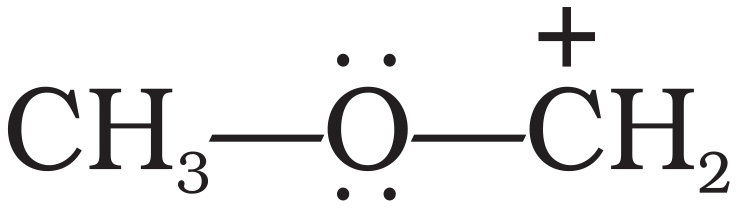
“Stability of carbocations depends upon the electron releasing inductive effect of groups adjacent to positively charged carbon atom involvement of neighbouring groups in hyperconjugation and resonance.”
Draw the possible resonance structures for and predict which of the structures is more stable. Give reason for your answer.
Write hydrocarbon radicals that can be formed as intermediates during monochlorination of 2-methylpropane. Which of them is more stable? Give reasons.