Question
Explain how, nitrogen, oxygen and argon gases are separated form air.

Answer

Air is mixture of gases like nitrogen, oxygen, argon, carbon dioxide, helium, neon, krypton, xeon etc. The various gases of air are separated from one another by fractional distillation of liquid air. This separation is based on the fact that different gases of air have different boiling points(in liquid form).
The air is first filtered to remove dust, then water vapour and carbon dioxide are removed. Air is compressed to a high pressure and then cooled. The cooled air is then allowed to expand quickly into a chamber through a jet. This cools the air even more. This process of compression, cooling and rapid expansion of air is repeated again and again to make the air more and more cool so that it becomes liquid air. Now, the liquid air is fed into a tall fractionating column and warmed up slowly.
Liquid nitrogen has lowest boiling point of -196°C. So, on warming, it boils off first to form nitrogen gas and is collected at the upper part of the fractional distillation column. Liquid argon has a slightly higher boiling point of -186°C. So, it boils off next and collected as argon gas in the middle part of fractional distillation column. Liquid oxygen has a still higher boiling point of -183°C. So, liquid oxygen boils off last and collected as oxygen gas at the bottom of fractional distillation column.
Need a full question paper?

Generate a complete, print-ready paper with questions like this in minutes — across 16+ boards, with answer keys.

Start Generating Free

Similar questions

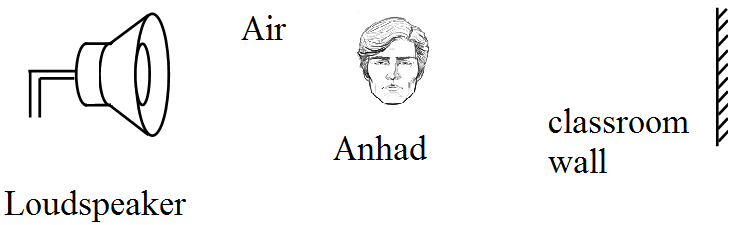
In an experiment, Anhad studies sound waves. He sets up a loudspeaker to produce sound as shown below:
Anhad adjusts the signal to the loudspeaker to give a sound of frequency 200Hz.
  1. What happens to the air in-between Anhas and the loudspeaker?
  2. Explain how Anhad receives sound in both ears.
Define the process of differentiation.
How will you separate a mixture of iron filings, chalk powder an common salt?
Three different vibrating objects produce three types of sounds X, Y and Z. Sounds X and Y cannot be heard by a man having normal range of hearing but sound Z can be heard easily. The sound X is used in hospitals to break kidney stones of a patient into fine grains whioch then get flushed out with urine. The sound Y is similar to that which is produced during an earthquake before the main shock wave is generated.
  1. What type of sounds are (i) X, (ii) Y, and (iii) Z?
  2. Name one device which can produce sound like X.
  3. Name one device in a science laboratory which can produce sound like Y.
  4. Name one device in our homes which can produce sound like Z.
  5. What is the frequency range of sounds like Z?
The atom of an element $X$ has $7$ electrons in its M$$ shell:
  1. Write the electronic configuration of element $X.$
  2. What is the atomic number of element $X?$
  3. Is it a metal or a non-metal$?$
  4. What type of ion will be formed by an atom of element $X?$ Write the symbol of the ion formed.
  5. What could element $X$ be$?$
Explain composite fish culture system with examples. State the major problem associated with this system. Can fish culture be done in any type of combination? If yes, explain.
Derive the following equation of motion by the graphical method:
$v^2 = u^2 + 2as$
where the symbols have their usual meanings.
What should be do to get maximum benefit from a crop field?
The mass of one atom of an element $X$ is $2.0 \times 10^{-23}g.$
  1. Calculate the atomic mass of element $X.$
  2. What could element $X$ be$?$
​​​​​​​
A boy walks from his classroom to the bookshop along a straight corridor towards North. He covers a distance of 20m in 25 seconds to reach the bookshop. After buying a book, he travels the same distance in the same time to reach back in the classroom. Find (a) average speed, and (b) average velocity, of the boy.