Question
Explain how, nitrogen, oxygen and argon gases are separated form air.

Answer

Air is mixture of gases like nitrogen, oxygen, argon, carbon dioxide, helium, neon, krypton, xeon etc. The various gases of air are separated from one another by fractional distillation of liquid air. This separation is based on the fact that different gases of air have different boiling points(in liquid form).
The air is first filtered to remove dust, then water vapour and carbon dioxide are removed. Air is compressed to a high pressure and then cooled. The cooled air is then allowed to expand quickly into a chamber through a jet. This cools the air even more. This process of compression, cooling and rapid expansion of air is repeated again and again to make the air more and more cool so that it becomes liquid air. Now, the liquid air is fed into a tall fractionating column and warmed up slowly.
Liquid nitrogen has lowest boiling point of -196°C. So, on warming, it boils off first to form nitrogen gas and is collected at the upper part of the fractional distillation column. Liquid argon has a slightly higher boiling point of -186°C. So, it boils off next and collected as argon gas in the middle part of fractional distillation column. Liquid oxygen has a still higher boiling point of -183°C. So, liquid oxygen boils off last and collected as oxygen gas at the bottom of fractional distillation column.
Need a full question paper?

Generate a complete, print-ready paper with questions like this in minutes — across 16+ boards, with answer keys.

Start Generating Free

Similar questions

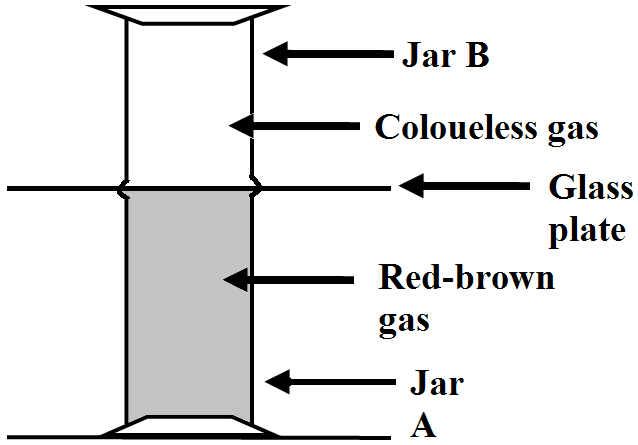
Look at the diagram on the right side. Jar A contains are d-brown gas whereas Jar B contains a colourless gas. The two gas jars are separated by a glass plate placed between them:
  1. What will happen when the glass plate between the two jars is pulled away?
  2. What name is given to the phenomenon which takes place?
  3. Name the brown gas which could be in jar A.
  4. Which is the colorless gas most likely to be present in jar B?
  5. Name one coloured solid and one colourless liquid which can show the same phenomenon.
Describe the method of separating a mixture containing common salt, sand and ammonium chloride.
State and explain Kepler’s laws of planetary motion. Draw diagrams to illustrate these laws.
Discuss the conservation of momentum in each of the following cases:
  1. A rocket taking off from ground.
  2. Flying of a jet aeroplane.
What is the difference between a compression and a rarefaction in a sound wave? Illustrate your answer with a sketch.
Two objects having equal masses are moving with uniform velocities of 2m/s and 6m/s respectively. Calculate the ratio of their kinetic energies.
With the help of a labelled diagram, describe the method of separating ammonium chloride from a mixture of ammonium chloride and common salt. Mention the difference in the properties of ammonium chloride and sodium chloride which has made this separations possible.
Draw a labelled diagram of the fractional distillation apparatus used for separating a mixture of alcohol and water.
An atom of element E contains $3$ protons, $3$ electrons and $4$ neutrons:
  1. What is its atomic number?
  2. What is its mass number?
  3. Write the electronic configuration of the element E.
  4. State whether element E is a metal or non-metal. Why?
  5. What type of ion, cation or anion, will be formed by an atom of element E? Why?
  6. Write the symbol of the ion formed by an atom of element E.
  7. What could element X be?
The distance between Delhi and Agra is 200km. A train travels the first 100km at a speed of 50km/h. How fast must the train travel the next 100km, so as to average 70km/h for the whole journey?