Question
Explain how radioactive nuclei can emit $\beta-$particles even though atomic nuclei do not contain these particles? Hence explain why the mass number of radioactive nuclide does not change during $\beta-$decay?

Answer

Radioactive nuclei do not contain electrons ($\beta-$particles), but $\beta-$particles are formed due to conversion of a neutron into a proton according to equation.
$^1_0\text{n}\ \rightarrow \ ^1_1\text{p}\ +\ _{-1} ^{0}\beta \ + \ \bar{ \upsilon}\\ \ \ \ \ \ \ \ \ \ \ \ \ \ \ \ \ ^{\beta-\text{particle}}\ \ ^\text{antincutrino}$
The $\beta-$particle so formed is emitted at once. In this process one neutron is converted into one proton; so that the number of nucleons in the nucleus remains unchanged; hence mass number of the nucleus does not change during a $\beta-$decay.

Need a full question paper?

Generate a complete, print-ready paper with questions like this in minutes — across 16+ boards, with answer keys.
Start Generating Free

Similar questions

  1. State two important features of Einstein's photoelectric equation.
  2. Radiation of frequency 1015 Hz is incident on two photosensitive surface P and Q. There is no photoemission from surface P. Photoemission occurs from surface Q but photoelectrons have zero kinetic energy. Explain these observations and find the value of work function for surface Q.
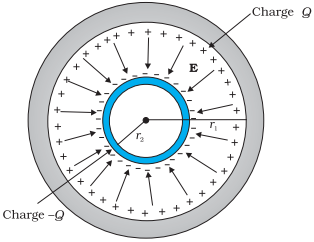
A spherical capacitor consists of two concentric spherical conductors, held in position by suitable insulating supports (2.36). Show

that the capacitance of a spherical capacitor is given by $\text{C}=\frac{{4}\pi\in_{0}\text{r}_1\text{r}_2}{\text{r}_1-\text{r}_2}$

where r1 and r2 are the radii of outer and inner spheres, respectively.

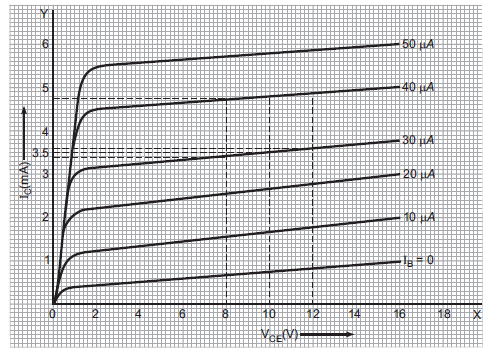
Output characteristics of an n-p-n transistor in CE configuration is shown in the figure. Determine:
  1. Dynamic output resistance.
  2. Dc current gain and.
  3. Ac current gain at an operating point VCE  = 10V, when IB =30$\mu$A.

The current in a solenoid of 240 turns, having a length of 12cm and a radius of 2cm, changes at a rate of 0.8A/s. Find the emf induced in it.
A proton is projected with a velocity of 3 × 10⁶ ms-1 perpendicular to a uniform magnetic field of 0.6T. Find the acceleration of the proton.
Write two differences between electromagnet and permanent magnet.
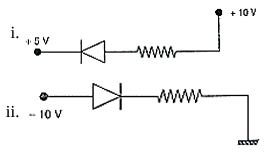
Explain, with the help of a circuit diagram, how the thickness of depletion layer in a p-n junction diode changes when it is forward biased. In the following circuits which one of the two diodes is forward biased and which is reverse biased?
Image
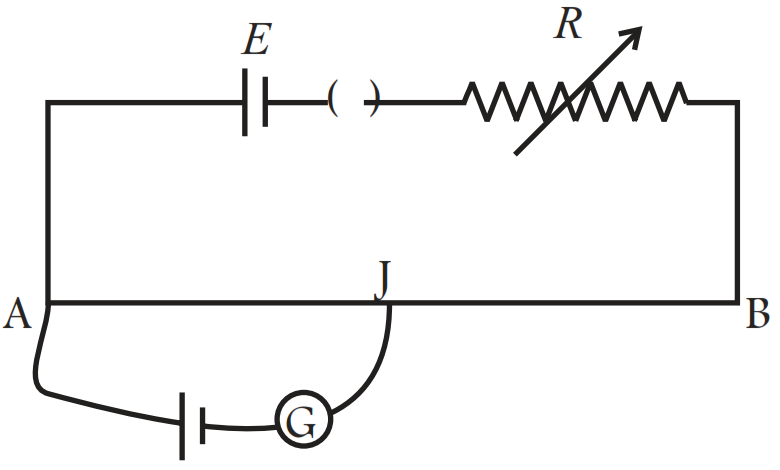
AB is a potentiometer wire (Fig). If the value of R is increased, in which direction will the balance point J shift?

A thin but long, hollow, cylindrical tube of radius r carries a current i along its length. Find the magnitude of the magnetic field at a distance $\frac{\text{r}}{2}$ from the surface (a) inside the tube (b) outside the tube.
A uranium reactor develops thermal energy at a rate of 300MW. Calculate the amount of 235U being consumed every second. Average released per fission is 200MeV.