Question
Explain how the image is formed by thin convex lens and derive
$-\frac{1}{u}+\frac{1}{v}=\left(n_{21}-1\right)\left[\frac{1}{R_1}-\frac{1}{ R _2}\right]$
Derive lens maker's formula for thin convex lens.
Answer

Image
Image
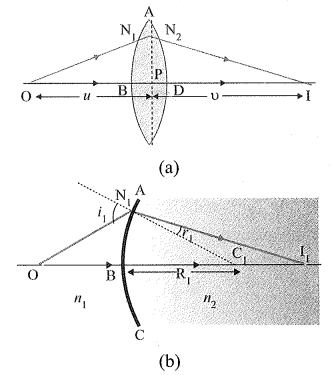
$\rightarrow$ Figure $(a)$ shows the geometry of image formation by a convex lens.
$\rightarrow$ A point object $O$ is placed at a distance $u$ from the optical centre.
On the other side of the lens there is image $I$.
Here image distance is $v$.
The radii of curvature of both surfaces of the lens are $R_1$ and $R_2$ respectively and the focal length of the lens is $f$.
$\rightarrow$ The image formation can be seen in terms of two steps :
$(i)$ The first refracting surface forms the image $I_1$ of the object $O. ($figure $b)$
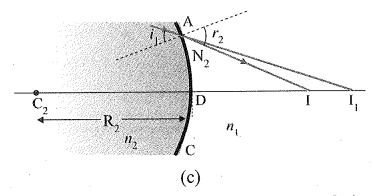
$(ii) $ The image $I _1$ acts as a virtual object for the second surface. $($figure $c)$ that forms image at $I$ .
$\rightarrow$ For refraction at interface $\text{ABC} $,
$\frac{n_1}{ OB }+\frac{n_2}{ BI _1}=\frac{n_2-n_1}{ BC _1}......(1)$
$\rightarrow $ A similar procedure applied to the interface $\text{ADC}$ gives,
$-\frac{n_2}{ DI _1}+\frac{n_1}{ DI }=\frac{n_2-n_1}{ DC _2}$
$\rightarrow$ For a thin lens,
$BI _1= DI _1$
$\therefore -\frac{n_2}{ BI _1}+\frac{n_1}{ DI }=\frac{n_2-n_1}{ DC _2}......(2)$
$\rightarrow$ Adding equations $(1)$ and $(2),$
$\frac{n_1}{ OB }+\frac{n_1}{ DI }=\frac{n_2-n_1}{ BC _1}+\frac{n_2-n_1}{ DC _2}......(3)$
$\rightarrow$ Suppose the object is at infinity
i.e. $OB \rightarrow \infty$ and $DI \rightarrow f \ ($focal length$)$
$\rightarrow$ from equation $(3),$
${c}0+\frac{n_1}{f}=\frac{n_2-n_1}{ BC _1}+\frac{n_2-n_1}{ DC _2}$
$\therefore \frac{n_1}{f}=\left(n_2-n_1\right)\left(\frac{1}{ BC _1}+\frac{1}{ DC _2}\right)$
$\rightarrow$ Now substituting $BC _1= R _1$ and $DC _2=- R _2$ in above equation.
$($Positive and negative signs are determined according to the sign convention$)$.
$\therefore \frac{n_1}{f}=\left(n_2-n_1\right)\left(\frac{1}{ R _1}-\frac{1}{ R _2}\right)$
$\therefore \frac{1}{f}=\left(\frac{n_2-n_1}{n_1}\right)\left(\frac{1}{ R _1}-\frac{1}{ R _2}\right)$
$\therefore \frac{1}{f}=\left(\frac{n_2}{n_1}-1\right)\left(\frac{1}{ R _1}-\frac{1}{ R _2}\right)$
$\therefore \frac{1}{f}=\left(n_{21}-1\right)\left(\frac{1}{ R _1}-\frac{1}{ R _2}\right)$
$\rightarrow$ This equation is known as lensmaker's formula.
$\rightarrow$ Note that the formula is true for a concave lens also.
For concave lens $R_1$ is negative, $R_2$ positive and therefore $f$ is negative.

Need a full question paper?

Generate a complete, print-ready paper with questions like this in minutes — across 16+ boards, with answer keys.

Start Generating Free

Similar questions

The reduction factor K of a tangent galvanometer is written on the instrument. The manual says that the current is obtained by multiplying this factor to tane. The procedure works well at Bhuwaneshwar. Will the procedure work if the instrument is taken to Nepal? If there is some error, can it be corrected by correcting the manual or the instrument will have to be taken back to the factory?
What are signals ? What do you mean by analog and digital signals ?
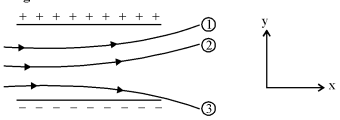
Figure shows track of three charged particles in a uniform elecrostatic field. Give the signs of the three charges. Which particle has the highest charge to mass ratio?
Image
Refer to the previous problem. Suppose, the goldsmith argues that he has not mixed copper or any other material with gold, rather some cavities might have been left inside the ornament. Calculate the volume of the cavities left that will allow the weights given in that problem.
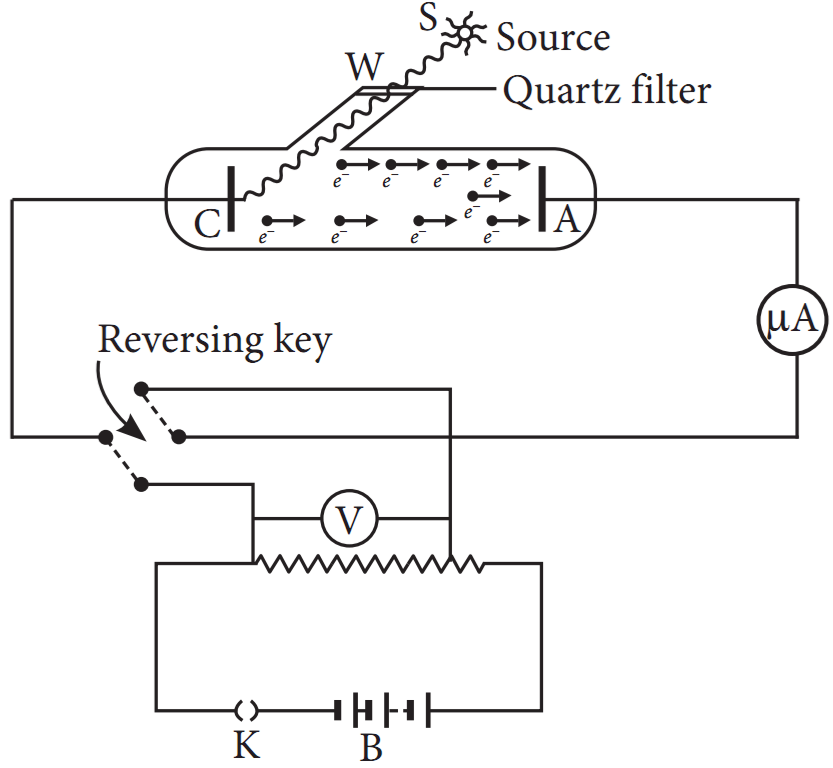
When a monochromatic radiations of suitable frequency obtained from source $S,$ after being filtered by a filter attached on the window $W,$ fall on the photosensitive place $C,$ the photo electrons are emitted from $C,$ which get accelerated towards the plate $A$ if it is kept at positive potential. These electrons flow in the outer circuit resulting in photoelectric current. Due to it, the microammeter shows a deflection. The reading of micrommeter measures the photoelectric current.

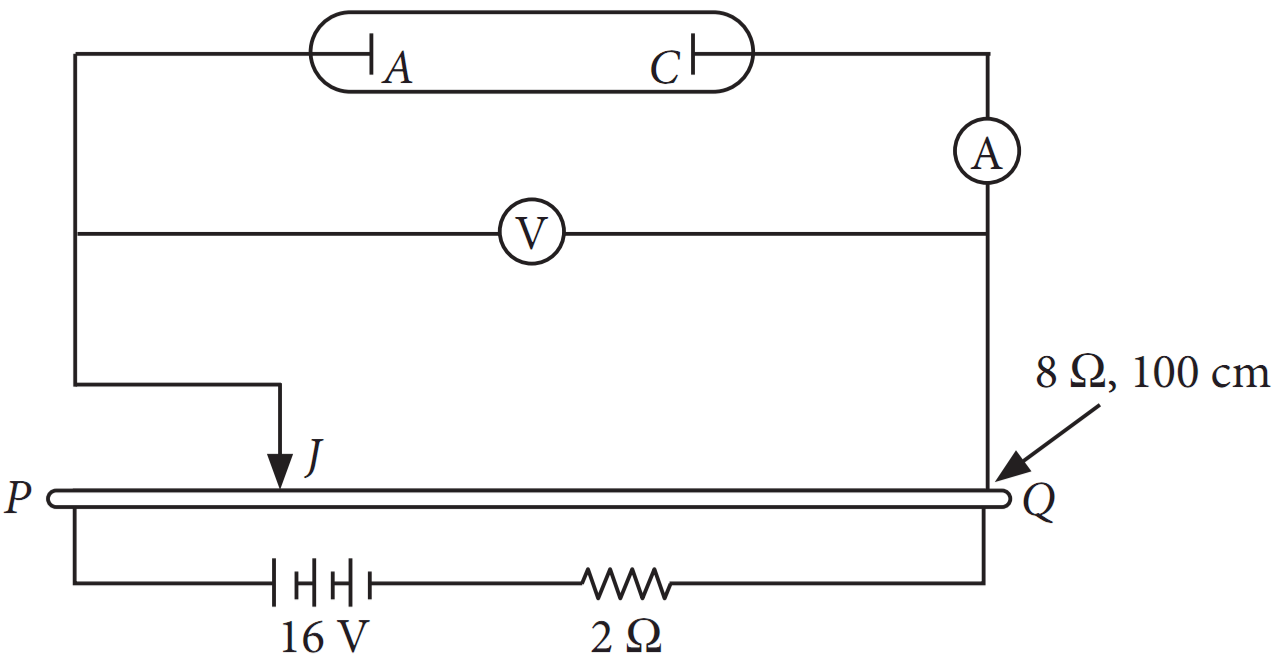
An experimental setup of verification of photoelectric effect is shown in figure. The voltage across the electrodes is measured with the help ofan ideal voltmeter, and which can be varied by moving jockey Jon the potentiometer wire. The battery used in potentiometer circuit is of $16 V$ and its internal resistance is $2\Omega$. The resistance of $100\ cm$ long potentiometer wire is $8\Omega$.

The photocurrent is measured with the help of an ideal ammeter. Two plates of potassium oxide of area $50\ cm^2$ at separation $0.5\ mm$ are used in the vacuum tube. Photocurrent in the circuit is very small, so we can treat the potentiometer circuit as an independent circuit.​​​​​​​
Light
$1$ Violet
$2$ Blue
$3$ Green
$4$ Yellow
$5$ Orange
$6$ Red
$\lambda(\text{in } \mathring{\text{A}})$
$4000-500$ $4500-5000$ $5000-5500$ $5500-6000$ $6000-6500$ $6500-7000$
  1. When radiation falls on the cathode plate, a current of $2\mu\text{A}$ is recorded in the ammeter. Assuming that the vacuum tube setup follows Ohm's law, the equivalent resistance of vacuum tube operating in the case when jockey is at end $P$ is:
  1. $8\times10^8\Omega$
  2. $16\times10^6\Omega$
  3. $8\times10^6\Omega$
  4. $10\times10^6\Omega$
  1. It is found that ammeter current remains unchanged $(2\mu\text{A})$ even when the jockey is moved from the end $P$ to the middle point of the potentiometer wire. Assuming that all the incident photons eject electrons and the power of the light incident is $4\times10^{-6}\Omega$. Then, the color of the incident light is:
  1. Green
  2. Violet
  3. Red
  4. Orange
  1. Which of the following colors may not give photoelectric effect for this cathode?
  1. Green
  2. Violet
  3. Red
  4. Orange
  1. When other light falls on the anode plate, the anuneter reading zero till jockey is moved from the end $P$ to the middle point of the wire $PQ$. Therefore, the deflection is recorded in the anuneter. The maximum kinetic energy of the emitted electron is:
  1. $16eV$
  2. $8eV$
  3. $4eV$
  4. $10eV$
  1. If the intensity of incident radiation is increased twice, the number of photoelectrons emitted per second will be:
  1. Halves
  2. Double
  3. Remain same
  4. Four times
 For the past some time, Aarti had been observing some erratic body movement, unsteadiness and lack of coordination in the activities of her sister Radha, who also used to complain of severe headache occasionally. Aarti suggested to her parents to get a medical check-up of Radha. The doctor thoroughly examined Radha and diagnosed that she has a brain tumour.
  1. What, according to you, are the values displayed by Aarti?
  2. How can radioisotopes help a doctor to diagnose brain tumour? 
The potential barrier in the $p-n$ junction diode is the barrier in which the charge recquires additional force for crossing the region. ln other words, the barrier in which the charge carrier stopped by the obstructive force is known as the potential barrier.
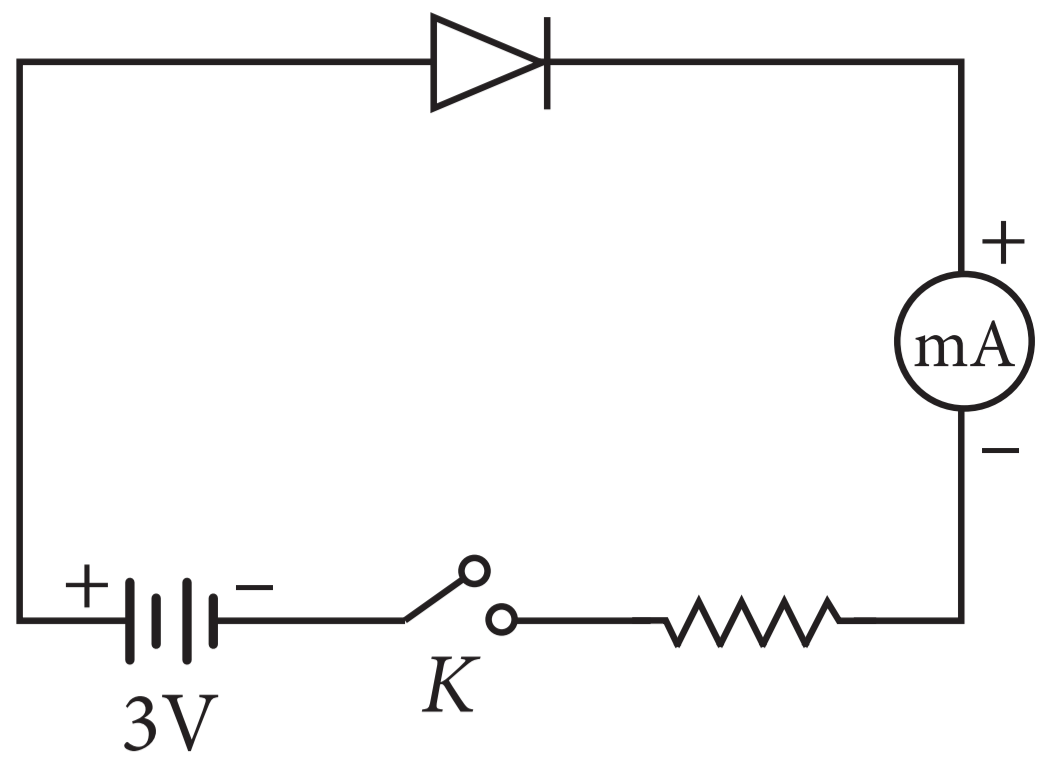
When a $p-$type semiconductor is brought into a close contact with $n-$ ype semiconductor, we get a $p-n$ junction with a barrier potential $0.4V,$ and width of depletion region is $4.0 \times 10^{-7}m.$ This $p-n$ junction is forward biased with a battery of voltage $3V$ and negligible internal resistance, in series with a resistor of resistance $R,$ ideal millimeter, and key $K$ as shown in figure. When key is pressed, a current of $20\ mA$ passes through the diode.
  1. The intersity of the electric field in the depletion region when $p-n$ junction is unbiased is:
  1. $0.5 \times 10^6\ Vm^{-1}$
  2. $1.0 \times 10^6\ Vm^{-1}$
  3. $2.0 \times 10^6\ Vm^{-1}$
  4. $1.5 \times 10^6\ Vm^{-1}$
  1. The resistance of resistor $R$ is:
  1. $150\Omega$
  2. $300\Omega$
  3. $130\Omega$
  4. $180\Omega$
  1. In a $p-n$ junction, the potential barrier is due to the charges on either side of the junction, these charges are:
  1. Majority carriers.
  2. Minority carriers.
  3. Both $(a)$ and $(b)$.
  4. Fixed donor and acceptor ions.
  1. If the voltage of the potential barrier is $V_0.$ A voltage Vis applied to the input, at what moment will the barrier disappear?
  1. $V < V_0$
  2. $V = V_0$
  3. $V > V_0$
  4. $V << V_0$
  1. If an electron with speed $4.0 \times 10^5ms^{-1}$ approaches the $p-n$ junction from then$-$side, the speed with which it will enter the $p-$side is:
  1. $1.39 \times 10^5\ ms^{-1}$
  2. $2.78 \times 10^5\ ms^{-1}$
  3. $1.39 \times 10^6\ ms^{-1}$
  4. $2.78 \times 10^6\ ms^{-1}$
This energy possessed by a system of charges by virtue of their positions. When two like charges lie infinite distance apart, their potential energy is zero because no work has to be done in moving one charge at infinite distance from the other.
In carrying a charge q from point $A$ to point $B, $ work done $W = q(V_A - V_B)$. This work may appear as change in $\frac{\text{KE}}{\text{PE}}$ of the charge. The potential energy of two charges $q_1$ and $q_2$ at a distance $r$ in air is $\frac{\text{q}_1\text{q}_2}{1\pi\epsilon_0\text{r}}.$ It is measured in joule. It may be positive, negative or zero depending on the signs of $q_1$ and $q_2$.
  1. Calculate work done in separating two electrons form a distance of $1m$ to $2m$ in air, where e is electric charge and $k$ is electrostatic force constant.
  1. $ke^2$
  2. $\frac{\text{e}^2}{2}$
  3. $-\frac{\text{ke}^2}{2}$
  4. Zero
  1. Four equal charges $q$ each are placed at four corners of a square of side a each. Work done in carrying a charge $-q$ from its centre to infinity is:
  1. $\text{Zero}$
  2. $\frac{\sqrt{2}\text{q}^2}{\pi\epsilon_0\text{a}}$
  3. $\frac{\sqrt{2}\text{q}}{\pi\epsilon_0\text{a}}$
  4. $\frac{\text{q}^2}{\pi\epsilon_0\text{a}}$
  1. Two points $A$ and Bare located in diametrically opposite directions of a point charge of $+2\mu\text{C}$ at distances 2m and 1m respectively from it. The potential difference between $A$ and $B$ is:
  1. $3 \times 10^3V$
  2. $6 \times 10^4V$
  3. $-9 \times 10^3V$
  4. $-3 \times 10^3V$
  1. Two point charges $A = + 3nC$ and $B = + 1nC$ are placed $5\ cm$ apart in air. The work done to move charge $B$ towards $A$ by $1\ cm$ is:
  1. $2.0 \times 10^{-7}J$
  2. $1.35 \times 10^{-7}J$
  3. $2.7 \times 10^{-7}J$
  4. $12.1 \times 10^{-7}J$
  1. $A$ charge $Q $ is placed at the origin. The electric potential due to this charge at a given point in space is $V.$ The work done by an external force in bringing another charge $q$ from infinity up to the point is:
  1. $\frac{\text{V}}{\text{q}}$
  2. $Vq$
  3. $V + q$
  4. $V$
Out of the two magnetic materials, 'A' has relative permeability slightly greater than unity while oB' has less than unity. Identify the nature of the materials 'A' and 'B'. Will their susceptibilities be positive or negative?
Suppose you are running fast in a field when you suddendly find a snake in front of you. You stop quickly. Which force is responsible for your deceleration?