Question
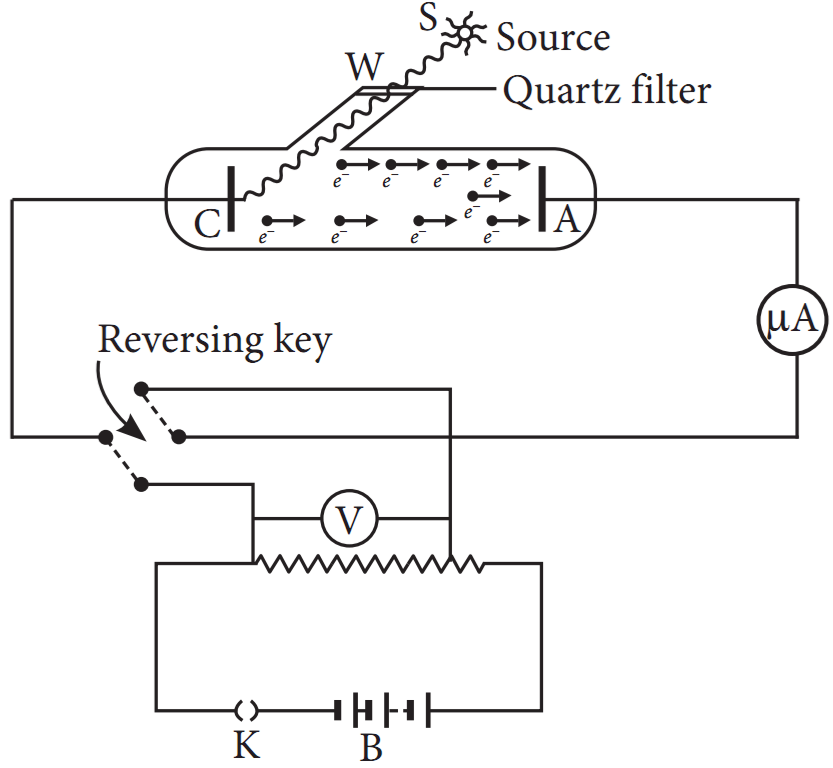
When a monochromatic radiations of suitable frequency obtained from source $S,$ after being filtered by a filter attached on the window $W,$ fall on the photosensitive place $C,$ the photo electrons are emitted from $C,$ which get accelerated towards the plate $A$ if it is kept at positive potential. These electrons flow in the outer circuit resulting in photoelectric current. Due to it, the microammeter shows a deflection. The reading of micrommeter measures the photoelectric current.
An experimental setup of verification of photoelectric effect is shown in figure. The voltage across the electrodes is measured with the help ofan ideal voltmeter, and which can be varied by moving jockey Jon the potentiometer wire. The battery used in potentiometer circuit is of $16 V$ and its internal resistance is $2\Omega$. The resistance of $100\ cm$ long potentiometer wire is $8\Omega$.
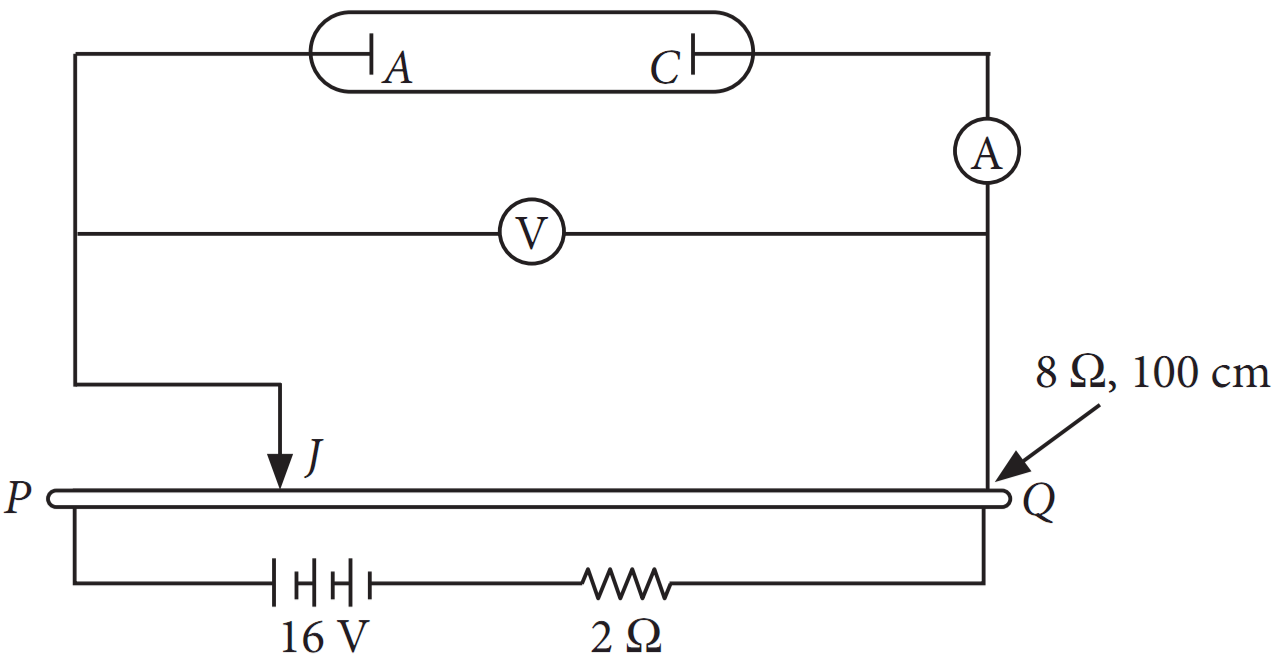
The photocurrent is measured with the help of an ideal ammeter. Two plates of potassium oxide of area $50\ cm^2$ at separation $0.5\ mm$ are used in the vacuum tube. Photocurrent in the circuit is very small, so we can treat the potentiometer circuit as an independent circuit.​​​​​​​
Light
$1$ Violet
$2$ Blue
$3$ Green
$4$ Yellow
$5$ Orange
$6$ Red
$\lambda(\text{in } \mathring{\text{A}})$
$4000-500$ $4500-5000$ $5000-5500$ $5500-6000$ $6000-6500$ $6500-7000$
  1. When radiation falls on the cathode plate, a current of $2\mu\text{A}$ is recorded in the ammeter. Assuming that the vacuum tube setup follows Ohm's law, the equivalent resistance of vacuum tube operating in the case when jockey is at end $P$ is:
  1. $8\times10^8\Omega$
  2. $16\times10^6\Omega$
  3. $8\times10^6\Omega$
  4. $10\times10^6\Omega$
  1. It is found that ammeter current remains unchanged $(2\mu\text{A})$ even when the jockey is moved from the end $P$ to the middle point of the potentiometer wire. Assuming that all the incident photons eject electrons and the power of the light incident is $4\times10^{-6}\Omega$. Then, the color of the incident light is:
  1. Green
  2. Violet
  3. Red
  4. Orange
  1. Which of the following colors may not give photoelectric effect for this cathode?
  1. Green
  2. Violet
  3. Red
  4. Orange
  1. When other light falls on the anode plate, the anuneter reading zero till jockey is moved from the end $P$ to the middle point of the wire $PQ$. Therefore, the deflection is recorded in the anuneter. The maximum kinetic energy of the emitted electron is:
  1. $16eV$
  2. $8eV$
  3. $4eV$
  4. $10eV$
  1. If the intensity of incident radiation is increased twice, the number of photoelectrons emitted per second will be:
  1. Halves
  2. Double
  3. Remain same
  4. Four times

Answer

  1. $(c)\  8\times10^6\Omega$
Equivalent resistance
$\text{A}=\frac{\text{V}}{\text{I}}=\frac{16\text{V}}{2\times10^{-6}\text{A}}=8\times10^6\Omega$
  1. $(d)\ 10\times10^6\Omega$
$\text{P}=\frac{\text{IhC}}{\text{e}\lambda}$
$\lambda=\frac{(2\times10^{-6})(6.6\times10^{-34})(3\times10^8)}{(4\times10^{-6})(1.6\times10^{-19})}$
$\frac{9.9}{1.6}\times10^{-7}\text{m}=\frac{9900}{1.6}\mathring{\text{A}}=6187\mathring{\text{A}}$
Which is in the range of orange light.
  1. $(c)$ Red
The range of wavelength for red light is beyond the wavelength of incident light.
  1. $(b) \ 8eV$
Stopping potential $, V_s = 8V$ and $K.E. = eV_s$
$\therefore K.E. = 8eV$
  1. $(b)$ Double
Photoelectric current varies linearly with the intensity of the incident radiation.

Need a full question paper?

Generate a complete, print-ready paper with questions like this in minutes — across 16+ boards, with answer keys.

Start Generating Free

Similar questions

If an automobile engine is overheated, it is cooled by putting water on it. It is advised that the water should be put slowly with engine running. Explain the reason.
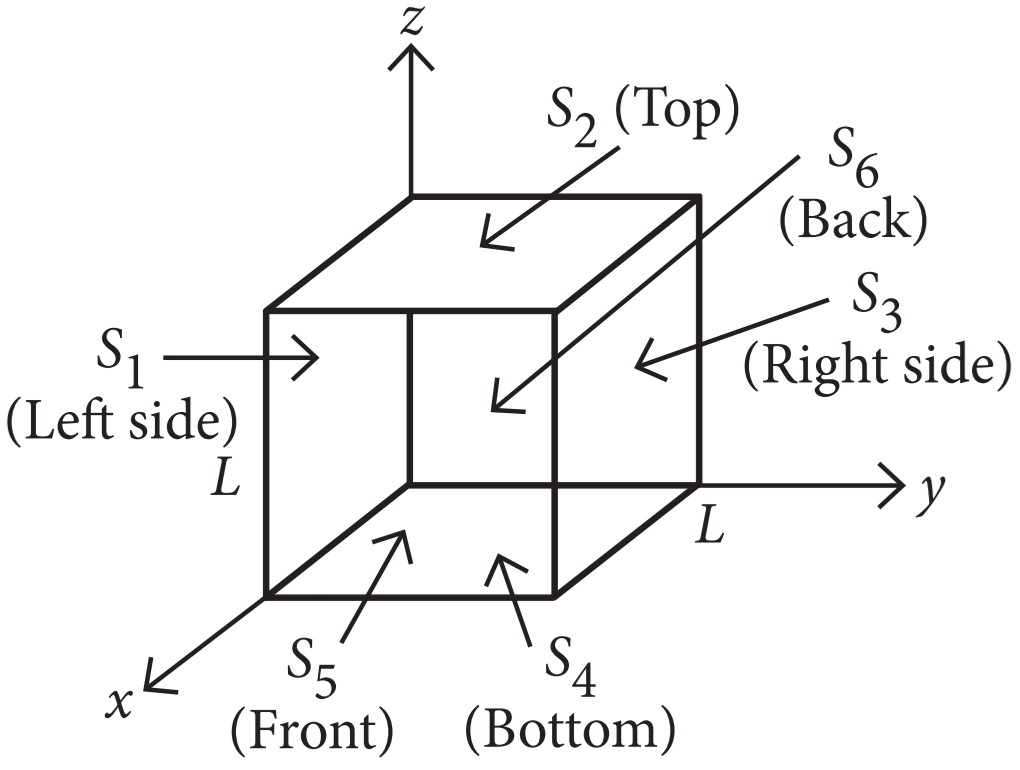
Net electric flux through a cube is the sum of fluxes through its six faces. Consider a cube as shown in figure, having sides of length $L = 10.0\ cm$. The electric field is uniform, has a magnitude $E = 4.00 \times 10^3N C^{-1}$ and is parallel to the xy plane at an angle of $37^\circ$ measured from the $+ x - $ axis towards the $+ y -$ axis.
  1. Electric flux passing through surface $S_6 $ is:
  1. The surfaces that have zero flux are:
  2. $-24N m^{2 }C^{-1}$
  3. $24N m^2 C^{-1}$
  4. $32N m^2 C^{-1}$
  5. $-32N m^2 C^{-1}$
  6. Electric flux passing through surface $S_1$ is:
  7. $-24N m^{2 }C^{-1}$
  8. $24N m^{2 }C^{-1}$
  9. $32N m^{2 }C^{-1}$
  10. $-32N m^{2 }C^{-1}$
  1. $S_1$ and $S_3$
  2. $S_5$ and $S_6$
  3. $S_2$ and $S_4$
  4. $S_1$ and $S_2$
  5. The total net electric flux through all faces of the cube is:
  6. $8N m^2 C^{-1}$
  7. $-8N m^2 C^{-1}$
  8. $24N m^2 C^{-1}$
  9. Zero.
  1. The dimensional formula of surface integral $\oint\vec{\text{E}}\cdot\text{d}\vec{\text{S}}$ of an electric field is:
  1. $[M L^{2 }T^{-2} A^{-1}]$
  2. $[M L^{3 }T^{-3} A^{-1}]$
  3. $[M L^{-1 }T^3 A^{-3}]$
  4. $[M L^{-3 }T^{-3} A^{-1}]$
A simple pendulum fixed in a car has a time period of $4$ seconds when the car is moving uniformly on a horizontal road. When the accelerator is pressed, the time period changes to $3.99$ seconds. Making an approximate analysis, find the acceleration of the car.
Out of the two magnetic materials, 'A' has relative permeability slightly greater than unity while 'B' has less than unity. Identify the nature of the materials 'A' and 'B'. Will their susceptibilities be positive or negative?
Sunita and her friends visited an exhibition. The policeman asked them to pass through a metal detector. Sunita’s friends were initially scared of it. Sunita, however, explained to them the purpose and working of the metal detector.
Answer the following questions:
  1. On what principle does a metal detector work?
  2. Why does the detector emit sound when a person carrying any metallic object walks through it?
  3. State any two qualities which Sunita displayed while explaining the purpose of walking through the detector.
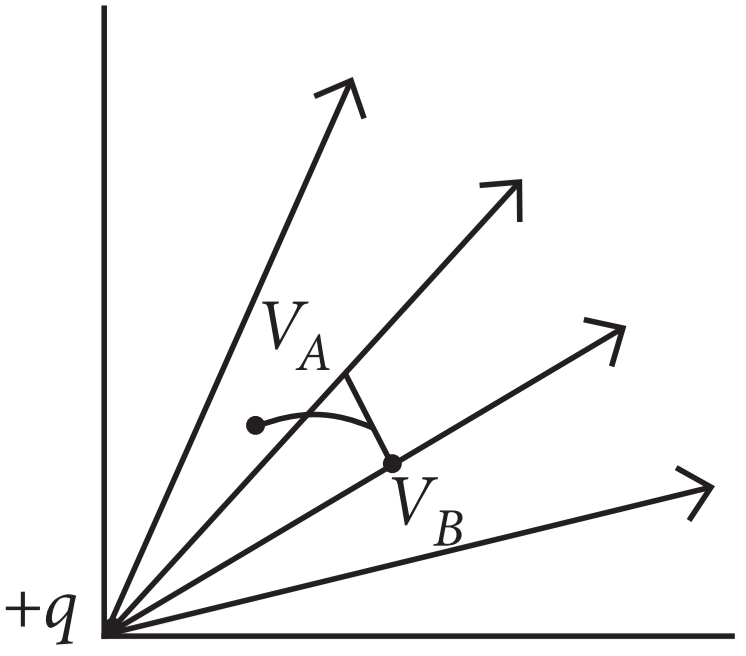
Electrostatic potential energy of a system of point charges is defined as the total amount of work done in bringing the different charges to their respective positions from infinitely charge mutual separations. The work is stored in the system of two point charges in the form of electrostatic potential energy $U$ of the system. Electric potential difference between any points $A$ and $B$ in an electric field is the amount of work done in moving a unit positive test charge from $A$ to $B$ along any path agents the electrostatic force $\text{V}_\text{B}-\text{V}_\text{A}=\frac{\text{W}_\text{AB}}{\text{q}_\text{o}}=\int\vec{\text{E}}.\text{dl}.$
  1. A test charge is moved from lower potential point to a higher potential point. The potential energy of test charge wiII.
  1. $40V$
  2. $-40V$
  3. $20V$
  4. $-60V$
If $1\mu\text{C}$ charge is shifted from $A$ to $B$ and it is found that work done by an external force is $40\mu\text{J}.$ ln doing so against electrostatics force, the potential difference $ V_A - V_B$ is:
  1. $\frac{\text{WQ}}{\text{x}}$
  2. $W$
  3. $\frac{\text{W}}{\text{x}}$
  4. $WQ$
The work done in bringing a unit positive charge from infinite distance to a point at distance $x$ from a positive charge $Q$ is $W$. Then the potential $\phi$ at that point is:
  1. Always zero.
  2. Non $-$ zero.
  3. May be zero.
  4. None of these.
Work done in moving a charge from one point to another inside a uniformly charged conducting sphere is:
  1. Electrostatic force is a conservative force.
  2. Potential energy of charge $q$ at a point is the work done per unit charge in bringing a charge from any point to infinity.
  3. Spring force and gravitational force are conservative force.
  4. Both $(a)$ and $(c).$
Which of the following statement is not true?
  1. Remain the same.
  2. Increase.
  3. Decrease.
  4. Become zero.
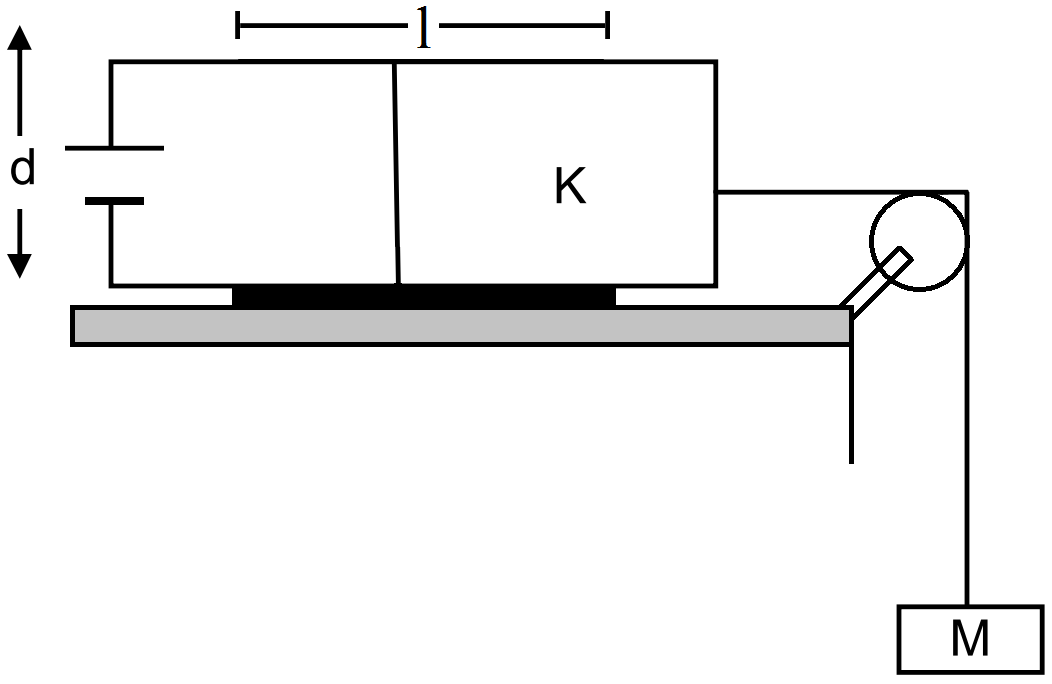
Consider the situation shown in figure. The width of each plate is b. The capacitor plates are rigidly clamped in the laboratory and connected to a battery of emf $\epsilon.$ All surfaces are frictionless. Calculate the value of M for which the dielectric slab will stay in equilibrium.
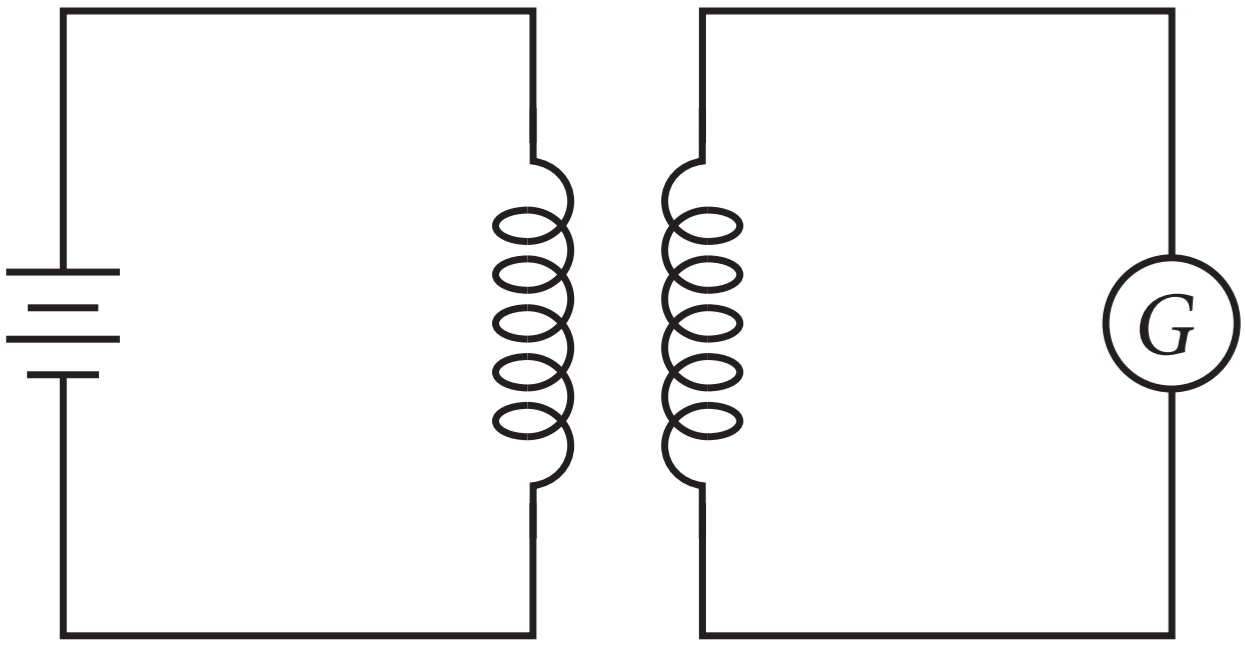
Mutual inductance is the phenomenon of inducing emfina coil, due to a change of current in the neighbouring coil. The amount of mutual inductance that links one coil to another depends very much on the relative positioning of the two coils, their geometry and relative separation between them. Mutual inductance between the two coils increases ft, times if the coils are wound over an iron core of relative permeability.
  1. A short solenoid of radius a, number of turns per unit length $n_1,$ and length $L$ is kept coaxially inside a very long solenoid of radius $b,$ number of turns per unit length $n_2.$ What is the mutual inductance of the system?
  1. $\ce{\mu_0\pi\text{b}^2\text{n}_1\text{n}_2\text{L}}$
  2. $\ce{\mu_0\pi\text{a}^2\text{n}_1\text{n}_2\text{L}^2}$
  3. $\ce{\mu_0\pi\text{a}^2\text{n}_1\text{n}_2\text{L}}$
  4. $\ce{\mu_0\pi\text{b}^2\text{n}_1\text{n}_2\text{L}^2}$
  1. If a change in current of $0.01A$ in one coil produces a change in magnetic flux of $2 \times 10^{-2}$ weber in another coil, then the mutual inductance between coils is:
  1. $0$
  2. $0.5H$
  3. $2H$
  4. $3H$
  1. Mutual inductance of two coils can be increased by:
  1. Decreasing the number of turns in the coils.
  2. Increasing the number of turns in the coils.
  3. Winding the coils on wooden cores.
  4. None of these.
  1. When a sheet of iron is placed in between the two co$-$axial coils, then the mutual inductance between the coils will:
  1. Increase.
  2. Decrease.
  3. Remains same.
  4. Cannot be predicted.
  1. The $SJ$ unit of mutual inductance is:
  1. $\ce{Ohm}.$
  2. $\ce{Mho}.$
  3. Henry.
  4. None of these.
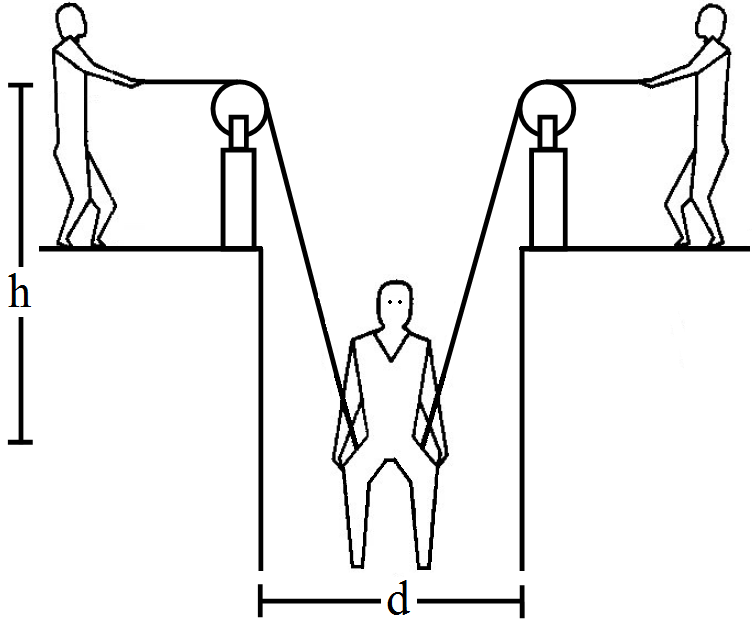
A man has fallen into a ditch of width d and two of his friends are slowly pulling him out using a light rope and two fixed pulleys as shown in figure. Show that the force (assumed equal for both the friends) exerted by each friend on the road increases as the man moves up. Find the force when the man is at a depth h.
Draw a neat labelled diagram of human eye. Explain shortsightedness and longsightedness eye defects giving their cause and method of removal showing ray diagram.