Question
Explain how the scattering experiment can be analyzed in detail from Rutherford's nuclear model.

Answer

Image

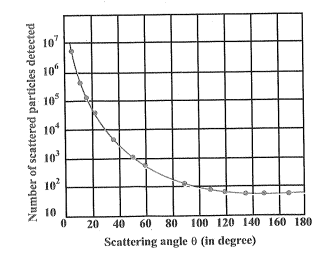
The figure shows a graph of the number of $\alpha$-particles scatterd versus the angle of scattering.
The scattering experiment can be analysed in detail from Rutherford's nuclear model. Since the gold foil is very thin, it can be assumed that $\alpha$-particles will suffer not more than one scattering during their passage through it. Hence it is sufficient to calculate the path (trajectory) of an $\alpha$-particle scattered by a single nucleus.
$\alpha$-particles are nuclei of helium atoms, so they have two units mass of positive charge $2 e$ and mass equal to that of a helium atom. The charge of the gold nucleus is Ze , where Z is the atomic number of the atom; for gold $Z =79$.
Since the nucleus of gold is about 50 times heavier than an $\alpha$-particle, it remains stationary throughout the scattering process.
The trajectory of an $\alpha$-particle can be calculated using newton's second law of motion and the coulomb's law for electrostatic force of repulsion between the $\alpha$-particle and the positively charged nucleus.
The magnitude of this force is
$F =\frac{1}{4 \pi \varepsilon_0} \frac{(2 e)( Ze )}{r^2}$
Where, $r$ is the distance between the $\alpha$-particle and the nucleus.
The force is directed along the line joining the $\alpha$-particle and the nucleus.
The magnitude and direction of the force on an $\alpha$-particle changes continuously as it moves towards and away from the nucleus.

Need a full question paper?

Generate a complete, print-ready paper with questions like this in minutes — across 16+ boards, with answer keys.

Start Generating Free

Similar questions

A ball of mass $0.50\ kg$ moving at a speed of $5.0\ m/s$ collides with another ball of mass $1.0\ kg.$ After the collision the balls stick together and remain motionless. What was the velocity of the $1.0\ kg$ block before the collision?
A sphere of mass $20\ kg$ is suspended by a metal wire of unstretched length $4m$ and diameter $1\ mm$. When in equilibrium, there is a clear gap of $2\ mm$ between the sphere and the floor. The sphere is gently pushed aside so that the wire makes an angle $\theta$ with the vertical and is released. Find the maximum value of $\theta$ so that the sphere does not rub the floor. Young's modulus of the metal of the wire is $2.0 \times 10^{11}\ N/m^2$. Make appropriate approximations.
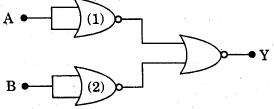
The inputs A and B are inverted by using two NOT gates and their outputs are fed to the NOR gate as shown below.

Analyse the action of the gates (1) and (2) and identify the logic gate of the complete circuit so obtained. Give its symbol and the truth table.
An electron in a hydrogen atom makes transitions from orbits of higher energies to orbits of lower energies.
a. When will such transitions result in (a) Lyman (b) Balmer series?
b. Find the ratio of the longest wavelength in Lyman series to the shortest wavelength in Balmer series.
For sound waves, the Doppler formula for frequency shift differs slightly between the two situations: (i) source at rest; observer moving, and (ii) source moving; observer at rest. The exact Doppler formulas for the case of light waves in vacuum are, however, strictly identical for these situations. Explain why this should be so. Would you expect the formulas to be strictly identical for the two situations in case of light travelling in a medium?
The number of silicon atoms per $m^3$ is $5 \times 10^{28}$. This is doped simultaneously with $5 \times 10^{22}$ atoms per $m^3$ of Arsenci and $5 \times 10^{20}$ per $m^3$ atoms of Indium. Calculate the number of electrons and holes Given that $n_i = 1.5 \times 10^{16} m^{-3}$. Is the material $n-$ type or $p-$ type?
A pole of length 1.00m stands half dipped in a swimming pool with water level 50.0 cm higher than the bed. The refractive index of water is 1.33 and sunlight is coming at an angle of 45° with the vertical. Find the length of the shadow of the pole on the bed.
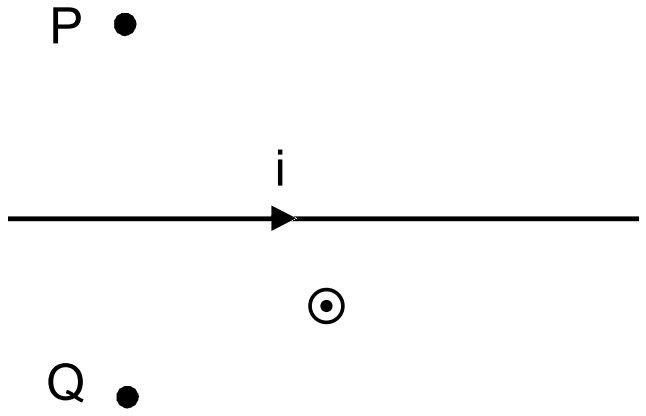
A long, straight wire carrying a current of $1.0A$ is placed horizontally in a uniform magnetic field $B = 1.0 \times 10^{-5}T$ pointing vertically upward figure. Find the magnitude of the resultant magnetic field at the points $P$ and $Q,$ both situated at a distance of $2.0\ cm$ from the wire in the same horizontal plane.
Define the terms (i) drift velocity, (ii) relaxation time.
A conductor of length L is connected to a dc source of emf ε. If this conductor is replaced by another conductor of same material and same area of cross-section but of length 3L, how will the drift velocity change?
Two small bodies of masses $10\ kg$ and $20\ kg$ are kept a distance $1.0m$ apart and released, Assuming that only mutual gravitational forces are acting, find the speeds of the particles when the separation decreases to $0.5m$.