Define the terms (i) drift velocity, (ii) relaxation time.
A conductor of length L is connected to a dc source of emf ε. If this conductor is replaced by another conductor of same material and same area of cross-section but of length 3L, how will the drift velocity change?
A conductor of length L is connected to a dc source of emf ε. If this conductor is replaced by another conductor of same material and same area of cross-section but of length 3L, how will the drift velocity change?
CBSE DELHI - SET 1 2011
Download our app for free and get started
Drift velocity: The average velocity with which the free electrons drift under the influence of an external field. RelaxationTime: Average time interval between two successive collisions of an electron with the ions/atoms of the conductor. The drift velocity will be inversely proportional to 1 $( \text {or }\text{v}_{d}\propto\frac{1}{l})$ and hence it will become one third of its initial value.Alternate Answer
$\text{V}'_{d} = \frac{\text{V}_{d}}{3}.$
$\text{V}'_{d} = \frac{\text{V}_{d}}{3}.$

Download our appand get started for free
Experience the future of education. Simply download our apps or reach out to us for more information. Let's shape the future of learning together!No signup needed.*
Similar Questions
- 1View SolutionAnswer the following:
- Why are the connections between the resistors in a meter bridge made of thick copper strips?
- Why is it generally preferred to obtain the balance point in the middle of the meter bridge wire?
- Which material is used for the meter bridge wire and why?
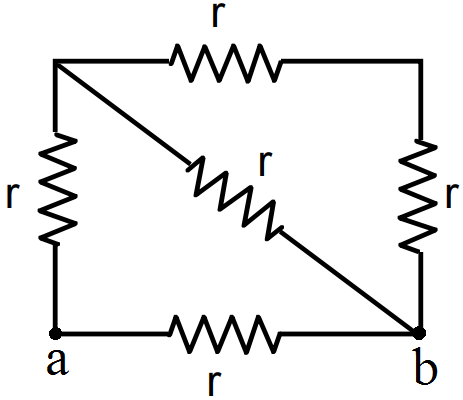
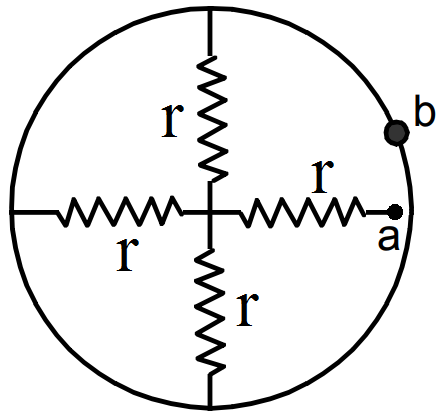
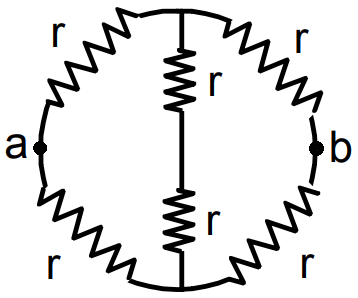
- 2View SolutionFind the equivalent resistances of the networks shown in the figure. between the points a and b.
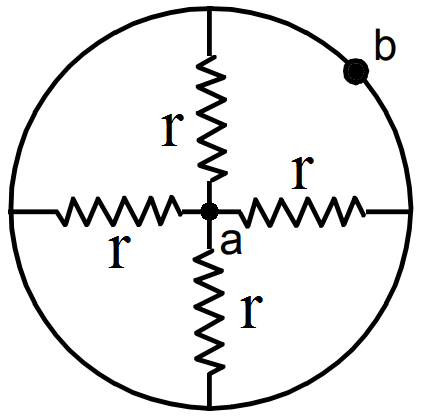
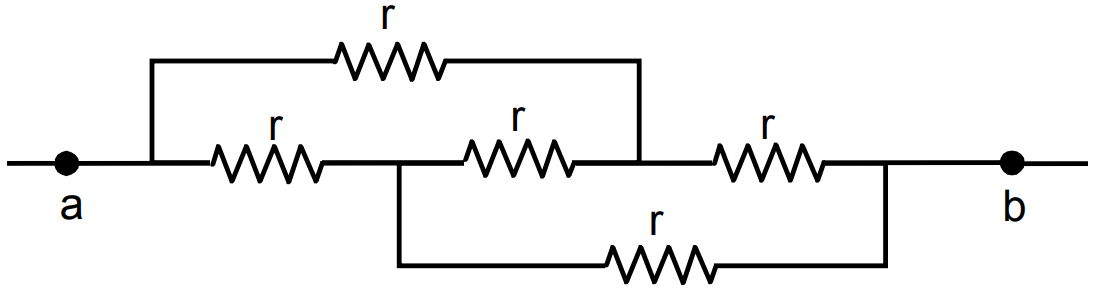
- 3A coil of resistance $100\Omega$ is connected across a battery of emf $6.0V.$ Assume that the heat developed in the coil is used to raise its temperature. If the heat capacity of the coil is $4.0J/K,$ how long will it take to raise the temperature of the coil by $15^\circ C$?View Solution
- 4View SolutionA potentiometer wire of length 1 m is connected to a driver cell of emf 3 V as shown in the figure. When a cell of 1.5 V emf is used in the secondary circuit, the balance point is found to be 60 cm. On replacing this cell and using a cell of unknown emf, the balance point shifts to 80 cm.
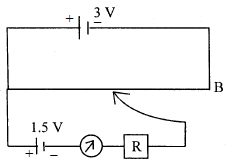
- Calculate unknown emf of the cell.
- Explain with reason, whether the circuit works, if the driver cell is replaced with a cell of emf 1 V.
- Does the high resistance R, used in the secondary circuit affect the balance point? Justify your answer.
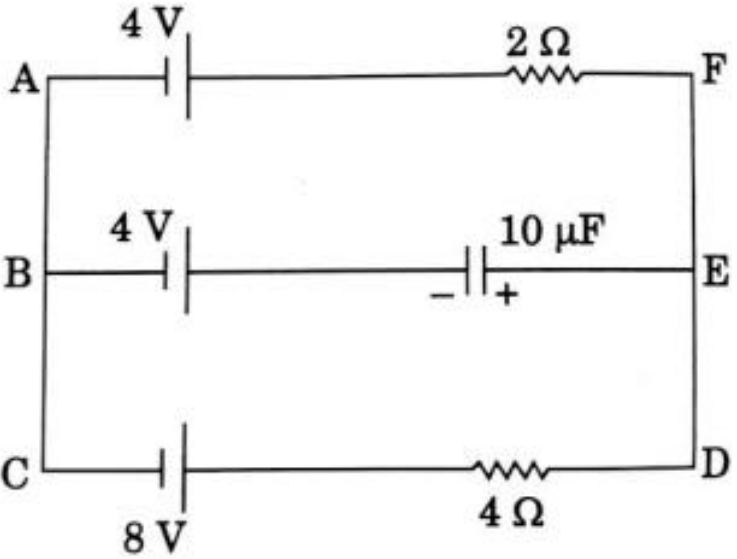
- 5View SolutionIn the given circuit, with steady current, calculate the potential drop across the capacitor and the charge stored in it.
- 6View SolutionYou are given n resistors each of resistance r. They are first connected to get the minimum possible resistance. In the second case, these are again connected differently to get the maximum possible resistance. Calculate the ratio between minimum and maximum values of resistance so obtained.
- 7View SolutionAn electric bulb, when connected across a power supply of 220V, consumes a power of 60W. If the supply drops to 180V, what will be the power consumed? If the supply is suddenly increased to 240V, what will be the power consumed?
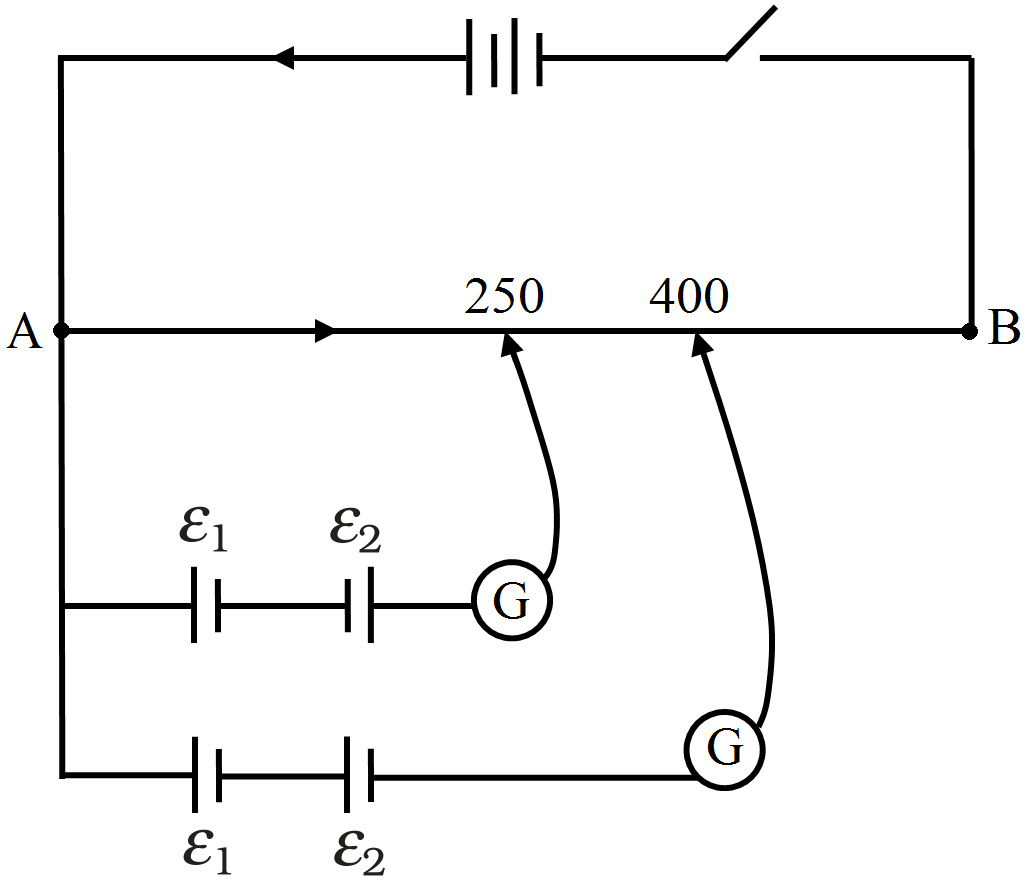
- 8Two primary cells of emfs wire $\varepsilon_1$ and $\varepsilon_2(\varepsilon_1>\varepsilon_2)$ are connected to a potentiometer wire AB as shown in fig. If the balancing lengths for the two combinations of the cells are 250cm and 400cm, find the ratio of $\varepsilon_1$ and $\varepsilon_2.$View Solution
- 9View SolutionDefine relaxation time of the free electrons drifting in a conductor. How is it related to the drift velocity of free electrons? Use this relation to deduce the expression for the electrical resistivity of the material.
- 10In the figure a long uniform potentiometer wire $AB$ is having a constant potential gradient along its length. The null points for the two primary cells of emfs $\varepsilon_{1}$ and $\varepsilon_{2}$View Solution
connected in the manner shown are obtained at a distance of $120 \ cm $ and $300 \ cm$ from the end $A$.
Find $(i) \varepsilon_{1} / \varepsilon_{2}$ and $(ii)$ position of null point for the cell $\varepsilon_{1}$. How is the sensitivity of a potentiometer increased?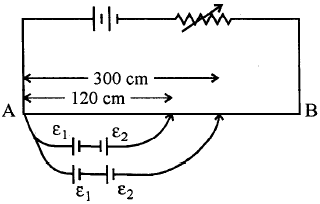
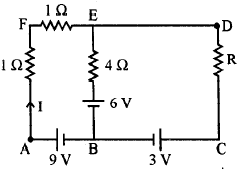
Using Kirchoffs rules determine the value of unknown resistance $R$ in the circuit so that no current flows through 4 $\Omega$ resistance. Also find the potential difference between $A$ and $D.$