Question
Explain hybridisation in $NH _3$.

Answer

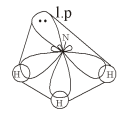
In $NH _3, N$ is $s p^3$ hybridised.
The electronic configuration of N in ground state is :
Image
Out of four $s p^3$ hybrid orbitals three are have unpaired electrons while fourth one have one 1.p electron. Three $s p^3$ hybrid orbitals of nitrogen overlapped with $1 s$ orbitals of three hybrogen atoms and form three $N - H$ bond. The repulsion between l.p-b.p is more than b.p-b.p. Hence in molecule of $NH _3$ bond order get decreased from $109.5^{\circ}$ to $107^{\circ}$ and geometry of molecule get distorted and become pyramidal.

Need a full question paper?

Generate a complete, print-ready paper with questions like this in minutes — across 16+ boards, with answer keys.

Start Generating Free

Similar questions

What is the difference between molality and molarity?
  1. Name the two factors that influence the entropy change that takes place in the surrounding.
  2. Write an equation that shows the relationship.
The pH of a sample of vinegar is 3.76. Calculate the concentration of hydrogen ion in it.
  1. Describe the hybridisation in case of PCl5.
  2. Deduce the shape of SF4 molecule on the basis of VSEPR theory.
Write the structural formula of following compounds :
(i) Neopentyl isocyanide
(ii) Isopentyl alcohol
(iii) Ethylisopropyl ketone
(iv) Isopropyl methyl acetylene
What is the difference between extensive and intensive properties? Explain.
Identify the redox reactions out of the following reactions and identify the oxidising and reducing agents in them.
$3\text{HCl(aq)}+\text{HNO}_3\text{(aq)}\xrightarrow{ \ \ \ \ \ \ \ \ }\text{Cl}_2\text{(g)}+\text{NOCl}(\text{g})+2\text{H}_2\text{O(l)}$
A mixture of 1.57 mol of $N _2, 1.92 mol$ of $H _2$ and 8.13 mol of $NH _3$ is introduced into a 20 L reaction vessel at 500 K . At this temperature, the equilibrium constant, $K_c$ for the reaction $N_2(g)+$ $3 H _2(g) \rightleftharpoons 2 NH _3(g)$ is $1.7 \times 10^2$. Is the reaction mixture at equilibrium? If not, what is the direction of the net reaction?
The enthalpy of atomisation for the reaction CH4(g) → C(g) + 4H (g) is 16650kJ mol–1. What is the bond energy of C–H bond?