Question
Explain in brief about emission spectrum and absorption spectrum.

Answer

• Emission Spectrum
Each element has a characteristic spectrum of radiation emitted by it.
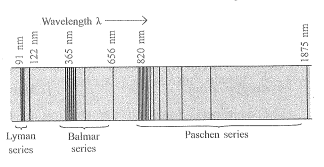
When an atomic gas or vapour is excited at low pressure by passing an electric current through it, the emitted radiation has a spectrum which contains certain specific wavelengths.
Image
A spectrum of this type is called emission line spectrum and it consists of bright lines on a dark background.
The spectrum emitted by atomic hydrogen is shown in the figure.
• Absorption spectrum :
When white light is passed through an atomic gas, certain types of wavelengths are absorbed.
An atom absorbs only those wavelengths that takes it from one excited state to another excited state.
As a result if the emitted light is analyzed with a spectrometer, a dark line is seen instead of the wavelength that has been absorbed.
Thus, this is called the absorption spectrum of the material of the gas.
Need a full question paper?

Generate a complete, print-ready paper with questions like this in minutes — across 16+ boards, with answer keys.

Start Generating Free

Similar questions

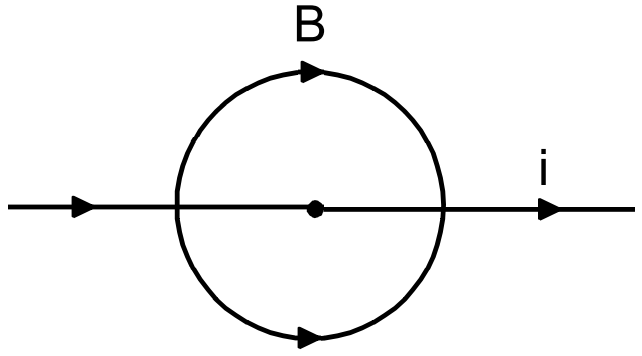
A conducting circular loop of radius a is connected to two Iong, straight wires. The straight wires carry current I as shown in figure. Find the magnetic field B at the centre of the loop.
Find the average magnitude of linear momentum of a helium molecule in a sample of helium gas at 0°C. Mass of a helium molecule $= 6.64 \times 10^{-27}kg$ nd Boltzmann constant $= 1.38 \times 10^{-23}JK^{-1}.$
A copper wire bent in the shape of a semicircle of radius r translates in its plane with a constant velocity v. A uniform magnetic field B exists in the direction perpendicular to the plane of the wire. Find the emf induced between the ends of the wire if:
  1. The velocity is perpendicular to the diameter joining free ends.
  2. The velocity is parallel to this diameter.
There is no change in the energy of a moving charged particle in a plane magnetic field. Explain, why?
What is conductivity ? On which what factors does it depend and also write its unit and dimension.
Consider a circuit containing an ideal battery connected to a resistor. Do "work done by the battery" and "the thermal energy developed" represent two names of the same physical quantity?
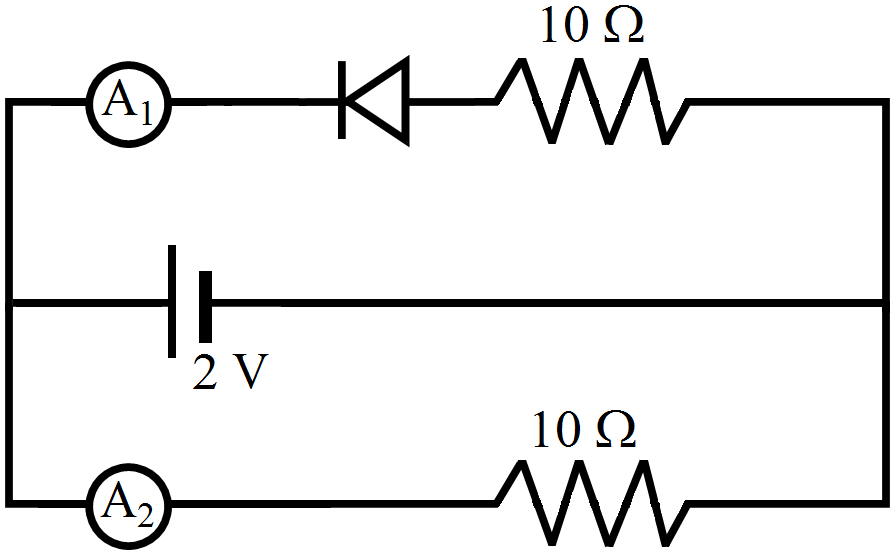
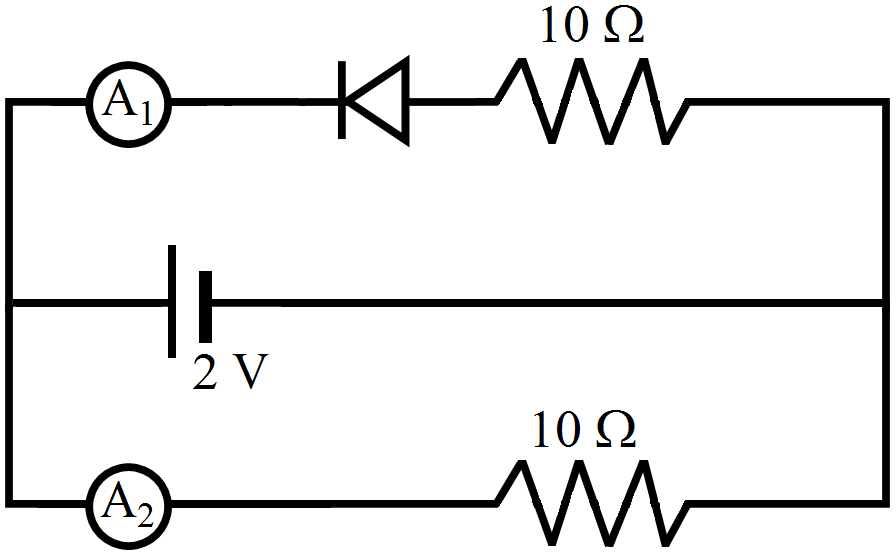
What are the readings of the ammeters $A_1$ and $A_2$ shown in figure. Neglect the resistance of the meters.
Plot a graph showing the variation of stopping potential with the frequency of incident radiation for two different photosensitive materials having work functions $W_1$ and $W_2\left(W_1>W_2\right)$. On what factors does the (i) slope and (ii) intercept of the lines depend?
A proton and an a-particle have the same de-Broglie wavelength. Determine the ratio of (i) Their accelerating potentials and (ii) Their speeds.
State the types of electric charge. Who coined these names?