Question
Explain in brief, the Nitrogen cycle.

Answer

The nitrogen cycle involves the following steps:
  1. Nitrogen fixation:
  • It is the process of conversion of atmospheric free nitrogen into ammonia and other nitrogenous compounds.
  • It is carried out by soil microbes like Azotobacter, Azospirillum and Rhizobium.
  • Lightning and ultraviolet rays provide energy for conversion of nitrogen into oxides of nitrogen.
  1. Ammonification: It is the process of decomposition of organic nitrogenous compounds into ammonia.
  2. Nitrification: It is the process of converting ammonia first into nitrite (by Nitrosomonas, Nitrococcus) and then into nitrate (by Nitrobacter).
  3. Denitrification:
  • It is the process of conversion or reduction of nitrates in the soil to free nitrogen.
  • It is carried out by bacteria like Thiobacillus and Pseudomonas.

Need a full question paper?

Generate a complete, print-ready paper with questions like this in minutes — across 16+ boards, with answer keys.

Start Generating Free

Similar questions

What are the main criteria used for five kingdom system of classification?
What is the advantage of development of seed habits in seed plants?
Differentiate between diffusion and translocation in plants.
The lines A to D below show how change in temperature can affect the rate of enzyme reaction. Line N shows the rate of reaction under optimum temperature. Which line A, B, C or D shows the rate of enzyme reaction at 60°C?
Discuss “The respiratory pathway is an amphibolic pathway.”
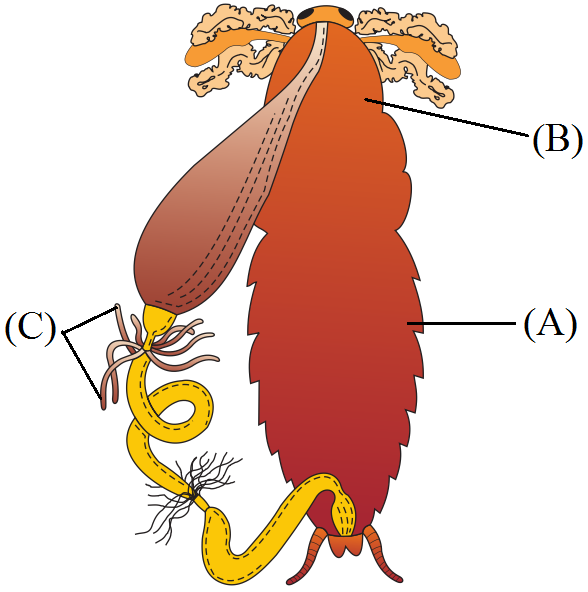
In the figure, some parts of alimentary canal of cockroach are shown. Name the organs A, B and C. State the function each of these organs.
On an educational trip to Uttaranchal, Ketki and her friends observe that many local people were having swollen necks. Please help Ketki and her friends to find out the solutions to the following questions.
  1. Which probable disease are these people suffering from?
  2. How is it caused?
  3. What effect does this condition have on pregnancy?
At a stage of their cycle, ascomycetes fungi produce the fruiting bodies like apothecium, perithecium or cleistothecium. How are these three types of fruiting bodies different from each other?
Find examples where the four daughter cells from meiosis are equal in size and where they are found unequal in size.
During the guest lecture organised by the school biology club, the professor explained students how soil acts as medium in providing growth to the plant. And how plants obtain most of their inorganic nutrients from the soil. Ravi was curious to know the mechanism behind. He reached tution in the evening and asked his biology tutor about what basic functions does soil play and how these inorganic nutrients 21 formed in the soil. Tutor explained that inorganic nutrients are formed from the weathering of rocks etc.
  1. Why are inorganic nutrients called mineral nutrients?
  2. Give any two functions of soil.
  3. How the ions of these elements are absorbed by the plants.
  4. What values are reflected from Ravi's tutor's character.