Questions

3 Marks Question

Take a timed test

28 questions · self-marked practice — reveal the answer and mark yourself.

Question 13 Marks
If a plant shows a symptom which could develop due to deficiency of more than one nutrient, how would you find out experimentally, the real deficient mineral element?
Answer
The plants which show symptoms due to the deficiency of more than one nutrient are grown in different sets in water culture. Set 1 is given one of the several nutrients showing deficiency symptoms, set 2 is given another nutrient and set 3 is given yet another nutrient. In this way, the different sets are grown in hydroponics by supplementing one of the different nutrients showing deficiency. The real deficient mineral element, if supplemented in the medium, causes plants to grow under normal conditions reverting the deficiency symptom.
View full question & answer
Question 23 Marks
‘All elements that are present in a plant need not be essential to its survival’. Comment.
Answer
Most of the mineral elements present in the soil enter plants through roots but all of these may not be essential for their survival. Some are absorbed and accumulated by plant only because they are present in excess amount. For example plants growing near nuclear test sites take up strontium, even though it is not required by them. Thus, an essential element is that which is necessary for supporting normal growth and reproduction, its requirement must be specific i.e. its deficiency cannot be met by supplying other element and it must be directly involved in the metabolism of plant.
View full question & answer
Question 33 Marks
Why is purification of water and nutrient salts so important in studies involving mineral nutrition using hydroponics?
Answer
Impure water contains a large number of impurities in the form of soluble minerals dissolved in it. Salts also contain impurities. If such impure water and mineral salts are used as solution culture for growing plants in hydroponics, then these impurities interfere with the experiments used for detection of essentiality of an element. Therefore, purified water and purified nutrient salts are used in studies involving mineral nutrition using hydroponics.
View full question & answer
Question 43 Marks
Rashi was complaining about the pain in her legs since monday. Her father decided to took her to the doctor where they came to know that it was nothing, but the deficiency of calcium from which Rashi was suffering. Rashi got confused and instantly asked doctor that her teacher had taught her that the deficiency of calcium occurs in plants which causes twisting and deterioration of tissues. Doctor patiently explained her that calcium as a mineral is important for the growth of both plants and animals including human beings. Read the passage above and answer the questions that follows,
  1. Which type of element is calcium?
  2. Mention the region where requirement of calcium is maximum in plants?
  3. What other deficiency symptoms does calcium show in plants. Also give two major functions of calcium in plants?
  4. What value does the character of Rashi imparts.
Answer
  1. Calcium is a macroelement.
  2. Most of the calcium is required in cell vacuoles and parts bounded in cell walls. It is also required in the meristematic tissues of roots, stems and leaves.
  3. Calcium deficiency in plants causes degeneration of fruits, the blossom in tomatoes and termination of growth of meristematic regions.
Functions: For normal growth of cell membranes. Control cell permeability.
  1. Rashi is a patient listner, attentive, intelligent, and careful about daily life.
View full question & answer
Question 53 Marks
Carnivorous plants exhibit nutritional adaptation. Citing an example explain this fact.
Answer
Carnivorous plants fulfill their nutritional requirements by feeding on small animals, like insects or protozoan’s. E.g., Nepenthes, Venus fly trap, Utricularia, etc. Carnivorous, plants grow in soil deficient in nitrogen. Pitcher plant in pitcher plant leaves are modified into pitcher which stores the juice to lure an insect. When an insect comes to suck this juice, chemicals present in nectar dissolves the skin of the prey and the plant obtains nutrients (mainly nitrogen) from its skin.
View full question & answer
Question 63 Marks
Write two names for each of the following:
  1. Free-living, nitrogen-fixing cyanobacteria.
  2. Free-living, aerobic, nitrogen-fixing bacteria.
  3. Symbiotic, nitrogen-fixing bacteria.
Answer
  1. Nostoc, Anabaena.
  2. Azotobacter, Beijerinckia.
  3. Frankia, Rhizobium.
View full question & answer
Question 73 Marks
Mention the differences between passive and active salt absorption.
Answer
Differences between passive and active salt absorption are:
S. No.
Passive Salt Absorption
Active Salt Absorption
1.
Does not need energy.
Requires expenditure of energy.
2.
Occurs along chemical and electrochemical gradient.
Occurs against chemical and electrochemical gradient.
3.
Passive salt absorption is a physical process in which accumulation of salts is less.
Active salt absorption is a biochemical process in which accumulation of salts is more.
View full question & answer
Question 83 Marks
Differentiate between macronutrieints and micronutrients with an example of each.
Answer
S.No.
Macronutrients
Micronutrients
(i)
These are the elements which are generally present in large amounts in the plant tissues, i.e. in excess of 10m mole $kg^{-1}$ of dry matter.
These are the elements which are needed in minute quantities, i.e. 0.1mg per gram of dry matter.
(ii)
e.g. carbon/nitrogen potassium/ calcium magnesium.
e.g. boron/ copper/ iron/ mananese/ zinc.
View full question & answer
Question 93 Marks
Describe nitrification along with the equations and the organisms involved in each step.
Answer
  1. Nitrification is the process of oxidation of ammonia, first into nitrite and then into nitrate.
  2. Ammonia is oxidised into nitrite, by bacteria like Nitrococcus and Nitrosomonas.
$2\text{NH}_3+3\text{O}_2\xrightarrow{\ \ \ \ \ }2\text{NO}_{2}^{-}+2\text{H}^++2\text{H}_2\text{O}$
  1. Nitrite is further oxidised to nitrate with the help of bacteria Nitrobacter.
$2\text{NO}_2+\text{O}_2\xrightarrow{\ \ \ }2\text{NO}_3$
View full question & answer
Question 103 Marks
Sangeeta during evening time while walking in her garden got an eye suddenly on yellow spots on the leaves of many plants. And observed that the colour of shoot axis had become purplish also the plants showing these symptoms also has stunted growth in comparison to the others. She came back home and start remembering the things that her biology teacher taught in the class about the deficiency symptoms of minerals in plants.
  1. Why only some trees show those symptoms?
  2. What essential role does this deficient mineral play in the development of plant?
  3. Explain the term 'necrosis'.
  4. What values are concerned with this exercise?
Answer
  1. Only some trees show those symptoms because, they were deficient in the element nitrogen.
  2. Nitrogen plays a significant role in plants by acting as an important component of protein, chlorophyll, cytochromes, auxin, DNA, RNA, NAD, etc. It promotes the vegetative growth of the plants.
  3. Necrosis is the phenomenon that often leads to the death of tissues, cell or organ (mainly leaf) while it is still a part of living plant.
  4. Values concerned with the excercise is that Sangeeta is caring about the plants in her garden and has scientific knowledge about nutrients. Also a good observer.
View full question & answer
Question 113 Marks
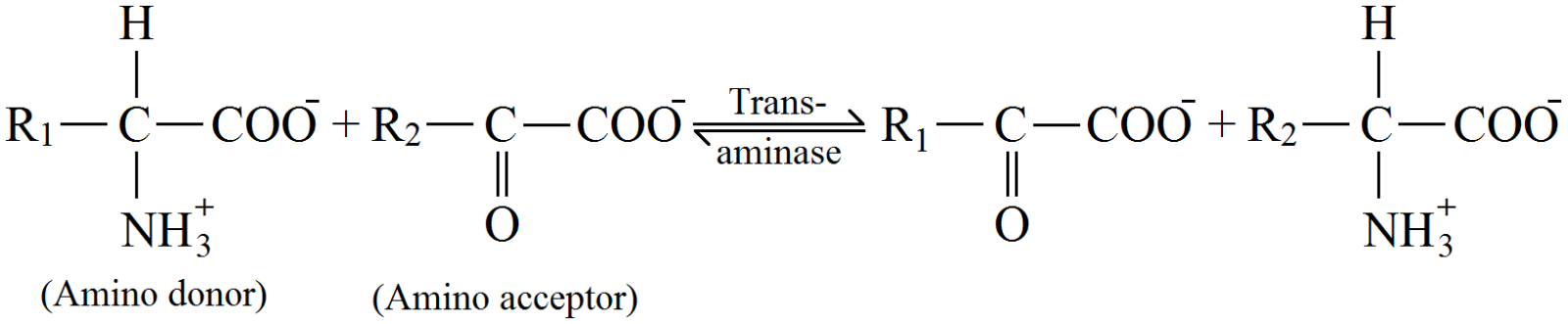
Describe transamination.
Answer
  1. Transamination is a method of formation of amino acid, which involves transfer of amino group from one amino acid to the keto group of a keto acid.
  2. Glutamic acid is the main amino acid from which the transfer of amino ($\mathrm{NH}_2$) group takes place to form other amino acids.
  3. Such reactions are catalysed by enzyme transaminase.
View full question & answer
Question 123 Marks
  1. Mention the symptoms of manganese toxicity in plants.
  2. How does manganese toxicity result in symptoms of deficiency of iron, magnesium and calcium in plants?
Answer
  1. The symptom of manganese toxicity is the appearance of brown spots surrounded by chloritic veins.
  2. Manganese toxicity leads to deficiency symptoms of iron, magnesium and calcium, for the following reasons:
  • Manganese competes with the uptake of iron and magnesium
  • It also competes with magnesium for binding with enzymes.
  • It inhibits translocation of calcium to shoot apex.
View full question & answer
Question 133 Marks
How are amides formed? Name two important amides found in plants.
Answer
a. An amide is formed by the addition of another amino group to an amino acid.
b. The hydroxyl part of the amino acid is replaced by the $\mathrm{NH}^{-}{}_2$(amine) radical.
c. Asparagine and glutamine are the amides in plants.
View full question & answer
Question 143 Marks
The Rhizobium lives in a symbiotic association with leguminous plants. This kind of relationship teaches us which of the following lessons? What are the benefits of cooperation for humans?
  1. We should learn to take benefit from others.
  2. Cooperation is always good for mutual benefit.
  3. We should always maintain friendly relations with our neighbours.
Answer
  1. Cooperation is always good for mutual benefit.
Explanation:
Cooperation has many benefits for humans. All of us live in complex society and everybody is dependent on others for most of the needs. Let us take example of the most basic need; the food. We get raw materials; like rice, flour, vegetables, etc. from the shopkeeper. The shopkeepers, in turn, get those materials from different suppliers. We may be living in one corner of the country and using something produced in another corner of the country. This becomes possible because of cooperation among different human beings. Even for our study, we depend on many people; like teachers, school staffs, stationery shops, stationery manufacturers, etc.
View full question & answer
Question 153 Marks
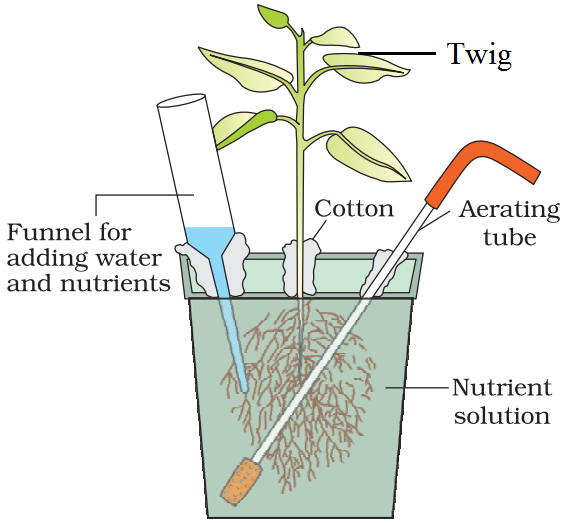
Carefully observe the following figure.
  1. Name the technique shown in the figure and the scientist who demonstrated this technique for the first time.
  2. Name at least three plants for which this technique can be employed for their commercial production.
  3. What is the significance of aerating tube and feeding funnel in this setup?
Answer
  1. This figure is showing the technique of hydroponics. This was first demonstrated by Julius von Sachs in 1860.
  2. This technique can commercially applied for many plants. Three of them are as follows: Tomato, seedless cucumber and lettuce.
  3. The aerating tube supplies oxygen to the roots. Feeding funnel is used to add water and nutrients as per requirement.
View full question & answer
Question 163 Marks
  1. State the function of leghaemoglobin in legume plants.
  2. How is ammonia converted into nitrate by the soil bacteria?
Answer
  1. Role of leghaemoglobin:
  • The enzyme nitrogenase is highly sensitive to molecular oxygen and requires anaerobic condition.
  • The leghaemoglobin acts as an oxygen scavenger and provides the anaerobic condition necessary for the functioning of nitrogenase.
  1. Conversion of ammonia to nitrate is called nitrification and occurs in two steps:
  • Ammonia is first oxidised to nitrite by bacteria like Nitrosomonas and Nitrococcus,
                   $2 \mathrm{NH}_3+3 \mathrm{O}_2 \rightarrow 2 \mathrm{NO}_2^{-}+2 \mathrm{H}^{+}+2 \mathrm{H}_2 \mathrm{O}$
  • The nitrite is then oxidised to nitrate by the bacterium Nitrobacter.
View full question & answer
Question 173 Marks
Hydroponics have been shown to be a successful technique for growing of plants. Yet most of the crops are still grown on land. Why?
Answer
Hydroponics appears to be a successful technique for commercial production of plants. Many plants have been grown using this technique. But crops are still grown on land because of certain limitations of hydroponics.
  1. Hydroponics is still at experimental stage and more developments need to happen before it can be used on mass scale.
  2. The initial cost of set up is very high and thus growing plants through technique cannot be commercially viable.
  3. There is frequent problem of maintaining a high level of sterilization while growing plants through this technique.
  4. Plants grown through this method need frequent input of nutrients and air which is highly cumbersome at present.
  5. Plants can be highly susceptible to environmental conditions because they are being grown in laboratory conditions.
View full question & answer
Question 183 Marks
Give the information about the following mineral nutrients in plants as asked against each:
  1. Sulphur: Any one amino acid in which it is present, effect of deficiency on flowering.
  2. Manganese: Chemical form in which absorbed from the soil, the best defined function in photosynthesis.
  3. Calcium: Two Roles during cell division.
Answer
  1.  
  • Cysteine/ methionine.
  • Delay in flowering.
  1.  
  • Absorbed as manganous ($Mn^{2+}$) ions.
  • The splitting of water to liberate oxygen.
  1.  
  • It is necessary for the formation of middle lamella.
  • It is involved in the formation of mitotic spindle.
View full question & answer
Question 193 Marks
In biology period, teacher was explaining about the soil and the different nutrients essential for the growth and development of plants. She told students that out of all the elements that plants absorb, only some of them are essential for plants to grow. Rajeev had a query and asked teacher next day that how can we derive and on what basis that this particular element is essential or not for the plant?
  1. What are essential elements?
  2. Mention any four criteria that ensure the essentiality, particular element.
  3. Name some essential elements.
  4. What values you infer from Rajeev's character?
Answer
  1. Essential elements are those which are required by the plant in appropriate amount in order to get proper growth and development. Thus, their absence may lead to deficiency of one or the another type.
  2. Basic criteria for essentiality are:
  • The element must be able to provide appropriate normal growth and reproduction.
  • The requirement of the elements must be specific and should not be replaceable by one or the another element.
  1. Some essential elements are carbon, hydrogen, oxygen, nitrogen, sulphur, potassium, phosphorus, zinc, magnesium, etc.
  2. Values associated with Rajeev's character are consciousness about the topic, careful, curious to know new things.
View full question & answer
Question 203 Marks
A section of root nodule of chick-pea plant appears pink,
  1. Name the pigment, responsible for pink colour.
  2. What is the role of this pigment in the nodule formation?
  3. Explain the process of biological nitrogen-fixation in the root nodules in short.
Answer
On observing the section of root nodule:
  1. The pink colour of root nodule is due to the presence of pigment leghaemoglobin.
  2. The pigment protects enzyme nitrogenase from oxygen as this enzyme is highly sensitive to $\mathrm{O}_2$ and functions only in anaerobic conditions (absence of oxygen).
  3. During the process of biological nitrogen-fixation, the molecular nitrogen present in the air is converted into inorganic nitrogenous compound (such as nitrite, nitrate and ammonia) through bacteria, cyanobacteria (blue-green algae), etc.
The organism reduces nitrogen by the help of an enzyme nitrogenase (present in only certain prokaryotes).
View full question & answer
Question 213 Marks
During the guest lecture organised by the school biology club, the professor explained students how soil acts as medium in providing growth to the plant. And how plants obtain most of their inorganic nutrients from the soil. Ravi was curious to know the mechanism behind. He reached tution in the evening and asked his biology tutor about what basic functions does soil play and how these inorganic nutrients 21 formed in the soil. Tutor explained that inorganic nutrients are formed from the weathering of rocks etc.
  1. Why are inorganic nutrients called mineral nutrients?
  2. Give any two functions of soil.
  3. How the ions of these elements are absorbed by the plants.
  4. What values are reflected from Ravi's tutor's character.
Answer
  1. Inorganic nutrients are called mineral nutrients because these are derived from the weathering of minerals of rocks.
  2. Functions of soil are:
  • Hold water and supplies air to the roots.
  • Acts as matrix that helps in stabilisation of plant.
  1. The ions are absorbed either by active or by passive absorption.
  2. Values indicated from the behaviour of Ravi's tutor are critical thinking about natural phenomenon, scientific knowledge.
View full question & answer
Question 223 Marks
Explain in brief, the Nitrogen cycle.
Answer
The nitrogen cycle involves the following steps:
  1. Nitrogen fixation:
  • It is the process of conversion of atmospheric free nitrogen into ammonia and other nitrogenous compounds.
  • It is carried out by soil microbes like Azotobacter, Azospirillum and Rhizobium.
  • Lightning and ultraviolet rays provide energy for conversion of nitrogen into oxides of nitrogen.
  1. Ammonification: It is the process of decomposition of organic nitrogenous compounds into ammonia.
  2. Nitrification: It is the process of converting ammonia first into nitrite (by Nitrosomonas, Nitrococcus) and then into nitrate (by Nitrobacter).
  3. Denitrification:
  • It is the process of conversion or reduction of nitrates in the soil to free nitrogen.
  • It is carried out by bacteria like Thiobacillus and Pseudomonas.
View full question & answer
Question 233 Marks
Every nutrient comes from the abiotic component of the ecosystem. These nutrients are converted by green plants into useful substances and finally go to other living beings through the food chain. Finally, after the death of plants and animals; decomposers send them back to the environment. Thus the balance of various components of the ecosystem is maintained. In your view which of the following is the correct approach? What is the importance of balance of ecosystem for us?
  1. We should protect the ecosystem so that its balance is maintained.
  2. We should enjoy our life and let the nature do its job of maintaining the balance in the ecosystem.
Answer
  1. We should protect the ecosystem so that its balance is maintained.
Explanation:
We are the most advanced species on this earth and have the capability to think. So, it becomes our responsibility to maintain the ecosystem.
The balance of the ecosystem is important for all the living beings and more so for human beings. We should remember that we are directly or indirectly dependent on various components of the ecosystem for our survival. Even if a seemingly inconspicuous material's balance is disturbed in the ecosystem, it can prove disastrous for us. Let us take example of carbon dioxide. Carbon dioxide is a very useful gas. Carbon dioxide traps solar radiation and prevents it from escaping the atmosphere of the earth and thus maintains an ambient temperature on the earth. Carbon dioxide is an important raw material for photosynthesis and is thus important for the survival of life on this earth. But when the same carbon dioxide becomes more than what is required, it can prove dangerous for us. A higher level of carbon dioxide would lead to global warming which would threaten the life on the earth.
View full question & answer
Question 243 Marks
  1. Why is plant nutrition referred to as mineral nutrition?
  2. Mention how soil supports plant growth.
Answer
  1. Since the inorganic elements involved in plant nutrition are derived from the rock minerals during weathering of rocks, plant nutrition is referred to as mineral nutrition.
  2. Role of soil in plant growth:
  • Soil supplies the mineral nutrients to plants.
  • It holds water that is absorbed by plants.
  • It supplies air to the roots.
  • It harbours microbes involved in nitrogen fixation, nitrification and other processes that enrich soil fertility.
  • It acts as a matrix that stabilises the plants.
View full question & answer
Question 253 Marks
Answer the following questions with reference to nitrogen:
  1. The form in which it is absorbed from the soil.
  2. In which part of the plant it is required?
  3. Two organic compounds in which it is a component.
Answer
  1. It is absorbed as $\mathrm{NO}_3{ }^{-}, \mathrm{NO}_2{}^{-}$and $\mathrm{NH}_4{ }^{+}$ ions.
  2. It is required in the meristematic tissues and metabolically active cells.
  3. It is a constituent of nucleic acids, amino acids, vitamins, proteins, etc.
View full question & answer
Question 263 Marks
How are the terms ‘critical concentration’ and ‘deficient’ different from each other in terms of concentration of an essential element in plants? Can you find the values of ‘critical concentration’ and ‘deficient’ for minerals – Fe and Zn.
Answer
 
Critical Concentration
Deficient
 
A concentration of a nutrient measured in tissue, just below the level that gives maximum growth is defined as, critical concentration. e.g., N, P and K are known as critical elements.
The concentration that is below the critical concentration and the deficiency of nutrient element can lead to a gradual fall in the plant growth is called deficient.
Zn
0.5-1%
Less then 0.5%
Fe
3.5-5%
Less than 3.5%
View full question & answer
Question 273 Marks
It is observed that deficiency of a particular element showed its symptoms initially in older leaves and then in younger leaves.
  1. Does it indicate that the element is actively mobilised or relatively immobile?
  2. Name two elements which are highly mobile and two which are relatively immobile.
How is the aspect of mobility of elements important to horticulture and agriculture?
Answer
  1. The plants try to supply more nutrients to its younger leaves than the older leaves. When nutrients are mobile, the deficiency symptoms are shown by the older leaves first because that particular nutrient reaches the top first and lower leaves do not get that nutrient.
  2. Highly mobile elements are P, K and Mn. Less mobile elements are $\mathrm{Ca}^{+}$and $\mathrm{K}^{+}$.
  3. The aspect of mobility of essential elements is important in horticulture and agriculture in the following ways
  4. A crop in which older leaves are harvested if show deficiency symptoms, will decrease its economic value.
  5. The crops in which flowers, fruits and inflorescence are harvested, the immobile nutrients will not reach to the apex/tip because of immobility, so this will reduce the yield.
View full question & answer
Question 283 Marks
On a trip of North-East region, Kirti saw some plants which have big leaves in order to trap organisms. Kirti was amazed and asked her teacher about the reason for absence of such plants in other areas. Teacher replied that such plants grow on soil that is deficient in nitrogen and therefore, catch insects to fulfil their nitrogen requirements.
  1. What is the role of nitrogen in plants?
  2. Name any two insectivorous plants?
  3. What is the nature of such plants? What is the strange thing about them?
  4. Which values of Kirti one should imbibe?
Answer
  1. It plays an important role in protein synthesis, photosynthesis, respiration, growth and almost all the metabolic processes.
  2. Utricularia and Nepenthes.
  3. These plants are autotrophic in nature. The strange thing about them is that, inspite of being autotrophs they behave like heterotrophic organisms by trapping insects.
  4. Values that imbibe from Kirti's character are org curiousness and excitation to know about our surroundings and consciousness towards nature.
View full question & answer