Question
Explain in brief: Use of graphs in analytical chemistry.

Answer

i. Analytical chemistry often involves deducing some relation between two or more properties of matter under study.
ii. For example, the relation between temperature and volume of a given amount of gas.
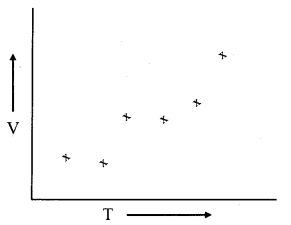
iii. A set of experimentally measured values of volume and temperature of a definite mass of a gas upon plotting on a graph paper appears as in the figure below:
Image

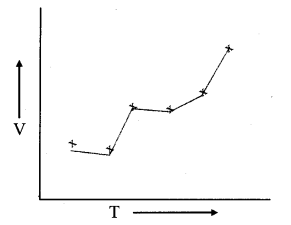
iv. When the points are directly connected, a zig zag pattern results as shown below:
Image
From the above pattern, no meaningful result can be deduced.
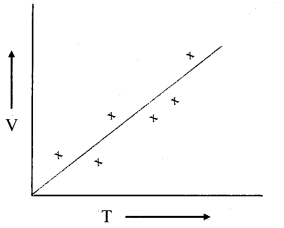
v. A smooth curve (or average curve) passing through these points can be drawn as shown below. This straight line is consistent with the V ∝ T .
Image
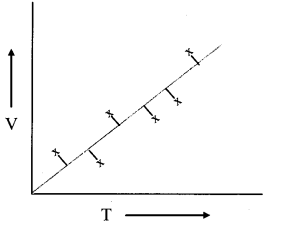
vi. While fitting the points into a smooth curve, all the plotted points should be evenly distributed. This can be verified mathematically, by drawing a perpendicular from each point to the curve. The perpendicular represents deviation of each point from the curve. Take sum of all the perpendiculars on side of the line and sum of all the perpendiculars on another side of the line separately. If the two sums are equal (or nearly equal), the curve drawn shows the experimental points in the best possible representation
Image

Need a full question paper?

Generate a complete, print-ready paper with questions like this in minutes — across 16+ boards, with answer keys.

Start Generating Free

Similar questions

State and explain Gay Lussac’s law of gaseous volume with two examples.
Explain the formation of water $(H_2O)$ molecule on the basis of hybridization.
Balance the following redox equation by oxidation number method. The reactions occur in acidic medium.
$i. \  H _2 O _{2( aq )}+ Cr _2 O _{7( aq )}^{2-} \longrightarrow O _{2( g )}+ Cr _{( mq )}^{3+}$
$ii. \  A g (s)+ N O _{3(\text { (mq) }}^{-} \longrightarrow A g _{(\text {(qq) }}^{+}+ N O _{2( g )}$
$iii. \  Sn _{(\text {(qq) }}^{2+}+ IO _{\text {(teq) }}^{-} \longrightarrow Sn _{( aq )}^{4+}+ I _{(\text {(aq) })}^{-}$
$iv. \  MnO _{4(\text { (q) })}^{-}+ IO _{3(\text { ave }}^{-} \longrightarrow MnO _{2( s )}+ IO _{4( mq )}^{-}$
$v. \  N O _{3( qq )}^{-}+ SO _{2( qq )} \longrightarrow SO _{4( sq )}^{2-}+ NO _{2( g )}$
Describe how the line spectrum of hydrogen is explained by Bohr theory.
Describe the process of filtration with a neat and labelled diagram.
Predict the block, periods and groups to which the following elements belong.
$i. Mg (Z = 12) \ \ ii. V (Z = 23) \ \ iii. Sb (Z = 51) \ \ iv. Rn (Z = 86) \ \ v. Na (Z = 11) \ \ vi. Cl (Z = 17)$
Explain graphically the effect of the following factors on the adsorption of gases by solids.
i. Temperature of the adsorbent surface
ii. Pressure of the gas (adsorbate)
How many litres of oxygen at $STP$ are required to burn completely $2.2 g$ of propane, $C_3H_8$?
Explain condensed orbital notation of electronic configuration of an atom.
Define chemisorption, Write its main features.