Question
Explain in short about electric dipole.

Answer

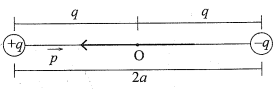
►A system consisting of two equal and opposite charges at some distance is called electric dipole.
►The total charge of the electric dipole is obviously zero. This does not mean that the field of the electric dipole is zero. Since the charge q and - q are separated by some distance, the electric fields due to them, when added, do not exactly cancel out.

Image
►The product of the magnitude of any electric charge on an electric dipole and the distance (2a) between them is called the electric dipole moment.
►Electric dipole moment $\vec{p}=\overrightarrow{2 a} q$
►SI unit of electric dipole moment is Cm (Coulomb meter), Dimensional formula is $M ^0 L^1 T^1 A^1$

Need a full question paper?

Generate a complete, print-ready paper with questions like this in minutes — across 16+ boards, with answer keys.
Start Generating Free

Similar questions

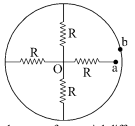
Calculate the magnitude of equivalent resistance across the points $a$ and $b$ in the network shown in the given figure.

Image
An oil drop of 12 excess electrons is held stationary under a constant electric field of 2.55 × 10⁴ NC-1 in Millikan’s oil drop experiment. The density of the oil is 1.26 g cm-3. Estimate the radius of the drop. (g = 9.81 m s-2; e = 1.60 × 10⁻¹⁹ C).
A semicircular wire of radius 5.0cm carries a current of 5.0A. A magnetic field B of magnitude 0.50T exists along the perpendicular to the plane of the wire. Find the magnitude of the magnetic force acting on the wire.
Explain recombination coeflicient of intrinsic semiconductor and obtain the relation $n_t^2=n_{ c } n_{ h }$.
A source of sound with adjustable frequency produces 2 beats per second with a tuning fork when its frequency is either 476Hz or 480Hz. What is the frequency of the tuning fork?
Can you hear your own words if you are standing in a perfect vacuum? Can you hear your friend in the same conditions?
Answer the following questions:
A high tension (HT) supply of, say, 6 kV must have a very large internal resistance. Why?
The $\text{K}_\beta$ X-ray of argon has a wavelength of 0.36nm. The minimum energy needed to ionize an argon atom is 16eV. Find the energy needed to knock out an electron from the K shell of an argon atom.
Define the term ‘linearly polarised light’.
When’ does the intensity of transmitted light become maximum, when a polaroid sheet is rotated between two crossed polaroids?
Can two identical and independent sodium lamps act as coherent sources? Give reason for your answer.