Question
Define the term ‘linearly polarised light’.
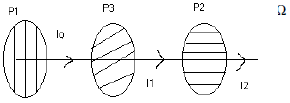
When’ does the intensity of transmitted light become maximum, when a polaroid sheet is rotated between two crossed polaroids?

Answer

When the vibrations of the electric field vector $(\overrightarrow{\text{E}})$ are confined to only one direction then light is called linearly polarized light.

Intensity of transmitted light is maximum when the Polaroid sheet makes an angle of 450 with the pass axis.

Alternate Answer

Need a full question paper?

Generate a complete, print-ready paper with questions like this in minutes — across 16+ boards, with answer keys.

Start Generating Free

Similar questions

Calculate the torque on the square plate of the previous problem if it rotates about a diagonal with the same angular acceleration.
Free electron density of copper is $8.5 \times 10^{28}$ per $m ^3$. Find out the current in copper wire of length 0.1 m and area of cross-section $1 mm^2$ when a battery of 3 V is joined across its ends. (Given mobility of electrons = $4.5 \times 10^{-6} m^2 V^{-1} s^{-1}$, charge on electron, $e=1.6 \times 10^{-19} C$ )
Explain : Static electric field inside a conductor is zero.
Why do tyres have a better grip of the road while going on a level road than while going on an incline?
A tightly-wound, long solenoid has n turns per unit length, a radius r and carries a current i. A particle having charge q and mass m is projected from a point on the axis in a direction perpendicular to the axis. What can be the maximum speed for which the particle does not strike the solenoid ?
Describe experiment of two coils explaining electromagnetic induction.
Two metallic wires P and Q of the same material and same length but different cross-sectional areas A1 and A2 are joined together and then connected to a source of emf. Find the ratio of the drift velocities of free electrons in the wires P and Q, if the wires are connected (i) in series, and (ii) in parallel.
Represent the Electric field and Magnetic field seen in the Electro magnetic waves (EM waves) in the form of equation.
  1. An electrostatic field line is a continuous curve. That is, a field line cannot have sudden breaks. Why not?
  2. Explain why two field lines never cross each other at any point?
A circular wire-loop of radius a carries a total charge Q distributed uniformly over its length. A small length dL of the wire is cut off. Find the electric field at the centre due to the remaining wire.