Question
Explain J J. Thomson's plum pudding model of atom.

Answer

Experiments by physicist J.J. Thomson showed that atoms of various elements contain negatively charged constituents (electrons). which are the same for all atoms. Although the atom is electrically neutral.
Hence the atom must also have some positive charge to neutralise the negative charge of the electron.
To explain the arrangement of positive and negative charge in atom, Thomson gave an atomic model called the plum pudding model.
The first model of the atom was given by J.J. Thomson. According to this model, the positive charge of the atom is uniformly distributed throughout the volume of the atom and the negatively charged electrons are embedded in like seeds in a watermelon. This model is called plum pudding model of the atom.

Need a full question paper?

Generate a complete, print-ready paper with questions like this in minutes — across 16+ boards, with answer keys.
Start Generating Free

Similar questions

Think over the experiment number 2 of Faraday and Henry and tell :
(a) What will you do to obtain more deflection in the galvanometer?
(b) How will you show the presence of current in the absence of a galvanometer?
White light is used in a Young's double slit experiment. Find the minimum order of the violet fringe $(\lambda=400\ \text{nm}),$ which overlaps with a red fringe $(\lambda=700\ \text{nm}).$
A metallic rod of 'L' length is rotated with angular frequency of '$\omega$' with one end hinged at the centre and the other end at the circumference of a circular metallic ring of radius L, about an axis passing through the centre and perpendicular to the plane of the ring. A constant and uniform magnetic field B parallel to the axis is present everywhere. Deduce the expression for the emf between the centre and the metallic ring.
Suppose the energy liberated in the recombination of a hole-electron pair is converted into electromagnetic radiation. If the maximum wavelength emitted is 820nm, what is the band gap?
Give the sign convection for electric or magnetic field leaving and entering the plane of the paper.
Write the difference between parallel combination and series combination of capacitors.
What is the principle of superposition of charges?
A point charge is taken from a point A to a point B in an electric field. Does the work done by the electric field depend on the path of the charge?
A block of mass m moving at a speed v compresses a spring through a distance x before its speed is halved. Find the spring constant of the spring.
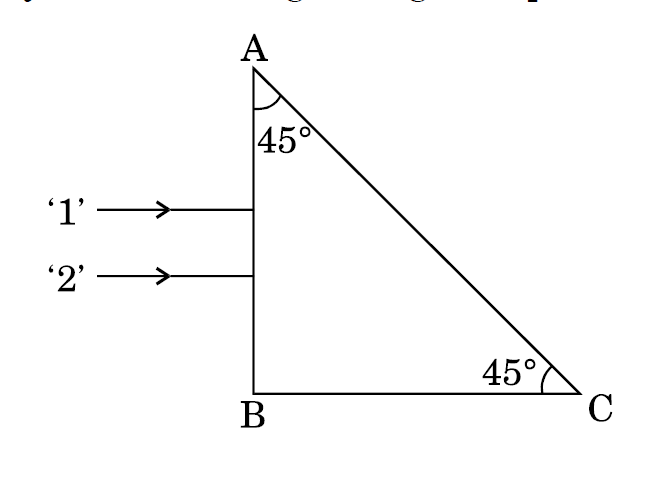
Two monochromatic rays of light are incident normally on the face AB of an isosceles right-angled prism ABC. The refractive indices of the glass prism for the two rays ‘1’ and ‘2’ are respectively 1.35 and 1.45. Trace the path of these rays after entering through the prism.