Question
Write the difference between parallel combination and series combination of capacitors.

Answer

(1) Such a combination of capacitors in which the value of potential difference on each capacitor is equal, is called parallel combination. Such a combination of capacitors, in which the magnitude of charge on each capacitor remains the same, is called a series combination.
(2) Combination of capacitors by connecting them in parallel, equivalent capacitance is equal to the sum of the capacitances of each capacitor. In series combination, the reciprocal of the equivalent capacitance of the circuit is equal to the sum of the reciprocals of the capacitance of each capacitor used in this combination.
The value of equivalence obtained in series combination is less than the value of any capacitance.
Need a full question paper?

Generate a complete, print-ready paper with questions like this in minutes — across 16+ boards, with answer keys.

Start Generating Free

Similar questions

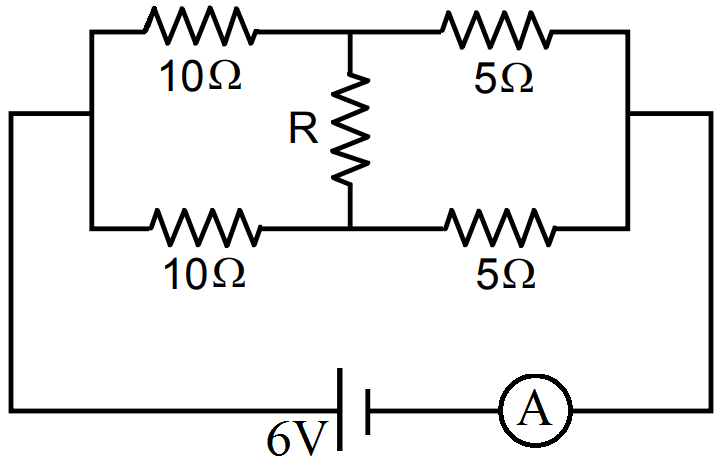
What should be the value of R in the figure. for which the current in it is zero?
In the Rutherford's nuclear model of the atom, the nucleus (radius about $10^{-15} m$ ) is analogous to the sun about which the electron move in orbit (radius $\approx 10^{-10} m$ ) like the earth orbits around the sun. If the dimensions of the solar system had the same proportions as those of the atom, would the earth be closer to or farther away from the sun than actually it is? The radius of earth's orbit is about $1.5 \times 10^{11} m$. The radius of sun is taken as $7 \times 10^8 m$.
A capacitor, made of two parallel plates each of plate area A and separation d, is being charged by an external ac source. Show that the displacement current inside the capacitor is the same as the current charging the capacitor.
Define electric flux. Write its $S.I.$ unit.
$A$ charge $q$ is enclosed by a spherical surface of radius $R.$ If the radius is reduced to half, how would the electric flux through the surface change?
The susceptibility of magnesium at $300K$ is $1.2 \times 10^{-5}.$ At what temperature will the susceptibility increase to $1.8 \times 10^{-5}?$
The rest mass of the photon is zero. Explain it.
The peak power consumed by a resistive coil, when connected to an AC source, is 80W. Find the energy consumed by the coil in 100 seconds, which is many times larger than the time period of the source.
The electric current existing in a discharge tube is $2.0\mu\text{A}.$ How much charge is transferred across a cross-section of the tube in 5 minutes?
A potential difference $V$ is applied across the ends of a conductor of length $L$ and diameter $D$. What will be the effect on drift velocity of charge carriers in the conductor when (i) V is made half (ii) L is doubled and (iii) D is made half?
Write the shortcomings of Rutherford atomic model. Explain how these were overcome by the postulates of Bohr's atomic model.