Question
Explain linear simple harmonic motion by taking an example. Find the expression for its period and explain its dependence.
Answer

SELF

Need a full question paper?

Generate a complete, print-ready paper with questions like this in minutes — across 16+ boards, with answer keys.

Start Generating Free

Similar questions

Derive expression for rate of flow of fluid as measured by venturimeter.
What is gravitational potential? Derive the formula for gravitational potential due to a ponit mass and also draw the graph.
An artificial satellite is revolving around a planet of mass M and radius R, in a circular orbit of radius r. From Kepler’s Third law about the period of a satellite around a common central body, square of the period of revolution T is proportional to the cube of the radius of the orbit r. Show using dimensional analysis, that $\text{T}=\frac{\text{k}}{\text{R}}\sqrt{\frac{\text{r}^3}{\text{g}}},$ where k is a dimensionless constant and g is acceleration due to gravity.
  1. Two particles of equal masses go around a circle of radius R under the action of their mutual gravitational force. Find the speed of each particle
  2. What is the binding energy of a satellite? Derive an expression for it.
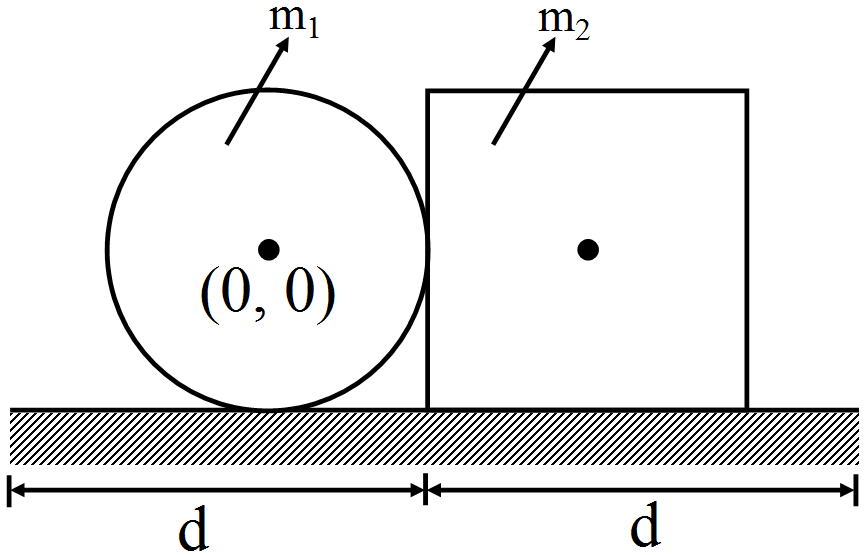
A square plate of edge d and a circular disc of diameter d are placed touching each other at the midpoint of an edge of the plate as shown in figure. Locate the centre of mass of the combination, assuming same mass per unit area for the two plates.

What do you understand by friction? Discuss about static friction, limiting friction, kinetic friction and rolling friction.
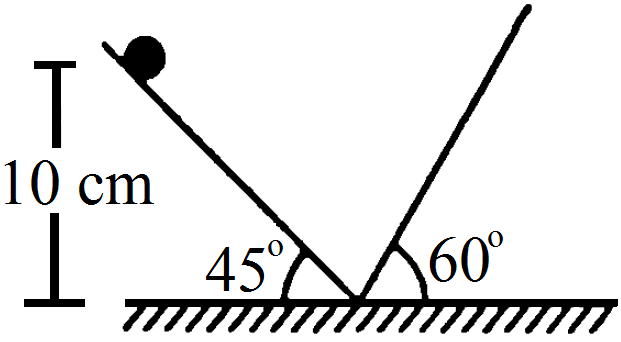
Find the time period of the motion of the particle shown in figure Neglect the small effect of the bend near the bottom.

Explain the international system of units. Explain its characteristics.
A simple harmonic motion has an amplitude A and time period T. What is the time taken to travel from $\text{x}=\text{A}$ $\text{x}=\frac{\text{A}}{2}$?
A man walking briskly in rain with speed v must slant his umbrella forward making an angle $\theta$ with the vertical. A student derives the following relation between $\theta$ and v: $\tan \theta = \text{v}$ and checks that the relation has a correct limit: as $\text{v}\rightarrow 0,\ \theta \rightarrow0,$ as expected. (We are assuming there is no strong wind and that the rain falls vertically for a stationary man). Do you think this relation can be correct? If not, guess the correct relation.