Question
Explain loss of biodiversity.

Answer

→ The biological wealth of our planet has been declining rapidly and the accusing finger is clearly pointing to human activities.
→ The colonisation of tropical Pacific Islands by humans is said to have led to the extinction of more than 2,000 species of native birds.
→ The IUCN Red List (2004) documents the extinction of 784 species (including 338 vertebrates, 359 invertebrates and 87 plants) in the last 500 years.
→Some examples of recent extinctions include the
→ Dodo (Mauritius), Quagga (Africa), Thylacine (Australia), Steller's Sea Cow (Russia) and three subspecies (Bali, Javan, Caspian) of tiger.
→ The last twenty years alone have witnessed the disappearance of 27 species.
→ Careful analysis of records shows that extinctions across taxa are not random; some groups like amphibians appear to be more vulnerable to extinction.
→ Adding to the grim scenario of extinctions is the fact that more than 15,500 species world- wide are facing the threat of extinction.
→ Presently, 12 per cent of all bird species, 23 per cent of all mammal species, 32 per cent of all amphibian species and 31per cent of all gymnosperm species in the world face the threat of extinction.
→ From a study of the history of life on earth through fossil records, shows that large-scale loss of species like the one we are currently witnessing have also happened earlier, even before humans appeared on the scene.
→ During long the period (> 3 billion years) since the origin and diversification of life on earth there were five episodes of mass extinction of species.
→ The difference is in the rates; the current species extinction rates are estimated to be 100 to 1,000 times faster than in the pre-human times and our activities are responsible for the faster rates.
→ Ecologists warn that if the present trends. continue, nearly half of all the species on earth might be wiped out within the next 100 years.
Need a full question paper?

Generate a complete, print-ready paper with questions like this in minutes — across 16+ boards, with answer keys.

Start Generating Free

Similar questions

Read the following and answer any four questions from (i) to (v) given below:
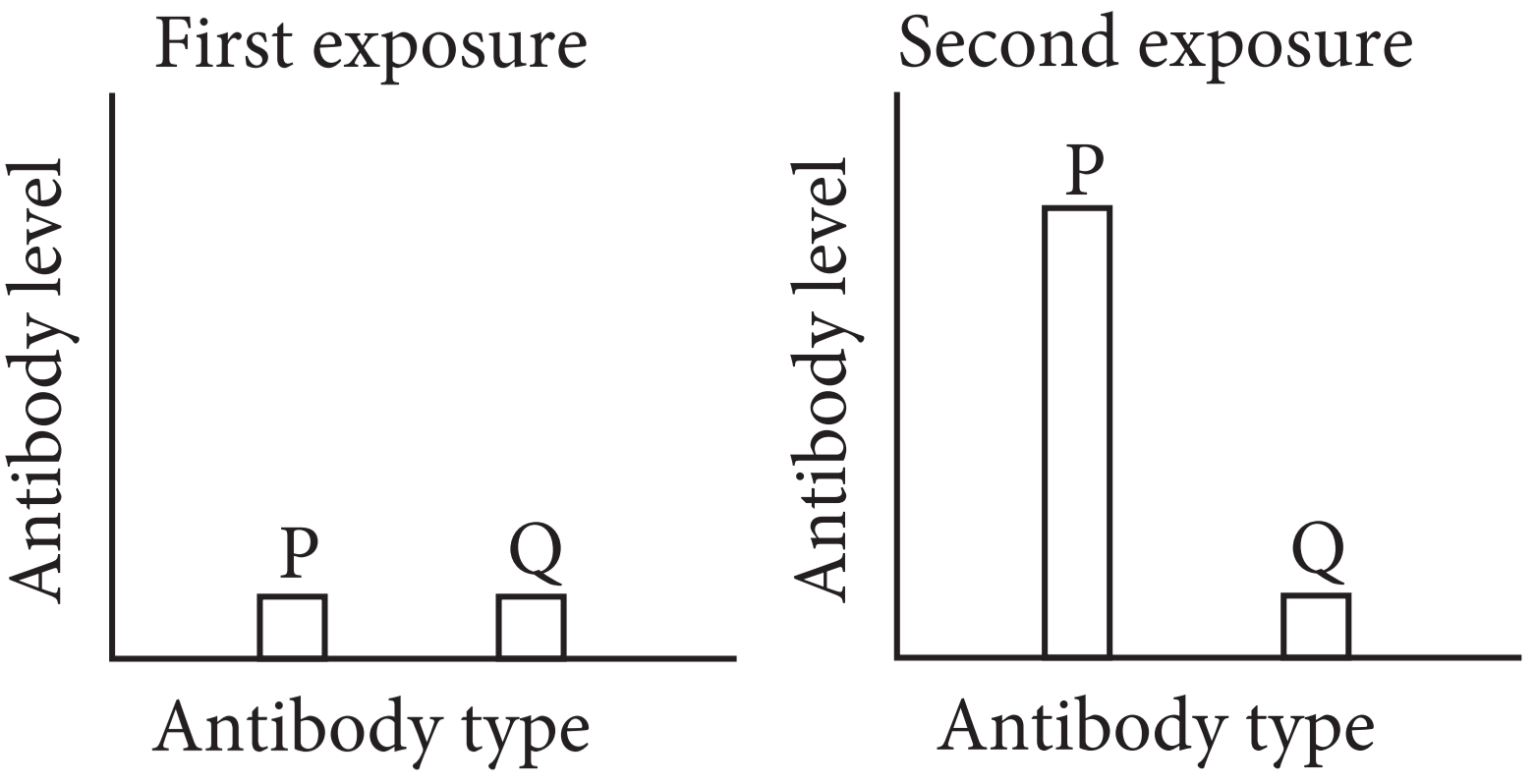
In a study to test a new vaccine against a viral disease, mouse model testing is done. In this process, mice are vaccinated and their blood samples were tested. Mice developed mild disease symptom. After few days those mice were again infected with the virus. This time they do not show any disease symptoms. Their blood samples were tested. Two graphs show antibody concentration for the first and second infection in mice blood.

Based on the above information, answer the following questions.
  1. P and Qin the given graphs indicate.
  1. IgM and IgG respectively.
  2. IgG and IgM respectively
  3. IgG and IgM respectively
  4. IgM and IgA respectively.
  1. Which form of pathogen is used in vaccination?
  1. Activated and strong pathogenic antigen.
  2. Inactivated and weakened pathogenic antigen.
  3. Hyperactive and strong pathogen.
  4. Preformed antibodies.
  1. Which of the following is incorrect for P?
  1. It is the most abundant class of lg.
  2. It is found in blood, lymph, and intestine.
  3. It is unable to cross the placental barrier.
  4. It is a monomer.
  1. How does vaccination work?
  1. The immune system produces antibodies which stay in the blood.
  2. Memory lymphocytes remain in the body to fight off any future infection with the same pathogen.
  3. The dead pathogen stays in the body and constantly stimulates the immune system.
  4. All of these.
  1. Assertion: Mice do not show any disease symptoms during second exposure to the pathogenic virus.
Reason: The antibody production is accelerated and more intense during secondary immune response.
  1. Both assertion and reason are true, and reason is the correct explanation of assertion.
  2. Both assertion and reason are true, but reason is not the correct explanation of assertion.
  3. Assertion is true, but reason is false.
  4. Both assertion and reason are false.
Early diagnosis is not possible by traditional methods for diagnosis and treatment- discuss in detail.
What is sewage? Describe secondary treatment (biological treatment) in Sewage Treatment plant.
Read the following and answer any four questions from 9(i) to 9(v) given below:
Bioreactors are considered as vessels in which raw materials are biologically converted into specific products by microbes, plant and animal cells or their enzymes. They are used for large scale production as they provide optimum growth conditions such as temperature, pH, substrate, vitamins, oxygen and salts for obtaining desired product. Most commonly used bioreactors are of stirring type which include simple stirred tank bioreactor and sparged stirred-tank bioreactor.
  1. Bioreactor are useful in:
  1. Amplifying a gene.
  2. Isolation of genetic material.
  3. Processing large volume of culture.
  4. Infecting DNA in a cell.
  1. Which of the following is essential to obtain desired product in a bioreactor?
  1. Size of the bioreactor.
  2. Sterile condition.
  3. Quantity of the raw material.
  4. All of these.
  1. Assertion: The stirred-tank is well suited for large scale production of microorganisms under aseptic conditions.
Reason: In sparged stirred tank bioreactor, surface area for oxygen transfer is increased.
  1. Both assertion and reason are true and reason is the correct explanation of assertion.
  2. Both assertion and reason are true but reason is not the correct explanation of assertion.
  3. Assertion is true but reason is false.
  4. Both assertion and reason are false.
  1. Growth condition that could affect the quality of obtained product in a bioreactor are:
  1. Temperature and pH only.
  2. pH and oxygen supply only.
  3. Temperature and oxygen supply only.
  4. Temperature, pH and oxygen supply.
  1. Vessels in which raw materials are biologically converted into specific products are.
  1. Bioreactors.
  2. Fermentors.
  3. Gene guns.
  4. Both (a) and (b).
Explain the amplification of gene of interest using PCR (Diagram is must)
Read the following and answer any four questions from (i) to (v) given below:DNA replication is a complex multistep process that requires enzymes, protein factors and metal ions. DNA replication in eukaryotes occurs in the nucleus during the S-phase of the cell cycle. It is semidiscontinuous in eukaryotes. in prokaryotes, replication takes place in the cytoplasm. DNA replication in bacteria occurs prior to fission. Nucleoid or viral chromosome is a single molecule of nucleic acid, it may be linear of circular. Nucleic acid in a virus is either DNA or RNA but never both.
  1. In viral DNA, how many origin of replication are present?
  1. Single
  2. Twice
  3. Multiple
  4. None
  1. Select the main enzyme involved in DNA replication.
  1. DNA ligase
  2. DNA dependent DNA polymerase
  3. Topoisomerase
  4. Helicase
  1. Read the given statement and select the option that correctly fill in the blanks. Enzyme (i) acts over the Ori site and unwinds the two strands of DNA by destroying (ii) bonds.
  1. (i)-Helicase (ii) Glycosidic
  2. (i)-Helicase (ii)-Hydrogen
  3. (i)-Unwindase (ii)-Phosphodiester
  4. (i)-Unwindase (ii)-Glycosidic
  1. DNA strand, built up of Okazaki fragments, is called.
  1. Lagging strand.
  2. Leading strand.
  3. Complementary strand.
  4. Parental strand.
  1. Select the incorrect statement about DNA polymerase in eukaryotes.
  1. Polymerase $\alpha$ is required for initiation of replication.
  2. When the RNA primer gets removed the gap is filled by DNA polymerase $\beta$ in eukaryotes.
  3. Polymerase $\in$ helps in elongation of lagging strand.
  4. Polymerase $\delta$ is largest and main enzyme for DNA replication in eukaryotes.
Write a self-explanatory note on biopatent.
Bacteria cannot be seen with the naked eyes, but these can be seen with the help of a microscope. If you have to carry a sample from your home to your biology laboratory to demonstrate the presence of microbes with the help of a microscope, which sample would you carry and why?
Read the following and answer any four questions from (i) to (v) given below:
Kangaroo rat seldom drinks water. It has thick coat to minimise evaporative desiccation. TI1e animal seldom comes out of its comparatively humid and cool burrow during the day time. 90% of its water requirement is met from metabolic water (water produced by respiratory breakdown of fats) while 10% is obtained from its food. Loss of water is minimised by producing nearly solid urine and faeces. As the animal faces acute water scarcity, it develops two types of adaptations : reducing water loss and ability to tolerate desert conditions.
  1. Kangaroo rat is a:
  1. Partial regulators
  2. Partial conformer
  3. Regulator
  4. Conformer
  1. Metabolic water refers to:
  1. Water required for metabolic activities.
  2. Water present in intercellular fluid.
  3. Water produced during oxidation of fat or carbohydrate.
  4. Water taken in, to promote metabolism.
  1. Desert animals minimise water loss by:
  1. Producing highly concentrated urine.
  2. Promoting maximum reabsorption of water in kidney tubules.
  3. Possessing one of the longest loop of Henle in kidney tubules.
  4. All of these.
  1. Assertion: Kangaroo rat can tolerate and thrive in wide temperature range and is known as stenothermal.
Reason: Kangaroo rats go into hibernation during winter to escape cold weather.
  1. Both assertion and reason are true and reason is the correct explanation of assertion.
  2. Both assertion and reason are true but reason is not the correct explanation of assertion.
  3. Assertion is true but reason is false.
  4. Both assertion and reason are false.
  1. The adaptations in an organism are meant for:
  1. Optimum primary production.
  2. Optimum life span.
  3. Optimum mobility.
  4. Optimum survival and reproduction.
Read the following text carefully and answer the questions that follow:
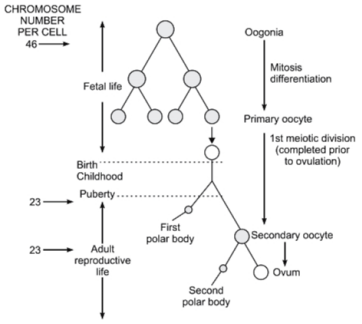
The process of formation of a mature female gamete is called oogenesis which is markedly different from spermatogenesis. A schematic representation of Oogenesis is shown below study the flow chart carefully.

Image
i. How is a primary oocyte different from a secondary oocyte? (1)
ii. Mention the changes taking place during the transition of a secondary follicle to Graafian follicle in the oogonia. (1)
iii. How many primary follicles are left in each ovary in a human female at puberty? (2)
OR
What happen to graafuan follicle after ovulation? (2)