Questions

Case study (4 Marks)

🎯

Test yourself on this topic

5 questions · timed · auto-graded

Question 14 Marks
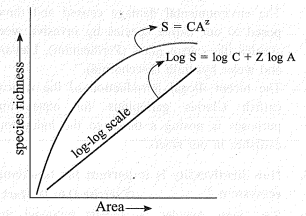
Explain Species-Area relationships graph.
View full question & answer
Question 24 Marks
Explain 'rivet popper hypothesis with example.
Answer
→ Stanford ecologist Paul Ehrlich used an analogy to give a proper perspective about biodiversity.
→ In an airplane (ecosystem) all parts are joined together using thousands of rivets (species).
→ If every passenger travelling in it starts popping a rivet to take home (causing a species to become extinct), it may not affect flight safety (proper functioning of the ecosystem) initially, but as more and more rivets are removed, the plane becomes dangerously weak over a period of time.
→ Furthermore, which rivet is removed may also be critical.
→ Loss of rivets on the wings is obviously a more serious threat to flight safety than loss of a few rivets on the seats or windows inside the plane.
→ The wings of airplane is compared with key species that drive major ecosystem functions.
View full question & answer
Question 34 Marks
Loss of habitat and fragmentation leads to loss in biodiversity. Explain with example.
Answer
→ This is the most important cause driving animals and plants to extinction.
→ The most dramatic examples of habitat loss come from tropical rain forests.
→ Once covering more than 14 per cent of the earth's land surface, these rain forests now cover no more than 6 per cent. They are being destroyed fast.
→ The Amazon rain forest it is so huge that it is called the 'lungs of the planet'.
→ The Amazon rain forest is the place of harbouring probably millions of species and is being cut and cleared for cultivating soya beans or for conversion to grasslands for raising beef cattle.
→ Besides total loss, the degradation of many habitats by pollution also threatens the survival of many species.
→ When large habitats are broken up into small fragments due to various human activities, mammals and birds requiring large territories and certain animals with migratory habits are badly affected, leading to population declines.
View full question & answer
Question 44 Marks
Explain in situ approach for conservation of biodiversity.
Answer
→ In situ conservation faced with the conflict between development and conservation, many nations find it unrealistic and economically not feasible to conserve all their biological wealth.
→ Invariably, the number of species waiting to be saved from extinction far exceeds the conservation resources available.
→ On a global basis, this problem has been addressed by eminent conservationists.
→ They identified for maximum protection certain 'biodiversity hotspots' regions with very high levels of species richness and high degree of endemism (that is, species confined to that region and not found anywhere else).
→ Initially 25 biodiversity hotspots were identified but subsequently nine more have been added to the list, bringing the total number of biodiversity hotspots in the world to 34.
→ These hotspots are also regions of accelerated habitat loss.
→ Three of these hotspots - Western Ghats and Sri Lanka, Indo-Burma and Himalaya - cover our country's exceptionally high biodiversity regions.
→ Although all the biodiversity hotspots put together cover less than 2 per cent of the earth's land area, the number of species they collectively harbour is extremely high and strict protection of these hotspots could reduce the ongoing mass extinctions by almost 30 per cent.
→ In India, ecologically unique and biodiversity- rich regions are legally protected as biosphere reserves, national parks and sanctuaries.
→ India now has 14 biosphere reserves, 90 national parks and 448 wildlife sanctuaries.
→ India has also a history of religious and cultural traditions that emphasised protection of nature.
→ India has also a history of religious and cultural traditions that emphasized protection of nature.
→ In many cultures, tracts of forest were set aside, and all the trees and wildlife within were venerated and given total protection.
→ Sacred groves means conservation of plants and animals according to religious beliefs.
Some sacred groves in India :
→ Such sacred groves are found in Khasi and Jaintia Hills in Meghalaya.
→ Aravalli Hills of Rajasthan.
→ Western Ghat regions of Karnataka and Maharashtra.
→ Sarguja, Chanda and Bastar areas of Madhya Pradesh.
→In Meghalaya, the sacred groves are the last refuges for a large number of rare and threatened plants.
View full question & answer
Question 54 Marks
Explain loss of biodiversity.
Answer
→ The biological wealth of our planet has been declining rapidly and the accusing finger is clearly pointing to human activities.
→ The colonisation of tropical Pacific Islands by humans is said to have led to the extinction of more than 2,000 species of native birds.
→ The IUCN Red List (2004) documents the extinction of 784 species (including 338 vertebrates, 359 invertebrates and 87 plants) in the last 500 years.
→Some examples of recent extinctions include the
→ Dodo (Mauritius), Quagga (Africa), Thylacine (Australia), Steller's Sea Cow (Russia) and three subspecies (Bali, Javan, Caspian) of tiger.
→ The last twenty years alone have witnessed the disappearance of 27 species.
→ Careful analysis of records shows that extinctions across taxa are not random; some groups like amphibians appear to be more vulnerable to extinction.
→ Adding to the grim scenario of extinctions is the fact that more than 15,500 species world- wide are facing the threat of extinction.
→ Presently, 12 per cent of all bird species, 23 per cent of all mammal species, 32 per cent of all amphibian species and 31per cent of all gymnosperm species in the world face the threat of extinction.
→ From a study of the history of life on earth through fossil records, shows that large-scale loss of species like the one we are currently witnessing have also happened earlier, even before humans appeared on the scene.
→ During long the period (> 3 billion years) since the origin and diversification of life on earth there were five episodes of mass extinction of species.
→ The difference is in the rates; the current species extinction rates are estimated to be 100 to 1,000 times faster than in the pre-human times and our activities are responsible for the faster rates.
→ Ecologists warn that if the present trends. continue, nearly half of all the species on earth might be wiped out within the next 100 years.
View full question & answer
Case study (4 Marks) - BIOLOGY STD 12 Science Questions - Vidyadip