Question
Explain loss of biodiversity.

Answer

→ The biological wealth of our planet has been declining rapidly and the accusing finger is clearly pointing to human activities.
→ The colonisation of tropical Pacific Islands by humans is said to have led to the extinction of more than 2,000 species of native birds.
→ The IUCN Red List (2004) documents the extinction of 784 species (including 338 vertebrates, 359 invertebrates and 87 plants) in the last 500 years.
→Some examples of recent extinctions include the
→ Dodo (Mauritius), Quagga (Africa), Thylacine (Australia), Steller's Sea Cow (Russia) and three subspecies (Bali, Javan, Caspian) of tiger.
→ The last twenty years alone have witnessed the disappearance of 27 species.
→ Careful analysis of records shows that extinctions across taxa are not random; some groups like amphibians appear to be more vulnerable to extinction.
→ Adding to the grim scenario of extinctions is the fact that more than 15,500 species world- wide are facing the threat of extinction.
→ Presently, 12 per cent of all bird species, 23 per cent of all mammal species, 32 per cent of all amphibian species and 31per cent of all gymnosperm species in the world face the threat of extinction.
→ From a study of the history of life on earth through fossil records, shows that large-scale loss of species like the one we are currently witnessing have also happened earlier, even before humans appeared on the scene.
→ During long the period (> 3 billion years) since the origin and diversification of life on earth there were five episodes of mass extinction of species.
→ The difference is in the rates; the current species extinction rates are estimated to be 100 to 1,000 times faster than in the pre-human times and our activities are responsible for the faster rates.
→ Ecologists warn that if the present trends. continue, nearly half of all the species on earth might be wiped out within the next 100 years.
Need a full question paper?

Generate a complete, print-ready paper with questions like this in minutes — across 16+ boards, with answer keys.

Start Generating Free

Similar questions

Read the following and answer any four questions from (i) to (v) given below:

Non-native or alien species are often introduced in advertently for their economic and other uses. They often become invasive and drive away the local species. Exotic species have proved harmful to both aquatic and terrestrial ecosystems. For example, water hyacinth (Eichhornia crassipes) was introduced in Indian waters to reduce pollution. It was clogged water bodies including wetlands at many places resulting in death of several aquatic plants and animals.

  1. Island water ecosystem are the most vulnerable due to:
  1. Small size.
  2. Small number of species.
  3. Increases reproductive capacity.
  4. Both (a) and (b).
  1. Which of the following is not an alien species?
  1. Lantana camara.
  2. Periplaneta americana.
  3. Nile Perch.
  4. Yucca moth.
  1. Second major cause of species extinction is:
  1. Habitat loss and fragmentation.
  2. Over exploitation.
  3. Alien species invasion.
  4. Co-extinction.
  1. Assertion: Eichhomia crassipes drains off oxygen from water and can be seen growing in standing water.

Reason: Eichhornia crassipes is an indigenous species of India.

  1. Both assertion and reason are true and reason is the correct explanation of assertion.
  2. Both assertion and reason are true but reason is not the correct explanation of assertion.
  3. Assertion is true but reason is false.
  4. Both assertion and reason are false.
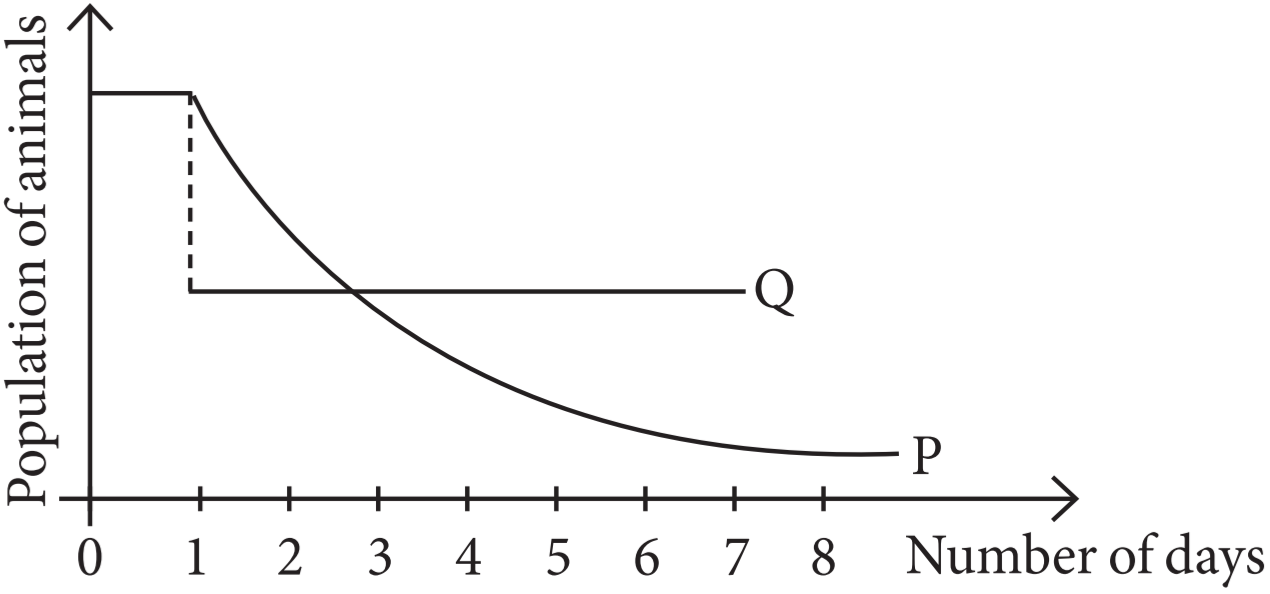
  1. The population of species Pin a certain conununity was constant until a population species Q from a distant land was subsequently introduced into that community. The interaction between the two populations is reflected in the graph below.

What could be the possible reason for the decrease in the population of species P over a number of days?

  1. Species Q is a predator of species P.
  2. Species Q is a prey species which wiped out the population of species P.
  3. Species P and Q compete for space but feeds on different food.
  4. None of these.
Read the following and answer any four questions from (i) to (v) given below:
Green manuring is the fanning practice where a leguminous plant which has derived enough benefits from its association with appropriate species of Rhizobium, is ploughed into the field soil and then a non-legume is sown and allowed to get benefitted from the already present nitrogen fixer. Some legumes, such as, Crotolaria juncea, Sesbania rostrata, Lencaena leucocephala, etc. are used as green manure. Rhizobia, that fix atmospheric nitrogen in the form of nitrate, live in the roots ofleguminous plants. These nutrients are used by non-leguminous plants through the practice of green manuring.
  1. Green manures mainly provide nutrient enriched in:
  1. Magnesium.
  2. Sulphur.
  3. Nitrogen.
  4. Both (a) and (b).
  1. Which of the following plants is used as green manure in crop fields?
  1. Saccharum.
  2. Dichanthium.
  3. Phyllonthus.
  4. Crotolaria.
  1. Green manure plants belong to the Family:
  1. Lamiaceae.
  2. Papilionaceae.
  3. Liliaceae.
  4. Poaceae.
  1. Due to excess use of chemical fertilisers rich in nitrate, ________ disease occurred in children.
  1. Jaundice.
  2. Septicemia.
  3. Methemoglobinemia.
  4. Botulism.
  1.  A green manure is:
  1. Rice.
  2. Maize.
  3. Sorghum.
  4. Sesbania.
Nematode specific genes were introduced into the tobacco host plant using a vector:
  1. pBR 322.
  2. Plasmid.
  3. Bacteriophage.
  4. Agrobacterium.
Explain: separation and isolation of DNA fragments.###How will you make separation and isolation of DNA fragments by using gel electrophoresis?
Read the following and answer any four questions from (i) to (v) given below:

Medical termination of pregnancy is termination of pregnancy before the fetus become viable. To reduce the incidence of illegal abortion and consequent maternal mortality, MTP Amendment Act, 2017 was enacted by the government of India. About 40-50 million MTPs are done in a year all over the world.

  1. Abortion can be safely done for about ______ weeks of pregnancy.
  1. 4
  2. 12
  3. 8-10
  4. 15-18
  1. How is MTP helpful in decreasing human population?
  1. By aborting normal female fetus.
  2. By aborting normal female fetus.
  3. By getting rid of unwanted pregnancies.
  4. None of these.
  1. Select an incorrect statement for MTP.
  1. Second trimester abortions are more risky than first trimester.
  2. It is being misused to abort normal female fetus.
  3. It helps to get rid of unwanted pregnancies.
  4. Child detected with congenital heart disease cannot be aborted.
  1. MTP was legalised by Government of India in:
  1. 1971
  2. 1982
  3. 1973
  4. 1991
  1. Assertion: MTPs are safe during first trimester of pregnancy.

Reason: After first trimester, fetus become intimately associated with the maternal tissues.

  1. Both assertion and reason are true, and reason is the correct explanation of assertion.
  2. Both assertion and reason are true, but reason is not the correct explanation of assertion.
  3. Assertion is true, but reason is false.
  4. Both assertion and reason are false.
Describe pregnancy and embryonic development.
Write a short note on transcription unit.### Explain : Transcription unit
Read the following and answer any four questions from (i) to (v) given below:
The pollen grains or microspores are the male reproductive bodies of a flower and are contained in the pollen sac or microsporangia. Each pollen grain consists of a single microscopic cell, possessing two coats: the exine and the in tine. The exine of a pollen grain is made of chemically stable material. Because of this, pollen grains are often very well preserved for thousands of years in soil and sediments.
  1. One of the most resistant biological material present in the exine of pollen grain is:
  1. Pectocellulose.
  2. Sporopollenin.
  3. Suberin.
  4. Cellulose.
  1. The exine possesses one or more thin places known as:
  1. Raphe.
  2. Germ pores.
  3. Hilum.
  4. Endothecium.
  1. What is the function of germ pore?
  1. Emergence of radicle.
  2. Absorption of water for seed germination.
  3. Initiation of pollen tube.
  4. All of these.
  1. What is the key advantage to the plant for having such strong pollen grain walls?
  1. It protects the vital genetic material in the pollen grain.
  2. It allows pollen to serve as a valuable fossil record for the study of ancient plants.
  3. It prevents the pollen tube from growing out before the pollen grain reaches the stigma of a compatible species.
  4. It gives weight to the pollen grain, allowing it to cling better to the body surfaces of insect pollinators.
  1. The number of germ pores in dicots and monocots respectively are:
  1. One and three.
  2. Three and two.
  3. Two and three.
  4. Three and one.
A patient is suffering from ADA deficiency. Can he be cured? How?
Read the following and answer any four questions from (i) to (v) given below:

Kangaroo rat seldom drinks water. It has thick coat to minimise evaporative desiccation. TI1e animal seldom comes out of its comparatively humid and cool burrow during the day time. 90% of its water requirement is met from metabolic water (water produced by respiratory breakdown of fats) while 10% is obtained from its food. Loss of water is minimised by producing nearly solid urine and faeces. As the animal faces acute water scarcity, it develops two types of adaptations : reducing water loss and ability to tolerate desert conditions.

  1. Kangaroo rat is a:
  1. Partial regulators
  2. Partial conformer
  3. Regulator
  4. Conformer
  1. Metabolic water refers to:
  1. Water required for metabolic activities.
  2. Water present in intercellular fluid.
  3. Water produced during oxidation of fat or carbohydrate.
  4. Water taken in, to promote metabolism.
  1. Desert animals minimise water loss by:
  1. Producing highly concentrated urine.
  2. Promoting maximum reabsorption of water in kidney tubules.
  3. Possessing one of the longest loop of Henle in kidney tubules.
  4. All of these.
  1. Assertion: Kangaroo rat can tolerate and thrive in wide temperature range and is known as stenothermal.

Reason: Kangaroo rats go into hibernation during winter to escape cold weather.

  1. Both assertion and reason are true and reason is the correct explanation of assertion.
  2. Both assertion and reason are true but reason is not the correct explanation of assertion.
  3. Assertion is true but reason is false.
  4. Both assertion and reason are false.
  1. The adaptations in an organism are meant for:
  1. Optimum primary production.
  2. Optimum life span.
  3. Optimum mobility.
  4. Optimum survival and reproduction.