Question
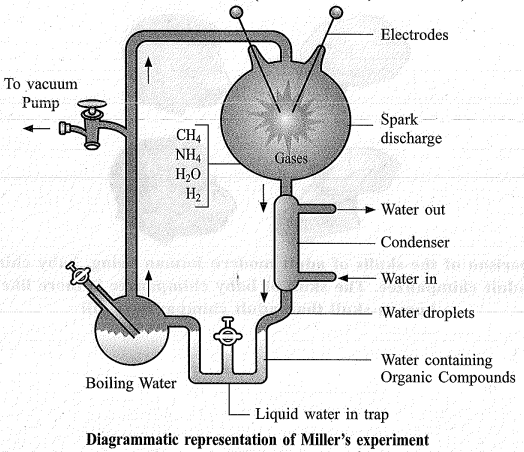
Explain Miller's experiment on origin of life with diagram.

Answer


Image
→ In 1953, an American scientist named S. L. Miller created in the laboratory a condition similar to the Earth's primordial atmosphere.
→ He mixed CH4, H2, NH3 and water vapour in a closed flask at a temperature of 800°C and arranged the electrodes and gave electric shocks. Then the mixture was cooled in the condenser and made a liquid.
→ He Collected the liquid in a separate flask.
→ After two weeks of the procedure, the fluid was analyzed by chromatography.
→ He found that amino acids were formed in it. Besides hydroxy acids (scientific name of H₂O) and aliphatic acids were also present.
→ Similarly, other scientists have observed in this type of experiment that sugars, nitrogen bases, pigments and fats were produced.
Need a full question paper?

Generate a complete, print-ready paper with questions like this in minutes — across 16+ boards, with answer keys.

Start Generating Free

Similar questions

Explain the role of tapetum in the formation pollen-grain wall.
Describe three important aspects of Biodiversity.###Explain the three important levels of biodiversity.
A species-area curve is drawn by plotting the number of species against the area. How is it that when a very large area is considered the slope is steeper than that for smaller areas?
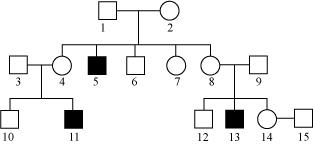
Haemophilia is a sex-linked recessive disorder of humans. The pedigree chart given below shows the inheritance of haemophilia in one family. Study the pattern of inheritance and answer the questions given.

  1. Give all the possible genotypes of the members 4; 5 and 6 in the pedigree chart.
  2. A blood test shows that the individual 14 is a carrier of haemophilia. The member numbered 15 has recently married the member numbered 14. What is the probability that their first child will be a haemophilia male?
Scutellum is the single cotyledon found in the monocot embryo only. Explain.
How did Louis Pasteur successfully demolish the popular theory of spontaneous generation?
'Sperm donation can help infertile couples'. Justify. In which type of cases, such sperm donation is helpful?
In the majority of angiosperms, the zygote divides by an asymmetric mitotic division and generates two cells. Discuss the fates of these cells.
What is the key difference between primary and secondary sewage treatment?
  1. Name the kind of diseases/ disorders that are likely to occur in humans if
    1. Mutation in the gene that codes for an enzyme phenyl alanine hydrolase occurs,
    2. There is an extra copy of chromosome 21,
    3. The karyotype is XXY.
  2. Mention any one symptom of the diseases/ disorders named above.