Question 13 Marks
Explain Miller's experiment on origin of life with diagram.
Answer
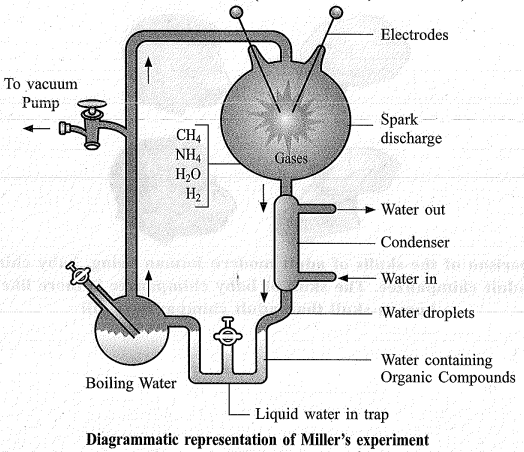
→ In 1953, an American scientist named S. L. Miller created in the laboratory a condition similar to the Earth's primordial atmosphere.
→ He mixed CH4, H2, NH3 and water vapour in a closed flask at a temperature of 800°C and arranged the electrodes and gave electric shocks. Then the mixture was cooled in the condenser and made a liquid.
→ He Collected the liquid in a separate flask.
→ After two weeks of the procedure, the fluid was analyzed by chromatography.
→ He found that amino acids were formed in it. Besides hydroxy acids (scientific name of H₂O) and aliphatic acids were also present.
→ Similarly, other scientists have observed in this type of experiment that sugars, nitrogen bases, pigments and fats were produced.
View full question & answer→→ In 1953, an American scientist named S. L. Miller created in the laboratory a condition similar to the Earth's primordial atmosphere.
→ He mixed CH4, H2, NH3 and water vapour in a closed flask at a temperature of 800°C and arranged the electrodes and gave electric shocks. Then the mixture was cooled in the condenser and made a liquid.
→ He Collected the liquid in a separate flask.
→ After two weeks of the procedure, the fluid was analyzed by chromatography.
→ He found that amino acids were formed in it. Besides hydroxy acids (scientific name of H₂O) and aliphatic acids were also present.
→ Similarly, other scientists have observed in this type of experiment that sugars, nitrogen bases, pigments and fats were produced.