Question
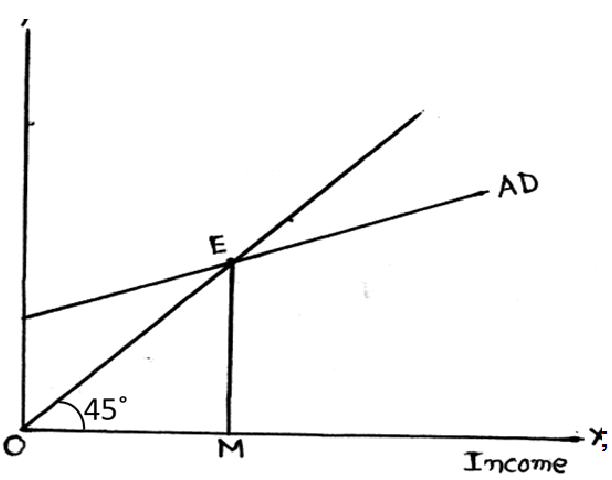
Explain national income equilibrium through aggregate demand and aggregate supply. Use diagram. Also explain the changes that take place in an economy when the economy is not in equilibrium.
Answer


The national income is in equilibrium when AD = AS. In the figure the equilibrium is at E, the intersection of the AD curve and the 45o line. The equilibrium income is OM.

When the economy is not in equilibrium AD is not equal to AS. Suppose AD>AS, will lead to fall in inventories with the producers. The producers in turn will produce more to reach the desired level of inventories: This raises AS till it becomes equal to AD.

Need a full question paper?

Generate a complete, print-ready paper with questions like this in minutes — across 16+ boards, with answer keys.

Start Generating Free

Similar questions

Explain effect of technological changes on supply of a product.
A consumer consumes only two goods X and Y whose prices are ₹ 4 and ₹ 5 per unit respectively. If the consumer chooses a combination of the two goods with marginal utility of X equal to 5 and that of Y equal to 4, is the consumer in equilibrium? Give reasons. What will a rational consumer do in this situation? Use utility analysis.
Calculate Gross Value Added at Factor Cost:
S. No.
 
(₹ in lakhs)
(i)
Units of output sold (units).
1,000
(ii)
Price per unit of output.
30
(iii)
Depreciation.
1,000
(iv)
Depreciation.
12,000
(v)
Closing stock.
3,000
(vi)
Opening stock.
2,000
(vii)
Excise duty.
2,500
(viiii)
Sales tax.
3,500
Explain the difference between (i) inferior goods and normal goods and (ii) cardinal utility and ordinal utility. Give example in each case.
A firm’s SMC schedule is shown in the following table. The total fixed cost of the firm is Rs 100. Find the TVC, TC, AVC and SAC schedules of the firm.
Q
SMC
0
1
2
3
4
5
6
-
500
300
200
300
500
800
Draw a hypothetical propensity to consume curve and from it draw the propensity to save curve.

OR

Explain the steps taken in derivation of the saving curve from the consumption curve. Use diagram.

Explain the role of the following in correcting the inflationary gap in an economy:
  1. Legal reserves
  2. Bank rate
With the help of a demand and supply schedule, explain the meaning of excess demand and its effect on price of a commodity.
Discuss briefly the meanings of:
  1. Fixed Exchange Rate.
  2. Flexible Exchange Rate.
  3. Managed Floating Exchange Rate.
Explain the concepts of the short run and the long run.