Question
Explain nitration of phenol in detail.

Answer

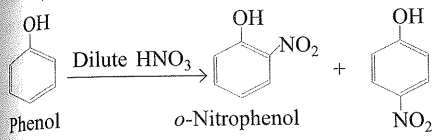
→ Nitration: With dilute nitric acid at low temperature (298 K), phenol yields a mixture of ortho and para nitrophenols.
Image
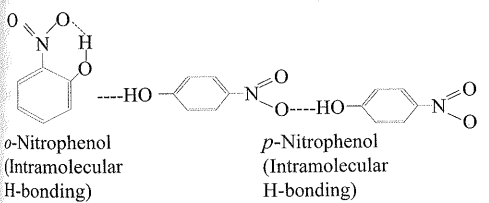
→ The ortho and para isomers can be separated by steam distillation. o-Nitrophenol is steam volatile due to intramolecular hydrogen bonding while p-nitrophenol is less volatile due to intermolecular hydrogen bonding which causes the association of molecules.
Image
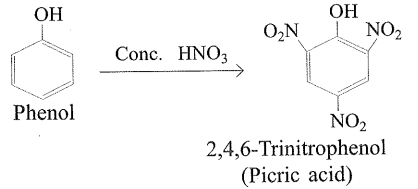
→ With concentrated nitric acid, phenol is converted to 2,4,6-trinitrophenol. The product is commonly known as picric acid. The yield of the reaction product is poor.
Image
→ Nowadays picric acid is prepared by treating phenol first with concentrated sulphuric acid which converts into phenol-2,4-disulphonic acid, and then with concentrated nitric acid to get 2,4,6-trinitrophenol.
Need a full question paper?

Generate a complete, print-ready paper with questions like this in minutes — across 16+ boards, with answer keys.

Start Generating Free

Similar questions

The electrochemical cell given alongside converts the chemical energy released during the redox reaction
$\text{Zn(s) + Cu}^{2+}\text{(aq)}\xrightarrow{ \ \ \ \ \ \ \ }\text{Zn}^{2+}(\text{aq) + Cu(s)}$
to electrical energy. It gives an electrical potential of $1.1V$ when concentration $Zn^{2+}$ and $Cu^{2+}$ ions is unity. State the direction of flow of current and also specify whether zinc and copper are deposited or dissolved at their respective electrodes when:
  1. An external opposite potential of less than $1.1V$ is applied.
  2. An external potential of $1.1V$ is applied.
  3. An external potential of greater than $1.1V$ is applied.
Calculate the molarity of 250 mL solution made by dissolving 5 g NaOH in water.
Calculate emf of the following cell at $25^\circ C:$
$Fe|Fe^{2+}(0.001M)||H^+(0.01M)|H_2(g) (1bar)|Pt(s)$
$E^o(Fe^{2+}| Fe) = –0.44 V E^o(H^+|H_2) = 0.00V$
Define the following as related to protein :
Primary structure
(a) Out of t-butyl alcohol and n-butanol, which one will undergo acid catalysed dehydration faster and why?
(b) Carry out the following conversions :
(i) Phenol to Salicylaldehyde
(ii) t-butylchloride to t-butyl ethyl ether
(iii) Propene to Propanol
Give reasons$:$
  1. $Mn$ shows the highest oxidation state of $+7$ with oxygen but with fluorine it shows the highest oxidation state of $+4.$
  2. Transition metals show variable oxidation states.
  3. Actinoids show irregularities in their electronic configurations.
Draw the structures of major monohalo products in each of the following reactions:
(1)
Image
(2)
Image
(3)
Image
  1. What type of isomerism is shown by the complex $\ce{[Co(NH_3)_5 (SCN)]^{2+}}$?
  2. Why is $\ce{[NiCl_4]^{2-}}$ paramagnetic while $\ce{[Ni(CN)_4]^{2-}}$ is diamagnetic? $($Atomic number of $Ni = 28)$
  3. Why are low spin tetrahedral complexes rarely observed?
Give reasons:
  1. The a $-$ hydrogen atoms of aldehydes and ketones are acidic in nature.
  2. Propanone is less reactive than ethanol toward addition of $\text{HCN}$.
  3. Benzoic acid does not give Friedal $-$ Crafts reaction.
For a weak electrolyte, molar conductance in dilute solution increases sharply as its concentration in solution is decreased. Give reason.