Question
Define the following as related to protein :
Primary structure

Answer

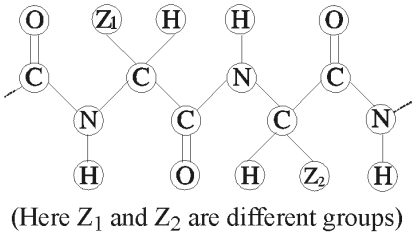
(i) Primary structure of protein : In proteins one or more polypeptide chains are present. In each polypeptide of a protein, amino acids are linked in specific and definite sequence. The specific sequence of amino acids is called the primary structure of proteins. This sequence varies in different proteins. Frederick Sanger (1953) was the first to determine the primary structure of insulin secreted by the pancreas.
Among the various amino acids present in a particular protein, replacement of one $\alpha$-amino acid with another $\alpha$ amino acid changes or destroys biochemical reactivity of that protein. Example : Disease sickel cell anemia is caused when glutamic acid in hemoglobin is replaced by valine. The primary structure of proteins can be represented by following figure :
Image

Need a full question paper?

Generate a complete, print-ready paper with questions like this in minutes — across 16+ boards, with answer keys.
Start Generating Free

Similar questions

Write the following reaction :
(i) Carbylamine reaction
(ii) Diazotization reaction
(iii) Hoffmann bromamide reaction
How does acetone reacts with $\ce{HCN}$ and $\ce{NaHSO_3}$?
In a reaction if the concentration of reactant $A$ is tripled, the rate of reaction becomes twenty seven times. What is the order of the reaction?
Draw figure to show the splitting of $d$ orbitals in an octahedral crystal field.
Calculate the molarity of each of the following solutions:
  1. $30\ g$ of $Co(NO_3)_2.\ 6H_2O$ in $4.3\ L$ of solution.
  2. $30\ mL$ of $0.5\ M\ H_2SO_4$ diluted to $500\ mL.$
Complte the following reaction : $\ce{C_6H_5 COOH + SOCI_2 \rightarrow}$
How can you convert?
  1. Toluene to Benzaldehyde.
  2. Ethanoic acid to 2-chloroethanoic acid.
  3. Acetone to Propane.
Predict the order of reactivity of the four isomeric bromobutanes in $S_N1$ and $S_N2$ reactions.
Give the structures of $A$ and $B$ in the following sequence of reactions:
  1. $\text{CH}_3\text{COOH}\xrightarrow[\Delta]{\text{NH}_3\ \ \ }\text{A}\ \ \ \xrightarrow{\text{NaOBr}}\text{B}$
  2. $\text{C}_6\text{H}_5\text{No}_2\xrightarrow{\text{Fe}/ \text{ HCl}}\text{A}\ \ \ \ \ \xrightarrow[0^\circ-5^\circ\text{C}]{\text{NaNo}_2+\text{HCl}}\text{B}$
  3. $\text{C}_6\text{H}_5\text{N}_2^+\text{Cl}^{-}\xrightarrow[\Delta]{\text{CuCN}}\text{A}\ \ \ \ \xrightarrow{\text{H}_2\text{O}/\text{ H}^+}\text{B}$
An organic compound gives hydrogen on reacting with sodium metal. It also gives iodofom test and the end product of its oxidation is ethanoic acid. Name the compound and give the equation of these reactions.