Question
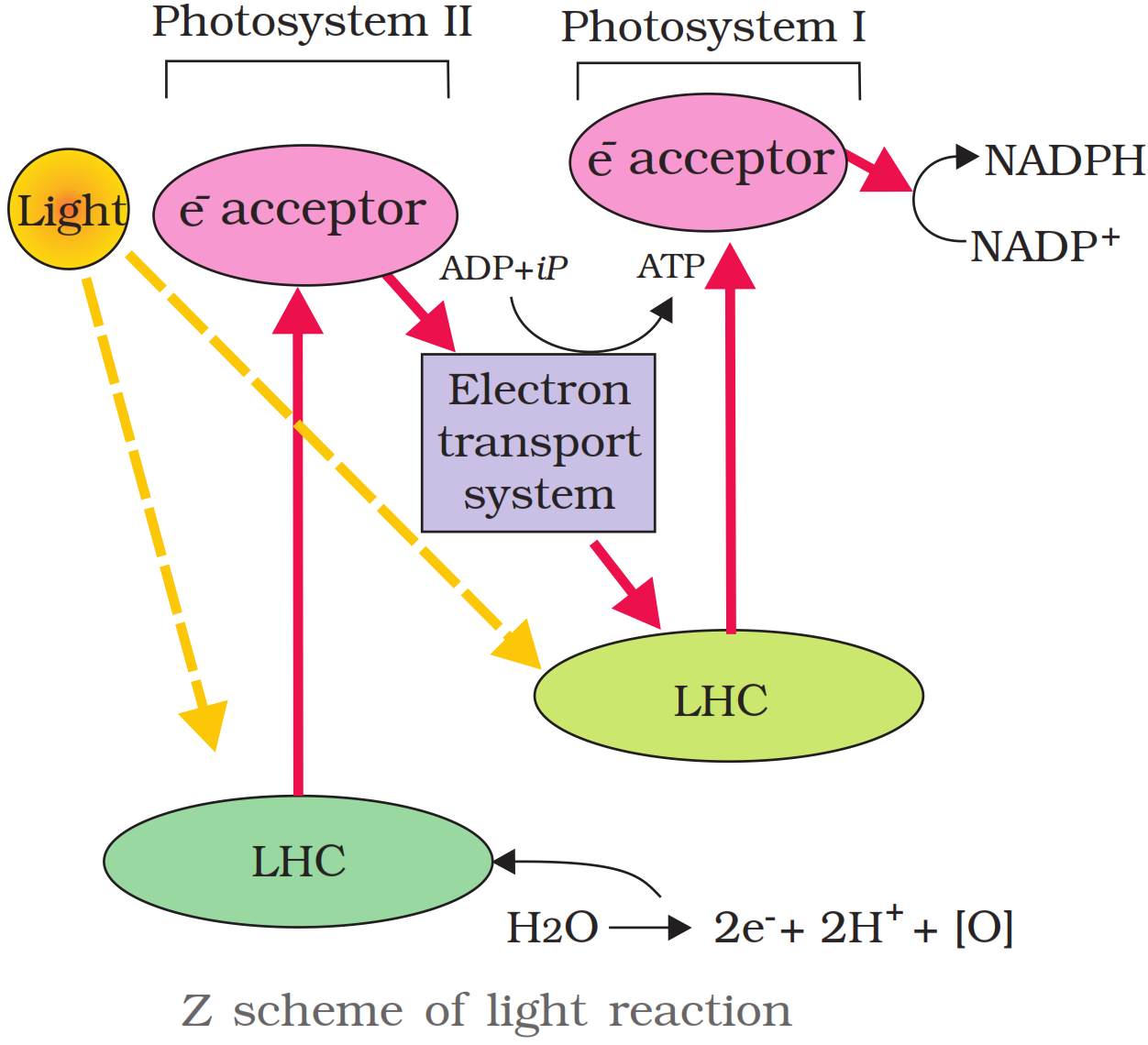
Explain non-cylic photophosphorylation in plants. Why is this process called so?OR
Where does non-cyclic photophosphorylation take place? Describe this process. Why is this process called so?
Answer

  • Non-cyclic photophosphorylation occurs in lamellae of grana.
  • It begins with the absorption of light by $P_{680}$ in PS II.
  • The electrons become excited and jump over into an orbit farther away from the atomic nucleus.
  • These electrons are picked up by the primary electron acceptor, which passes them into an electron transport system, consisting of cytochromes.
  • These electrons are not used by any component of the ETS, but are transferred to PS I.
  • Simultaneously, light of wavelength 700 nm is absorbed by PS I, which becomes excited and releases electrons.
  • These electrons are transferred to another electron acceptor, from where they are transferred to $NADP^+; NADP^+ $ is reduced (along with the protons formed by photolysis) to $NADPH + H^+$.
  • Both ATP and NADPH are formed during this electron flow.
  • Since the electrons lost from PS II do not return to PS II, but are replaced by those from water, the process is called non-cyclic.
  •  

Need a full question paper?

Generate a complete, print-ready paper with questions like this in minutes — across 16+ boards, with answer keys.

Start Generating Free

Similar questions

Does a group of smaller cells have a higher metabolic rate than a single large cell of the same volume? Explain.
Give the factors that govern the size of the cell.
Write semi-technical description of the family Liliaceae. Describe its economic importance.
Explain the difference between cilia and flagella. Draw a diagram and describe their internal structure.
Describe phylum Coelenterata. Give suitable examples.
Manish while performing a practical in laboratory on Grams stain observed that one type of bacteria stained dark blue or purple in colour, while the other type of bacteria did not retain the crystal violet dye even after staining again and again. Instead it keeps on loosing the dye on washing. He rushed to his teacher for showing the specimen.His teacher explained that there is nothing to get worried about. As different kinds ofbacteria are found.
  1. What is the basis of classifying bacteria.
  2. What is the basic difference between Gram positive and Gram negative bacteria.
  3. Name one Gram positive and one Gram negative bacteria.
  4. What values are shown by Manish's teacher?
Which glands are associated with the following diseases? Mention their names and the causes of the diseases :
1. Tetany, 2. Myxoedema, 3. Addison's disease, 4. Acromegaly, 5. Goitre, 6. Cones disease, 7. Diabetes, 8. Hashimoto's disease.
Describe the disorders related to respiration.
Describe the structure of the human eye with a well labeled diagram.
Explain the nature of enzyme action in detail.