Maharashtra BoardEnglish MediumSTD 12 ScienceChemistrySolid State4 Marks
Question
Explain nonstoichiometric defect.
✓
Answer
Nonstoichiometric defect : This defect arises when the ratio of number of one kind of atoms to that of other kind of atoms (or ratio of number of cations to anions) becomes different from the actual stoichiometric formula. This involves the change in stoichiometry of the compound. There are two types of nonstoichiometric defects as follows :
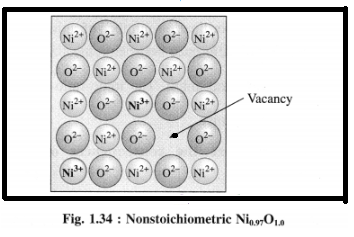
(1) Metal deficiency defect : This defect arises in compounds of metal which show variable oxidation states. In some metal crystals, positive metal ions are missing from their regular lattice sites. The extra negative charge is balanced by cations of the same metal with higher oxidation state than that of missing cation at site.
Consider a crystal of $NiO$. When one $Ni ^{2+}$ is missed from its lattice point, it creates a vacant site. The deficiency of two positive charges is compensated by two $Ni ^{3+}$ ions at other lattice points of $Ni ^{2+}$ ions and the composition of $NiO$ crystal becomes $Ni _{0.97} O _{1.0}$.
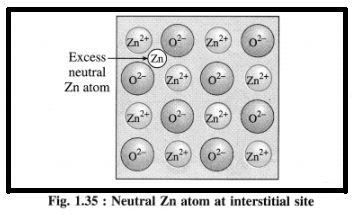
(2) Metal excess defect : There are two types of metal excess defect as follows: (a) Presence of a neutral atom or an extra positive ion at interstitial position:
There are two types or ways of metal excess defects in $ZnO$. In the first case, $Zn$ atom is present in the interstitial space as shown in figure.
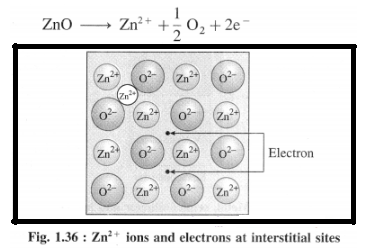
(b) Metal ions and electrons at interstitial sites: The second case arises when $ZnO$ is heated, $Zn ^{2+}$ and electrons are obtained,
The excess $Zn ^{2+}$ ions are trapped in interstitial sites in the crystal lattice. Electrons occupy interstitial sites by diffusing into the interstitial sites. In above both cases, the nonstoichiometric formula of $ZnO$ is $Zn _{1+x} O _{1.0}$
Need a full question paper?
Generate a complete, print-ready paper with questions like this in minutes — across 16+ boards, with answer keys.