Questions

Answer the following in detail.

Take a timed test

36 questions · self-marked practice — reveal the answer and mark yourself.

Question 14 Marks
How are the spheres arranged in first layer of simple cubic close-packed structures? How are the successive layers of spheres placed above this layer ?
Answer
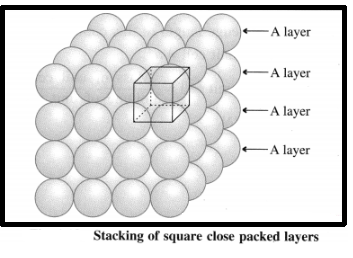
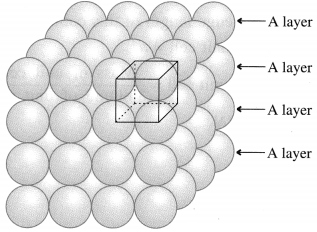
(i) Stacking of square close packed layers :

Image

Stacking of square close packed layers

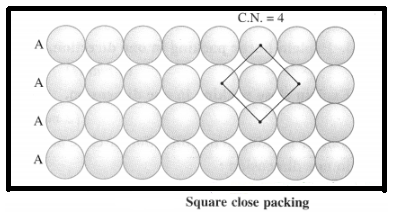
In this arrangement, the two dimensional AAAA type square closed packed layers are placed one over the other in such a way that the crests of all spheres are in contact with successive layers in all directions. All spheres of different layers are perfectly aligned horizontally and vertically forming unit cells having primitive or simple cubic structure. Since all the layers are identical and if each layer is labelled as layer A, then whole three dimensional crystal lattice will be of AAAA… type.

Each sphere is in contact with six surrounded spheres, hence the coordination number of each sphere is six.

(ii) Stacking of two hexagonal close packed layers :
A close packed three dimensional structure can be generated by arranging hexagonal close packed layers in a particular manner.

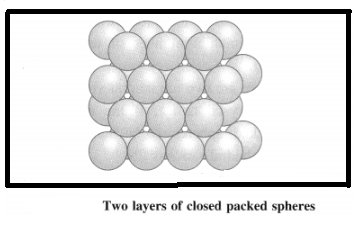
In this the spheres of second layer are placed in the depression of the first layer.
In this if first layer is labelled as A then second layer is labelled as B since they are aligned differently.

Two layers of closed packed spheres

In this, all triangular voids of the first layers are not covered by the spheres of the second layer. The triangular voids which are covered by second layer spheres generate tetrahedral void which is surrounded by four spheres. The triangular voids in one layer have above them triangular voids of successive layers.

The overlapping triangular voids from two layers together form an octahedral void which is surrounded by six spheres.
View full question & answer
Question 24 Marks
Distinguish between ionic solids and molecular solids.
Answer
Type/ Property Ionic solids Molecular solids
1. Particles of unit cell Cations and anions Monoatomic or polyatomic molecules
2. Interparticle forces Electrostatic London, dipole-dipole forces and/or hydrogen bonds
3. Hardness Hard and brittle Soft
4. Melting points High $600 ^\circ\ C$ to $3000 ^\circ\ C$ Low ($-272 ^\circ\ C$ to $400 ^\circ\ C$)
5. Thermal and electrical conductivity Poor electrical conductors in solid state. Good conductors when melted or dissolved in water. Poor conductor of heat and electricity
6. Examples $NaCl, CaF_2$ ice, benzoic acid
View full question & answer
Question 34 Marks
When $ZnO$ is heated it turns yellow and returns back to original white colour on cooling. What could be the reason ?
Answer
When colourless ZnO is strongly heated, the metal atoms are deposited on crystal surface and anions $O ^{2-}$ migrate to the surface producing vacancies at anion lattice points.
These anions combine with Zn atoms forming ZnO and release electrons.
$Zn+O^{2-} \rightarrow ZnO+2 e^{-}$
These released electrons diffuse into the crystal and occupy vacant sites of anions and produce F-centres. Due to these colour centres, ZnO turns yellow.
View full question & answer
Question 44 Marks
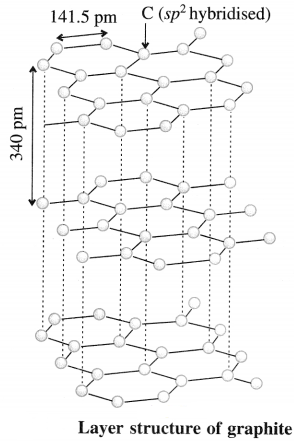
Graphite is a covalent solid yet soft and good conductor of electricity.
Answer

Image
  1. Each carbon atom in graphite is $sp^2$​​​​​​​ hybridised and covalently bonded to other three $sp2$ hybridised carbon atoms forming σ bonds and the fourth electron in $2p_z​​​​​​​$​​​​​​​ orbital of each carbon atom is used in the formation of a π bond. This results in the formation of hexagonal rings in two dimensions.
  2. In graphite, the layers consisting of hexagonal carbon network are held together by weak van der Waal’s forces imparting softness.
  3. The electrons in π bonds in the ring are delocalised and free to move in the delocalised molecular orbitals giving good electrical conductance.
View full question & answer
Question 54 Marks

Image

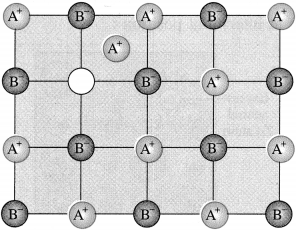
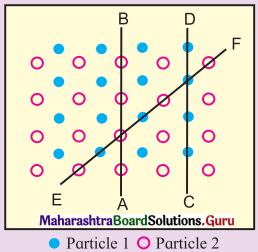
Observe the above figure carefully. The two types of circles in this figure represent two types of constituent particles of a solid.

Question 1.
Will you call the arrangement of particles in this solid regular or irregular ?

Question 2.
Is the arrangement of constituent particles in directions $\overrightarrow{ A B }, \overrightarrow{ C D }$ $\overrightarrow{ E F }$ same or different?

Answer
Answer 1: The arrangement of particles in this solid is regular.

Answer 2: $\overrightarrow{ A B }$ represents arrangement of identical particles of one type.
$\overrightarrow{ C D }$ represents arrangement of identical particles of another type.
$\overrightarrow{ E F }$ represents regular arrangement of two different particles in alternate positions.

View full question & answer
Question 64 Marks
What is an impurity defect? What are its types? Explain the formation of vacancies through aliovalent impurity with example.
Answer
Impurity defect : This defect arises when foreign atoms, that is, atoms different from the host atoms are present in the crystal lattice.There are two types of impurity defects namely
  1. Substitutional defects and
  2. Interstitial defects.
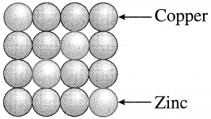
(1) Substitutional defects : These defects arises when foreign atoms occupy the lattice sites in place of host atoms, due to their displacements.
Examples : Solid solutions of metals (alloys). For example. Brass in which host atoms are of Cu which are replaced by impurity of Zn atoms. In this Zn atoms occupy regular sites while Cu atoms occupy substituted sites.
Image
Brass
Vacancy through aliovalent impurity :
By addition of impurities of aliovalent ions :
Image
Vacancy through aliovalent ion
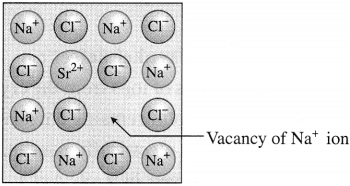
When aliovalent ion like $Sr ^{2+}$ in small amount is added by additing $SrCl _2$ to NaCl during its crystallisation, each $Sr ^{2+}$ ion (oxidation state $2+$ ) removes $2 Na ^{+}$ions from their lattice points, to maintain electrical neutrality. Hence one of vacant lattice site is occupied by $Sr ^{2+}$ ion while other site remains vacant.
Interstitial impurity defect:
Image
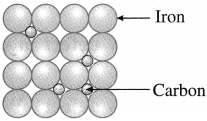
Stainless steel
A defect in solid in which the impurity atoms occupy interstitial vacant spaces of lattice structure is called interstitial impurity defect.
For example, in steel, normal lattice sites are occupied by Fe atoms but interstitial spaces are occupied by carbon atoms.
View full question & answer
Question 74 Marks
Explain with diagram. Frenkel defect. What are the conditions for its formation? What is its effect on density and electrical neutrality of the crystal?
Answer

Image
  1. Frenkel defect : This defect arises when an ion of an ionic compound is missing from its regular site and occupies interstitial vacant position between lattice points.
  2. Cations have smaller size than anions, hence generally cations occupy the interstitial sites.
  3. This creates a vacancy defect at its original position and interstitial defect at new position.
  4. Frenkel defect is regarded as the combination of interstitial defect and vacancy defect.
Conditions for the formation of Frenkel defect :
  1. This defect arises in ionic compounds with a large difference between the sizes of cation and anion.
  2. The ionic compounds must have ions with low coordination number.
Consequences of Frenkel defect :
  1. Since there is no loss of ions from the crystal lattice, the density of the solid remains unchanged.
  2. The crystal remains electrically neutral.
  3. This defect is observed in $ZnS, AgCl, AgBr, Agl, CaF_2$​​​​​​​, etc.
View full question & answer
Question 84 Marks
What are n-type semiconductors? Why is the conductivity of doped n-type semiconductor higher than that of pure semiconductor ? Explain with diagram.
Answer
n-type semiconductor:
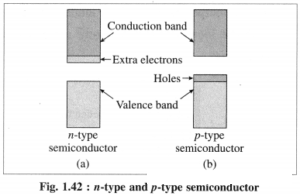
  • n-type semiconductor contains increased number of electrons in the conduction band.
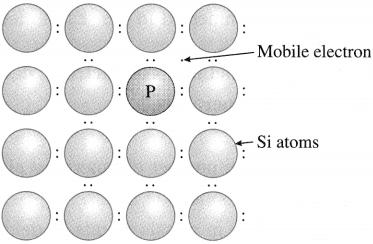
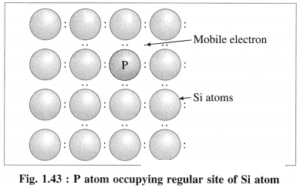
  • When Si semiconductor is doped with $15^{th}$​​​​​​​ group element phosphorus, P, the new atoms occupy some vacant sites in the lattice in place of Si atoms.
  • P has five valence electrons, out of which four are involved in covalent bonding with neighboring Si atoms while one electrons remains free and delocalised.
  • These free electrons increase the electrical conductivity of the semiconductor.
  • The semiconductors with extra non-bonding free electrons are called n-type semiconductors.
Image
P atom occupying regular site of Si atom.
View full question & answer
Question 94 Marks
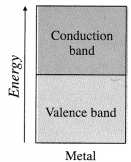
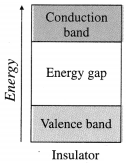
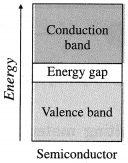
Distinguish with the help of diagrams metal conductors, insulators and semiconductors from each other.
Answer
Conductor:

  1. A substance which conducts heat and electricity to a greater extent is called conductor.
  2. In this, conduction bands and valence bands overlap or are very closely spaced.
  3. There is no energy difference or very less energy difference between valence bands and conduction bands.
  4. There are free electrons in the conduction bands.
  5. The conductance decreases with the increase in temperature.
  6. E.g., Metals, alloys.
  7. The conducting properties can’t be improved by adding third substance.

Image

Insulator:

  1. A substance which cannot conduct heat and electricity under any conditions is called insulator.
  2. In this, conduction bands and valence bands are far apart.
  3. The energy difference between conduction bands and valence bands is very large.
  4. There are no free electrons in the conduction bands and electrons can’t be excited from valence bands to conduction bands due to large energy difference.
  5. No effect of temperature on conducting properties.
  6. E.g., Wood, rubber, plastics.
  7. No effect of addition of any substance.

Image

Semiconductor:

  1. A substance that has poor electrical conductance at low temperature but higher conductance at higher temperature is called semiconductor.
  2. In this, conduction bands and valence bands are spaced closely.
  3. The energy difference between conduction bands and valence bands is small.
  4. The electrons can be easily excited from valence bands to conduction bands by heating.
  5. Conductance increases with the increase in temperature.
  6. E.g., Si, Ge
  7. By doping, conducting properties improve. E.g. n-type, p-type semiconductors.

Image

View full question & answer
Question 104 Marks
An element has a bcc structure with unit cell edge length of $288\ pm.$ How many unit cells and number of atoms are present in $200\ g$ of the element?
$(1.16 \times 10^{24}, 2.32 \times 10^{24})$
Answer
self
View full question & answer
Question 114 Marks
An element with molar mass $27\ g/mol$ forms cubic unit cell with edge length of 405 pm. If density of the element is $2.7\ g/cm^3$, what is the nature of cubic unit cell ? (fcc or ccp)
Answer
Given : Molar mass $= M =27 g mol ^{-1}$
Nature of crystal = cubic unit cell
Edge length $= a =405 pm =4.05 \times 10^{-8} cm$
Density $=\rho=2.7 g cm ^{-3}$
Nature of unit cell $=$ ?
$ \rho=\frac{n \times M}{a^3 \times N_{ A }}$
$\therefore  n=\frac{\rho \times a^3 \times N_{ A }}{M} \text { MaharashtraBoardSolutions.Guru }$
$ =\frac{2.7 \times\left(4.05 \times 10^{-8}\right)^3 \times 6.022 \times 10^{23}}{27}$
$=  3.997$
$\cong  4$
Hence the nature of unit cell = face-centred cubic unit cell
Radius of $Al$ atom $=125 pm$
The nature of cubic unit cell is fcc.
View full question & answer
Question 124 Marks
Third layer of spheres is added to second layer so as to form hcp or ccp structure. What is the difference between the addition of third layer to form these hexagonal close-packed structures?
Answer
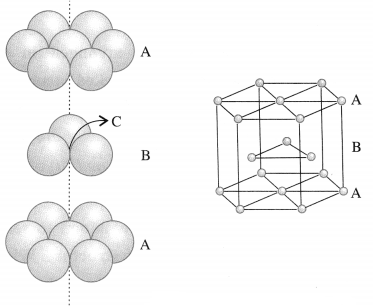
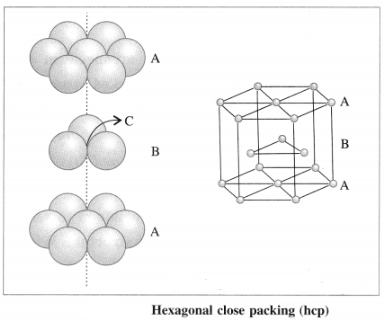
  1. In the formation of hexagonal closed-packed (hcp) structure, the first one dimensional row shows depressions between neighbouring atoms.
  2. When a second row is arranged so that spheres fit in these depressions then a staggered arrangement is obtained. If the first row is A then the second row is B.
  3. When third row is placed in staggered manner in contact with second row then A type arrangement is obtained.
  4. Similarly, the spheres in fourth row can be arranged as B type layer. This results in ABAB… type setting of the layers. This gives hexagonal close packing (hcp) structure.

Image

Hexagonal close packing (hcp)

View full question & answer
Question 134 Marks
How are tetrahedral and octahedral voids formed?
Answer
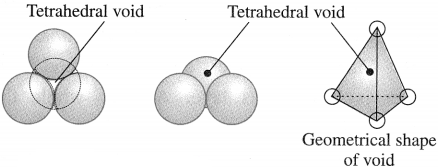
Tetrahedral void : The vacant space or void among four constituent particles having tetrahedral arrangement in the crystal lattice is called tetrahedral void.

Image

The arrangement of four spheres around the void is tetrahedral. A tetrahedral void is formed when a triangular void made by three coplanar spheres is in contact with fourth sphere above or below it.

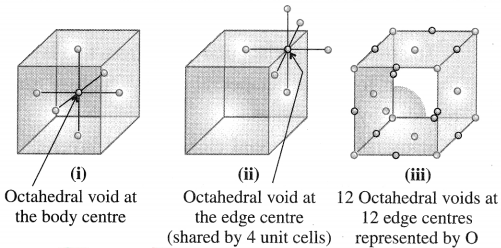
Octahedral void : The vacant space or void at the centre of six spheres (or atoms) which are placed octahedrally is called octahedral void.

Image

View full question & answer
Question 144 Marks
In an ionic crystalline solid atoms of element Y form hcp lattice. The atoms of element X occupy one third of tetrahedral voids. What is the formula of the compound?
Answer
In the given hcp lattice, Y atoms are present at 12 corners and 2 face centres. $\therefore$ Number of $Y$ atoms $=\frac{1}{2} \times 12+2 \times \frac{1}{2}=3$ There are 6 tetrahedral voids, the number of $X$ atoms $=\frac{1}{3} \times 6=2$ $\therefore$ Formula of the compound is $X_2 Y_3$.
View full question & answer
Question 154 Marks
Aluminium crystallizes in cubic close packed structure with unit cell edge length of $353.6\ pm$ . What is the radius of Al atom ? How many unit cells are there in $1.00 cm^3$ of Al ?
Answer
Given : Structure of AI
= Cubic close packed structure
= ccp structure
Edge length of unit cell $= a =353.6 pm$
$=3.536 \times 10^{-8} cm$
$r =$ ?
Number of unit cells in $1.00 cm^3$ of $AI =$ ?Radius of Al atom $=r=\frac{a}{2 \sqrt{2}}=\frac{353.6}{2 \sqrt{2}}=\frac{353.6}{2 \times 1.414}=125 pm$
Volume of one unit cell $=a^3=\left(3.536 \times 10^{-8}\right)^3=4.421 \times 10^{-23} cm^3$
Number of unit cells $=\frac{1.00}{4.421 \times 10^{-23}}=2.26 \times 10^{22}$
Radius of Al atom $=125 pm$
Number of unit cells $=2.26 \times 10^{22}$
View full question & answer
Question 164 Marks
The density of iridium is $22.4\ g/cm3$. The unit cell of iridium is fcc. Calculate the radius of iridium atom. Molar mass of iridium is $192.2\ g/mol$.
Answer
Given : Crystal structure of iridium $= fcc$
Molar mass of iridium $=192.2 gmol ^{-1}$
Density $=\rho=22.4 gcm ^{-3}$
Radius of iridium = ?
In fcc structure, there are 8 Ir atoms at 8 comers and 6 Ir atoms at 6 face centres.
$\therefore \text { Total number of } Ir \text { atoms }=\frac{1}{8} \times 8+\frac{1}{2} \times 6$
$=1+3$
$=4$
$\text { Mass of Ir atom }=\frac{192.2}{6.022 \times 10^{23}}=31.92 \times 10^{-23} g$
$\therefore \text { Mass of } 4 lr \text { atoms }=4 \times 31.92 \times 10^{-23}$
$=1.277 \times 10^{-21} g$
$\therefore \text { Mass of unit cell }=1.277 \times 10^{-21} g$
$\text { Density of unit cell }=\frac{\text { Mass of unit cell }}{\text { Volume of unit cell }}$
$22.4=\frac{1.277 \times 10^{-21}}{a^3}$
$\therefore a^3=\frac{1.277 \times 10^{-21}}{22.4}$
$=57 \times 10^{-24} cm^3$
$\therefore a=\left(57 \times 10^{-24}\right)^3=3.848 \times 10^{-8} cm$
If $r$ is the radius of iridium atom, then for fcc structure,
$r=\frac{a}{2 \sqrt{2}}$
$=\frac{3.848 \times 10^{-8}}{2 \times 1.414}$
$=1.36 \times 10^{-8} cm$
$=136\ pm$
Radius of iridium atom $=136\ pm$
View full question & answer
Question 174 Marks
Classify the following semiconductors into n or p-type.
(i) B doped with Si
(ii) As doped with Si
(iii) P doped with Si
(vi) Ge doped with In.
Answer
SemiconductorType
(i) B doped with Sip-type
(ii) As doped with Sin-type
(iii) P doped with Sin-type
(iv) Ge doped with Inp-type
View full question & answer
Question 184 Marks
Explain the origin of magnetic properties in solids.
Answer
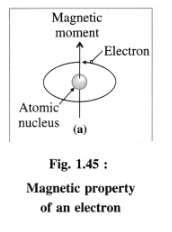
(1) The magnetic properties of a substance arise due to the presence of electrons in their atoms or molecules.

(2) The electrons while revolving around the nucleus in various orbits, also spin around their own axes. Both these motions of electrons result in generating magnetic field and magnetic moments. Hence electron be haves as a tiny magnet.
Image
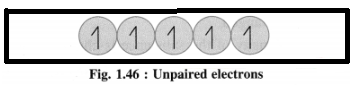
(3) An atomic orbital can accommodate maximum two electrons with opposite spins, clockwise and anticlockwise. The degenerate orbitals like p, d and f orbitals can accommodate electrons with same spins until they are half filled.

(4) When a substance contains one or more unpaired electrons spinning in same direction, then their magnetic moments and magnetic properties add and the substance is said to be paramagnetic.
Image
If a substance contains all electrons paired then their spins are balanced and magnetic moments and magnetic properties are cancelled and the substance is said to be diamagnetic.
View full question & answer
Question 194 Marks
Explain extrinsic semiconductor and doping.
Answer
$(1)$ A semiconductor obtained by doping intrinsic semiconductor with elements of third group and fifth group is called extrinsic semiconductor.
$(2)$ This extrinsic semiconductor has higher electrical conductivity than pure intrinsic semiconductor.
Image
$(3)$ There ate two types of extrinsic semiconductors:
$(A) \ n-$type semiconductors:
$(i) \ n-$type semiconductor contains increased number of electrons in the conduction band.
$(ii)$ When $Si$ semiconductor is doped with $15^{th}$ group element phosphorus, $P,$ the new atoms occupy some vacant sites in the lattice in place of $Si$ atoms.
Image
$(iii) \ P$ has five valence electrons, out of which four are involved in covalent bonding with neigh$-$bouring $Si$ atoms while one electrons remains free and delocalised.
$(iv)$ These free electrons increase the electrical conductivity of the semiconductor.
$(v)$ The semiconductors with extra non$-$bonding free electrons are called $n-$type semiconductors.
$(B) \ p-$type semiconductor :
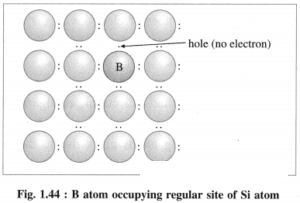
$(i) \ p-$type semiconductor is obtained by doping a pure semiconductor by an element of $13^{th}$ group like $B.$
$(ii) \ 13^{th}$ group element has less number of valence electrons. When pure $Si$ is doped with $B$ atoms, these atoms occupy $Si$ lattice points.
Image
$(iii)$ Boron $(_5B)$ has only $3$ valence electrons which form covalent bonds with the neighbouring $Si$ atoms, while one bond has shortage of one electron.
$(iv)$ This creates a vacancy or a hole, hence the electron from neighbouring $Si$ atom jumps into this hole creating a vacancy in itself. This process continues, i.e., positive holes move in one direction while
electrons moves in opposite direction.
$(v)$ Due to electron deficient positions, this semiconductor is called $p-$type semiconductor.
$(vi)$ When $p-$type semiconductor is connected to the external source of electricity, electrons from
neighbouring silicon atoms jump into the holes so that electrons move towards positive electrode and holes migrate towards negative electrode.
$(vii)$ Hence electrical conduction in $p-$type semiconductor is due to electrons and holes.
View full question & answer
Question 204 Marks
What are semiconductors ? Mention the types of semiconductors.
Answer
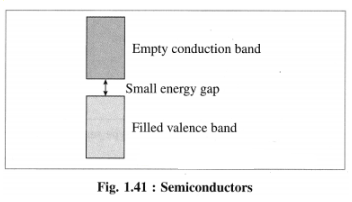
(1) Semiconductors : The substances like silicon, germanium which have poor electrical conductance at low temperature but the conductance increases with the increase in temperature are called semiconductors.

Image
(2) Their conductivity lies between metallic conductors and insulators.
(3) The energy difference between valence band and conduction band is relatively small, hence the electrons from valence band can be excited to conduction band by heating.

(4) Types of semiconductors : There are two types of semiconductors :
(a) Intrinsic semiconductor
(b) Extrinsic semiconductor

(a) Intrinsic semiconductor :
  • A pure semiconductor material like pure Si, Ge which have a very low but finite electrical conductivity is called intrinsic semiconductor.
  • The electrical conductivity of a semiconductor increases with the increase in temperature.
(b) Extrinsic semiconductor :
  • Semiconductor doped with different element is called extrinsic semiconductor.
  • By doping with elements like Ga or P, the electrical conductivity is increased.
View full question & answer
Question 214 Marks
Explain band theory.
###
Explain the origin of electrical properties in solids.
Answer
(1) Metals are good conductors of heat and electricity. This is explained on the basis of band theory which involves the presence of free electrons.

(2) According to band theory, the atomic orbitals of metal atoms overlap to form molecular orbitals which are spread all over the crystal structure.

(3) The energy difference between adjacent molecular orbitals decreases as the number of molecular orbitals increases and when it becomes very less, the orbitals merge into one another forming continuous bands which extent over the entire crystal.

(4) There are two types of bands of molecular orbitals as follows :
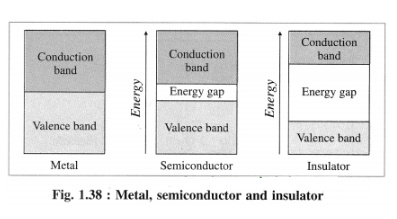
  • Valence band : The atomic orbitals with filled electrons from the inner shells form valence bands, where there are no free mobile electrons since they are involved in bonding.
  • Conduction band : Atomic orbitals which are partially filled or empty on overlapping form closely placed molecular orbitals giving conduction bands where electrons are delocalised and can conduct, heat and electricity.
(5) Band gap :
  • The energy difference between valence band and conduction band is called band gap.
  • Band gap decides whether electrons from valence band can be promoted to vacant conduction band or not.
  • The conductors like metals have very small or no band gap and electron can be promoted by thermal energy. The nonconductors have large band gap. The insulators have very large band gap.
Image
View full question & answer
Question 224 Marks
Explain nonstoichiometric defect.
Answer
Nonstoichiometric defect : This defect arises when the ratio of number of one kind of atoms to that of other kind of atoms (or ratio of number of cations to anions) becomes different from the actual stoichiometric formula. This involves the change in stoichiometry of the compound.
There are two types of nonstoichiometric defects as follows :

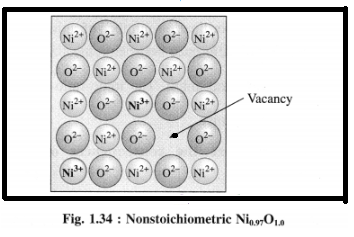
(1) Metal deficiency defect : This defect arises in compounds of metal which show variable oxidation states. In some metal crystals, positive metal ions are missing from their regular lattice sites. The extra negative charge is balanced by cations of the same metal with higher oxidation state than that of missing cation at site.

Image


Consider a crystal of $NiO$. When one $Ni ^{2+}$ is missed from its lattice point, it creates a vacant site.
The deficiency of two positive charges is compensated by two $Ni ^{3+}$ ions at other lattice points of $Ni ^{2+}$ ions and the composition of $NiO$ crystal becomes $Ni _{0.97} O _{1.0}$.

(2) Metal excess defect : There are two types of metal excess defect as follows:
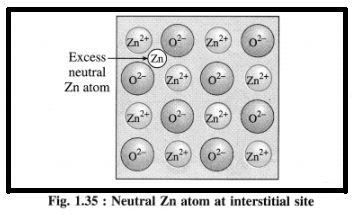
(a) Presence of a neutral atom or an extra positive ion at interstitial position:


Image

There are two types or ways of metal excess defects in $ZnO$. In the first case, $Zn$ atom is present in the interstitial space as shown in figure.

(b) Metal ions and electrons at interstitial sites:
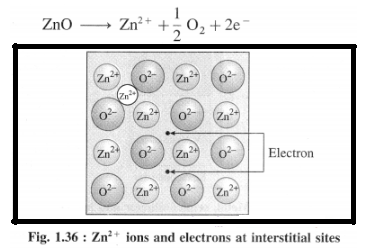
The second case arises when $ZnO$ is heated, $Zn ^{2+}$ and electrons are obtained,

Image

The excess $Zn ^{2+}$ ions are trapped in interstitial sites in the crystal lattice. Electrons occupy interstitial sites by diffusing into the interstitial sites.
In above both cases, the nonstoichiometric formula of $ZnO$ is $Zn _{1+x} O _{1.0}$
View full question & answer
Question 234 Marks
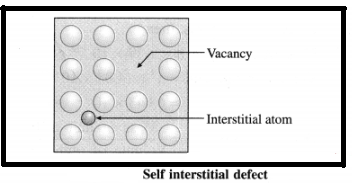
Explain self interstitial defect in elemental solid.
Answer
Self Interstitial defect in elemental solid : The empty spaces or voids in between the particles at lattice points represent interstitial defective sites or self interstitial defects.
This defect arises in the following two ways :

(1) An extra particle occupies the empty interstitial space. This extra particle is similar to those already present in the crystal.
(2) (i) A particle gets shifted from its original regular site to an empty interstitial space in the crystal.

Image

(ii) This displacement of a particle produces a vacancy defect at its regular site.
(iii) This defect is referred to as a combination of vacancy defect and self interstitial defect.
(iv) Since there is neither loss or gain in mass of the substance, the density of it remains unchanged.
View full question & answer
Question 244 Marks
Gold occurs as face centred cube and has a density of $19.30 kg dm ^{-3}$. Calculate atomic radius of gold. (Molar mass of $Au =197)$
Answer
Given : Density of $Au =19.3 kg dm ^{-3}$
Molar mass $=197 g mol ^{-1}$
Avogadro constant $= N _{ A }=6.022 \times 10^{23} mol ^{-1}$
Atomic radius of $Au =?$
In fcc unit cell, there are 8 atoms of Au at 8 comers and 6 atoms at 6 face centres.
Number of Au atoms in the unit cell $=\frac{1}{8} \times 8+\frac{1}{2} \times 6$
$=4$ atoms
Mass of $1 Au$ atom $=\frac{197}{6.022 \times 10^{23}}=3.271 \times 10^{-22} g$
$\therefore$ Mass of 4 Au atoms $=4 \times 3.271 \times 10^{-22} g =1.308 g \times 10^{-21} g$
$\therefore$ Mass of unit cell $=1.308 \times 10^{-21} g$
$\begin{aligned}
& \text { Density of the unit cell }=\frac{\text { Mass of unit cell }}{\text { Volume of unit cell }} \\
& \therefore \rho=\frac{1.308 \times 10^{-21}}{a^3} \\
& \therefore a^3=\frac{1.308 \times 10^{-21}}{\rho}=\frac{1.308 \times 10^{-24}}{19.3} \\
& =6.777 \times 10^{-24} dm 3 \\
& =6.777 \times 10^{-23} cm 3 \\
& \therefore a=\left(6.777 \times 10^{-23}\right)^{1 / 3}=\left(67.77 \times 10^{-24}\right)^{-1 / 3} \\
& =4.077 \times 10^{-8} cm \\
&
\end{aligned}$

If $r$ is the radius of $Au$ atom, then for $fcc$ unit cell,
$\begin{aligned}
& r =\frac{a}{2 \sqrt{2}} \\
& =\frac{4.077 \times 10^{-8}}{2 \sqrt{2}}=1.442 \times 10^{-8} cm =144.2 pm
\end{aligned}$

Ans. Radius of Au atom $=144.2 pm$.
View full question & answer
Question 254 Marks
Copper crystallises into a fcc structure and the unit cell has length of edge $3.61 \times 10^{-8} cm$. Calculate the density of copper. Atomic mass of copper is $63.5 g mol ^{-1}$.
Answer
Given : Crystalline structure of $Cu$ is $fcc$.
Edge length $=a=3.61 \times 10^{-8} cm$
Atomic mass of $Cu =63.5 g mol ^{-1}$
Avogadro number $=6.022 \times 10^{23} mol ^{-1}$
Density $= d =?$

In fcc structure, there are $8 Cu$ atoms at 8 comers and $6 Cu$ atoms at 6 face centres.
$\therefore$ Total number of $Cu$ atoms
$\begin{aligned}
& =\frac{1}{8} \times 8+\frac{1}{2} \times 6=1+3 \\
& =4
\end{aligned}$

Mass of one $Cu$ atom
$\begin{aligned}
& =\frac{63.5}{6.022 \times 10^{23}}=1.054 \times 10^{-22} g \\
& \therefore \text { Mass of } 4 Cu \text { atoms }=4 \times 1.054 \times 10^{-22} \\
& =4.216 \times 10^{-22} g
\end{aligned}$

Mass of unit cell $=$ Mass of $4 Cu$ atoms
$=4.216 \times 10^{-22} g$

Volume of unit cell $= a 3=\left(3.61 \times 10^{-8}\right) 3$
$=4.7 \times 10^{-24} cm ^3$

Density of unit cell $=\frac{\text { Mass of unit cell }}{\text { Volume of unit cell }}$
$\therefore \rho=\frac{4.216 \times 10^{-22}}{4.7 \times 10^{-23}}=8.97 g cm ^{-3}$

Ans. Density of $Cu =8.97 g cm ^{-3}$.
View full question & answer
Question 264 Marks
Niobium is found to crystallise with bcc structure and found to have density of $8.55 g \ cm ^{-3} (8.55 \ kg m ^{-3} )$. Determine the atomic radius of niobium if its atomic mass is $93.$
Answer
Given : Density of Niobium $(Nb)$ crystal $=8.55\ g \ cm ^{-3}$
Crystalline stmeture is $\text{bcc.}$
Atomic mass of $Nb =93 g mol ^{-1}$
Avogadro number $= N _{ A }=6.022 \times 10^{23} mol ^{-1}$
Atomic radius of Niobium $=?$
In bcc unit cell, there are $8$ atoms at $8$ comers and $1$ atom at the body centre.
$\therefore$ Number of $Nb$ atoms $=\frac{1}{8} \times 8+1=1+1=2$.
Mass of one $Nb$ atom $=\frac{93}{6.022 \times 10^{23}}=1.544 \times 10^{-22}$
$\therefore$ Mass of $2 Nb$ atoms $=2 \times 1.544 \times 10^{-22}=3.088 \times 10^{-22} g$
Mass of unit cell
$=$ Mass of $2 Nb$ atoms $=3.088 \times 10^{-22} g$
If  a is edge length of  $\text{bcc}$  unit cell, volume of unit cell $=a^3$
$\text { Density }=\frac{\text { Mass of unit cell }}{\text { Volume of unit cell }}$
$\rho=\frac{3.088 \times 10^{-22}}{a^3} \quad $
$\therefore a^3=\frac{3.088 \times 10^{-22}}{\rho}$
$=\frac{3.088 \times 10^{-22}}{8.55}$
$=0.361 \times 10^{-22} \ cm^3$
$=36.1 \times 10^{-24} \ cm^3$
$\therefore a=\left(36.1 \times 10^{-24}\right)^{-1 / 3}$
$=3.3 \times 10^{-8} \ cm$
If $r$ is the radius of $1\ Nb$ atom, then in $\text{bcc}$ structure
$r=\frac{\sqrt{3}}{4} a$
$=\frac{\sqrt{3}}{4} \times 3.3 \times 10^{-8}$
$=1.43 \times 10^{-8} \ cm$
$=1.43 \times 10^{-10} m$
$=1.43 \times 10^{-10} \times 10^9 \ nm$
$=0.143 \ nm$
Ans. Atomic radius of niobium atom $=0.143 \ nm$
View full question & answer
Question 274 Marks
Calculate the number of particles and unit cells in ‘x’ g of metallic crystal.
Answer
Consider ' $x$ ' gram of a metallic crystal of molar mass $M$ and density $\rho$. If the unit cell of the crystal has edge length ' $a$ ' then, volume of unit cell $=a^3$.
Mass of one metal atom $=\frac{M}{N_{ A }}$. If ' $n$ ' number of atoms are present in one unit cell then
Mass of unit cell $=\frac{n \times M}{N_{ A }}$
If ' $a$ ' is the edge length of the unit cell then, Volume of unit cell $=a^3$
Density of unit cell $=\rho=\frac{n \times M}{N_{ A }} \times \frac{1}{a^3}$
$\therefore M =\frac{\rho \times N_{ A } \times a^3}{n}$
$\because$ Molar mass $M$ gram contains $N _{ A }$ particles
$\therefore$ x gram contains $\frac{x \times N_{ A }}{M}$ particles.
Substituting the value $M$,

(i) Number of particles in $x g$ crystal
$\begin{aligned}
& =\frac{x \times N_{ A }}{\rho \times N_{ A } \times a^3 / n} \\
& =\frac{x \times n}{\rho \times a^3} \text { particles }
\end{aligned}$

(ii) Number of unit cells in $x g$ crystal :
$\because n$ particles are present in 1 unit cell
$\therefore \frac{x \times n}{\rho \times a^3}$ are present in, $\frac{x \times n}{\rho \times a^3} \times \frac{1}{n}$
$=\frac{x}{\rho \times a^3}$ unit cells

(iii) Number of unit cells in $V$ volume of crystal $=\frac{V}{a^3}$

Alternative method :
Consider ' $x$ ' $g$ metal of atomic mass $M g mol ^{-1}$.
Number of moles of metal $=\frac{x}{M}$
(a) Number of atoms (particles) of metal $=\frac{x}{M} \times N_{ A }$
(b) If unit cell contains ' $n$ ' atoms,
Number of unit cells $=\frac{x}{M} \times \frac{N_{ A }}{n}$
(c) If ' $a$ ' is the edge length then,
Volume of unit cells $=a^3$
$\therefore$ Number of unit cells in V volume of crystal $=\frac{IN}{a^3}$.
View full question & answer
Question 284 Marks
Calculate packing efficiency in face$-$centred cubic lattice.
Answer
Step $1 :$ Radius of sphere :
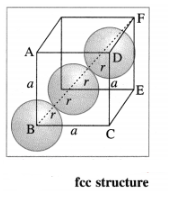
In the unit cell of face$-$centred cubic lattice, there $8$ atoms at $8$ corners and $6$ atoms at $6$ face centres. Consider the face $\text{ABCD}$.

Image
The atoms are in contact along the face diagonal $BD$. Let a be the edge length and $r$, the radius of an atom. Consider a triangle $B C D$.
$BD ^2= BC ^2+ CD ^2$
$ = a ^2+ a ^2=2 a$
$ \therefore BD =\sqrt{2} a$
From figure, $B D=4 r$
$\therefore 4 r =\sqrt{2} a$
$\therefore r =\frac{\sqrt{2}}{4} a=\frac{a}{2 \sqrt{2}}$
$r =\frac{a}{2 \sqrt{2}} \quad$
Step $2 :$ Volume of sphere :
$\text { Volume of one particle } =\frac{4}{3} \pi r^3$
$ =\frac{4 \pi}{3} \times\left(\frac{a}{2 \sqrt{2}}\right)^3$
$ =\frac{4}{3} \pi a^3\left(\frac{1}{2 \sqrt{2}}\right)^3$
$ =\frac{\pi a^3}{12 \sqrt{2}}$
Step $3 : $Total volume of particles :
The unit cell of fee crystal lattice contains 4 particles.
$\therefore \text { Volume occupied by } 4 \text { particles }=4 \times \frac{P i a^3}{12 \sqrt{2}}$
$=\frac{P i a^3}{3 \sqrt{2}}$
Step $4 :$ Packing efficiency :
$\text { Packing efficiency }$
$ =\frac{\text { Volume occupied by particles in unit cell }}{\text { Volume of unit cell }} \times 100$
$ =\frac{\pi a^3 / 3 \sqrt{2}}{a^3} \times 100$
$ =\frac{3.142}{3 \sqrt{2}} \times 100$
$ =74 \% \quad$
$\therefore$ Packing efficiency $=74 \%$
$\therefore$ Percentage of void space $=100-74$
$=26 \%$
Edge length and particle parameters in cubic system
Unit cell Relation between a and r Volume of one particle Total volume occupied by particles in unit cell
$1.$ scc $ r=a / 2=$
$ 0.5000 a$
$ \pi a^3 / 6=$
$ 0.5237 a^3$
$ \pi a^3 / 6=$
$ 0.5237 a^3$
$2.$ bec $r=\sqrt{3} a / 4$
$=0.4330 a$
$ \sqrt{3} \pi a^3 / 16$
$ =0.34 a^3$
$ \sqrt{3} \pi a^3 / 8$
$ =0.68 a^3$
$3.$ fcc/ccp $ r=\sqrt{2} a / 4=$
$ 0.3535 a$
$ \pi a^3 / 12 \sqrt{2}$
$ =0.185 a^3$
$ \pi a^3 / 3 \sqrt{2}$
$ =0.74 a^3$
Coordination number and packing efficiency in systems
Lattice Coordination number of atoms Packing efficiency
$1.$ scc $6 :$ four in the same layer, one directly above and one directly below $52.4\%$
$2.$ bec $8 :$ four in the layer below and four in the layer above $68 \%$
$3.$ fcc/ccp $12 :$ six in its own layer, three above and three below $74 \%$
View full question & answer
Question 294 Marks
Calculate packing efficiency in body-centred cubic lattice.
View full question & answer
Question 304 Marks
Explain close packing in three dimensions.
Answer
Close packing in three dimensions :
Three dimensional crystal structures are obtained by stacking of two dimensional layers. Simple cubic lattice is obtained by stacking of two dimensional square layers.
The stacking of two dimensional hexagonal close packed layers gives two structures namely hexagonal close packed (hcp) structure and face centred (fcc) structure.

(i) Stacking of square close packed layers :

Image

In this arrangement, the two dimensional AAAA type square closed packed layers are placed one over the other in such a way that the crests of all spheres are in contact with successive layers in all directions. All spheres of different layers are perfectly aligned horizontally and vertically forming unit cells having primitive or simple cubic structure. Since all the layers are identical and if each layer is labelled as layer A, then whole three dimensional crystal lattice will be of AAAA… type.

Each sphere is in contact with six surrounded spheres, hence the co-ordination number of each sphere is six.

(ii) Stacking of two hexagonal close packed layers :
A close packed three dimensional structure can be generated by arranging hexagonal close packed layers in a particular manner.
In this the spheres of second layer are placed in the depression of the first layer.
In this if first layer is labelled as A then second layer is labelled as B since they are aligned differently.

Image

In this, all triangular voids of the first layers are not covered by the spheres of the second layer. The triangular voids which are covered by second layer spheres generate tetrahedral void which is surrounded by four spheres. The triangular voids in one layer have above them triangular voids of successive layers.
The overlapping triangular voids from two layers together form an octahedral void which is surrounded by six spheres.
(iii) Placing third hexagonal close packed layer :
(a) Hexagonal close packing (hcp) : If the crests of spheres of third layer are placed on the triangular shaped tetrahedral voids C of the second layer, then three dimensional closest packing structure is obtained in which the spheres of third layer lie directly above the spheres of first layer, i.e., first and third layers are identical. Following same placing of layers, fourth layer will be identical to second layer.
If the first layer is labelled A and second layer B, then the arrangement of packing will be of ABAB type. This is also called hexagonal close packing (hcp) as shown in the figure. In this, packing efficiency is 74%. The coordination number of each sphere is 12. The metals Be. Mg, Zn, Cd crystallise in HCP crystalline structure.

Image

If first, second and third layers are labelled as A, B and C respectively then the arrangement of packing will be ABCABC type. This is also called cubic close packing (ccp) as shown in the figure. This is similar to face centred cubic (fcc) packing.
In this, arrangement packing efficiency is 74% and the coordination number of each sphere is 12.
View full question & answer
Question 314 Marks
Explain the following :
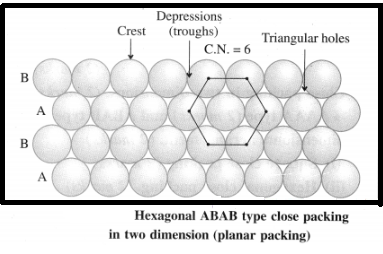
Planar packing arrangement of spheres.
OR
Close packing in two dimensions.
OR
AAAA type and ABAB type of two dimensional arrangement.
OR
(i) Square close packing
(ii) Hexagonal close packing.
Answer
Two dimensional close packing crystal structure can be generated by placing one dimensional linear crystal structure over another to form multiple layers. This staking of linear rows may be taking place in two different ways giving two different two dimensional structures as follows :

(i) ABAB type two dimensional close packing or square close packing :
In this arrangement, various one dimensional rows are placed on one over other so that each sphere in one row is over the another sphere of another row forming planar structure. In this, spheres have horizontal as well as vertical alignment. All the rows of spheres are identical in planar structure. All crests as well as all the depressions or troughs formed by the arrangement are also aligned.

Image

If the first row is labelled as A type, then second and all subsequent rows are also identical, hence are of A type. Therefore this planar two dimensional close packing is called AAAA type packing.

In this arrangement, each sphere is in contact with (or touching) four other spheres aroundit, hence the coordination number of each sphere is four and the packing is called two dimensional or planar square close packing. In this, packing efficiency is $5.4 \%$.


(ii) ABAB type two dimensional packing or hexag-onal close packing :

Image

In this arrangement, crests of the spheres of one row are placed into the depressions or troughs formed between adjacent spheres of next row. This arrangement is repeated consecutively throughout.

In this arrangement, crests of the spheres of one row are in contact with depressions or troughs of next row.

If one row of spheres is labelled as A then the next row will be B, third row will again be A, fourth row B and so on. Hence this planar or two dimensional close packing is called ABAB… type packing.

In this arrangement, each sphere is in contact with six other spheres around it hence the coordination number of each sphere is six and the packing is called two dimensional or planar hexagonal close packing. In this, the packing efficiency is $60.4 \%$ which is more than linear close packing.
View full question & answer
Question 324 Marks
Obtain a relation for the density of the unit cell and radius of atom or sphere for the following :
(1) Simple cubic (scc) crystal
(2) Body centred cubic (bcc) crystal
(3) Face centred cubic (fcc) crystal.
Answer
(1) Consider a unit cell of a simple cubic crystal. It has 8 atoms at 8 corners of the unit cell.
$\therefore$ Total number of atoms in unit cell $=\frac{1}{8} \times 8=1$
If $a$ is the length of edge of cubic unit cell and $r$ is the radius of the atom, then $r=a / 2$ or $a=2 r$. Volume of the unit cell $=a^3=(2 r)^3=8 r^3$
If $M$ is atomic mass of the element, then mass of one atom is $M / N_A$ where $N_A$ is Avogadro number. If there are $V$ atoms in one unit cell then,
Mass of unit cell $= n \times$ Mass of one atom $= n \times \frac{M}{N_{ A }}$
$\therefore$ Density $=\frac{\text { Mass of unit cell }}{\text { Volume of unit cell }}$
$\rho=\frac{n \times M / N_{ A }}{a^3} \quad \rho=\frac{n \times M}{N_{ A } \times a^3}$ 
Since there is one atom present in one unit cell,
$\rho=\frac{M}{N_{ A } \times a^3}$

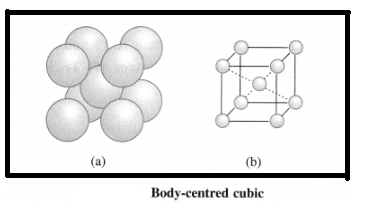
(2) Consider a unit cell of body centred cubic (bcc) crystal. It has 8 atoms at 8 comers and one additional atom at the centre of body of unit cell.
Number of atoms due to 8 corners $=\frac{1}{8} \times 8=1$
Body centred atom, wholly belong to the unit cell. Hence total number of atoms in the unit cell is two. If $M$ is atomic mass of an element then $M / N_A$ is mass of one atom where $N_A$ is Avogadro number.
Mass of unit cell = Mass of 2 atoms in unit cell $=2 M / N _{ A }$
If a is the edge length or lattice parameter then,
Volume of cubic unit cell $=a^3$
Density of unit cell $=\frac{\text { Mass of unit cell }}{\text { Volume of unit cell }}$
$\rho=\frac{2 M / N_{ A }}{a^3} \quad \therefore \rho=\frac{2 M}{N_{ A } a^3} $


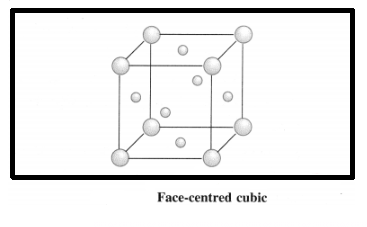
(3) Consider a unit cell of face centred cubic (fcc) crystal.
It has 8 atoms at 8 comers and 6 atoms at 6 face centres.
$\therefore$ Total number of atoms in unit cell $=\frac{1}{8} \times 8+\frac{1}{2} \times 6=1+3=4$
If $M$ is the atomic mass of an element, then mass of one atom is $M / N_A$, where $N_A$ is Avogadro number. Mass of unit cell $=$ Mass of 4 atoms
$=4 \times \frac{M}{N_{ A }}$ If $a$ is the edge length of this cubic unit cell then, volume of unit cell $=a^3$
Density of unit cell $=\frac{\text { Mass of unit cell }}{\text { Volume of unit cell }}$
$\rho=\frac{4 \times M / N_{ A }}{a^3}$
$\rho=\frac{4 M}{N_{ A } a^3}$ 
View full question & answer
Question 334 Marks
Find the number of atoms per unit cell in the following crystal structures.
(1) Simple cubic unit cell
(2) Body-centred cubic unit cell
(3) Face-centred cubic cell.
Answer
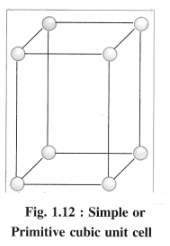
(1) Number of atoms in primitive simple cubic (scc) unit cell :
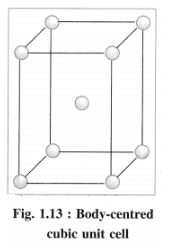
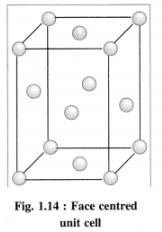
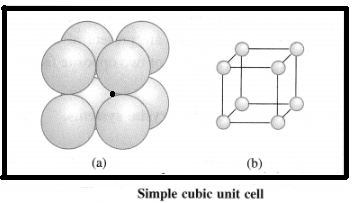
Image
In simple or primitive cubic unit cell, there are 8 atoms at 8 corners. Each corner contributes $1 / 8$ th atom to the unit cell.
$\therefore$ Number of atoms present in the unit cell $=\frac{1}{8} \times 8=1$
Hence the volume of the unit cell is equal to the volume of one atom.

(2) Number of atoms in body-centred cubic (bcc) unit cell:
Image
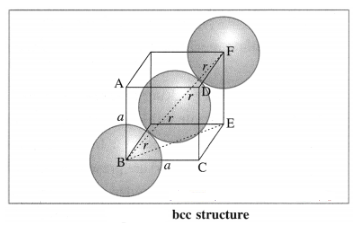
In this unit cell, there are 8 atoms at 8 corners and one additional atom at the body centre. Each corner contributes $1 / 8$ th atom, to the unit cell, hence due to 8 corners.
Number of atoms $=8 \times \frac{1}{8}$ $=1$ atom.
An atom at the body centre wholly belongs to the unit cell.
$\therefore$ Total number of atoms present in bcc unit cell $=1+1=2$.
Hence the volume of unit cell is equal to the volume of two atoms.

(3) Number of atoms in face-centred cubic (fcc) unit cell :
Image
In this unit cell, there are 8 atoms at 8 comers and 6 atoms at 6 face centres. Each corner contributes $1 / 8$ th atom to the unit cell, hence due to 8 corners, Number of atoms $=\frac{1}{8} \times 8=1$.
Each face centre contributes half of the atom to the unit cell, hence due to 6 face centres, Number of atoms $=\frac{1}{2} \times 6=3$.
$\therefore$ Total number of atoms present in fee unit cell $=1+3=4$.
Hence the volume of the unit cell is equal to the volume of four atoms.
View full question & answer
Question 344 Marks
Explain Bravais lattices of a cubic system.
###
Explain unit cells of a cubic system.
Answer
Cubic lattice : For this, edges are $a=b=c$ and angles are $\alpha=\beta=\gamma=90^{\circ}$. In this cubic system, there are three Bravais lattices.
(1) Simple (or primitive) cubic unit cell (SCC) : In this unit cell, atoms are present only at 8 corners of the cube.
Image

(2) Body-centred cubic unit cell (BCC) : In this, atoms are present at 8 corners along with one additional atom at the body-centre of the cube.
Image

(3) Face-centred cubic unit cell (FCC) : In this unit cell, atoms are present at 8 comers and at 6 face centres.

Image
View full question & answer
Question 364 Marks
Classify the following solids into different types:
(i) Plastic (ii) $P _4$ molecule (iii) $S _8$ molecule (iv) lodine molecule (v) Tetra phosphorus decoxide (vi) Ammonium phosphate (vii) Brass (viii) Rubidium (ix) Graphite (x) Diamond (xi) $NaCl$ (xii) Silicon.
View full question & answer