Question
Explain nuclear energy.

Answer

Image

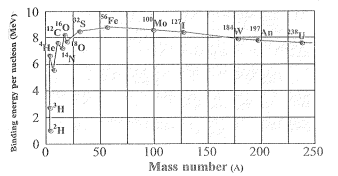
The curve of binding energy per nucleon versus mass number A is shown in figure.
The binding energy per nucleon is nearly constant ( 8 MeV ) in the region between $A =30$ to $A =170$.
For the lighter nuclei region $A <30$ and for the heavier nuclei region $A >170$ the binding energy per nucleon is less than 8.0 MeV .
If nuclei with less total binding energy transform to nuclei with greater binding energy there will be a net energy release.
"When a heavy nucleus decays into two or more intermediate mass fragments, then the total binding energy increases. Energy is released during this process. This process is called nuclear fission".
→"When two or more light nucleus fuse into heavier nucleus then also the total binding energy increases. Due to this energy is realeased during this process. This process is called nuclear fusion".
Exothermic chemical reactions underlie conventional energy sources such as coal or petroleum. Here the energies involved are in the range of electron volts. On the other hand, in a nuclear reaction, the energy release is of the order of MeV .
Thus for the same quantity of matter, nuclear sources produce a million $\left(10^6\right)$ times more energy than a chemical source.
For example :
Fission of 1 kg of uranium generates $10^{14} J$ of energy compare it with burning of 1 kg of coal that give $10^7 J$.

Need a full question paper?

Generate a complete, print-ready paper with questions like this in minutes — across 16+ boards, with answer keys.

Start Generating Free

Similar questions

12J of work has to be done against an existing electric field to take a charge of 0.01C from A to B. How much is the potential difference $V_B- V_A$?
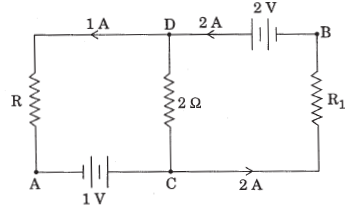
In the given circuit, assuming point A to be at zero potential, use Kirchhoff's rules to determine the potential at point B.
Write a short note : Size of the nucleus
###
How the radius of the nucleus is estimated?
Explain.
Is it possible to add two vectors of unequal magnitudes and get zero? Is it possible to add three vectors of equal magnitudes and get zero?
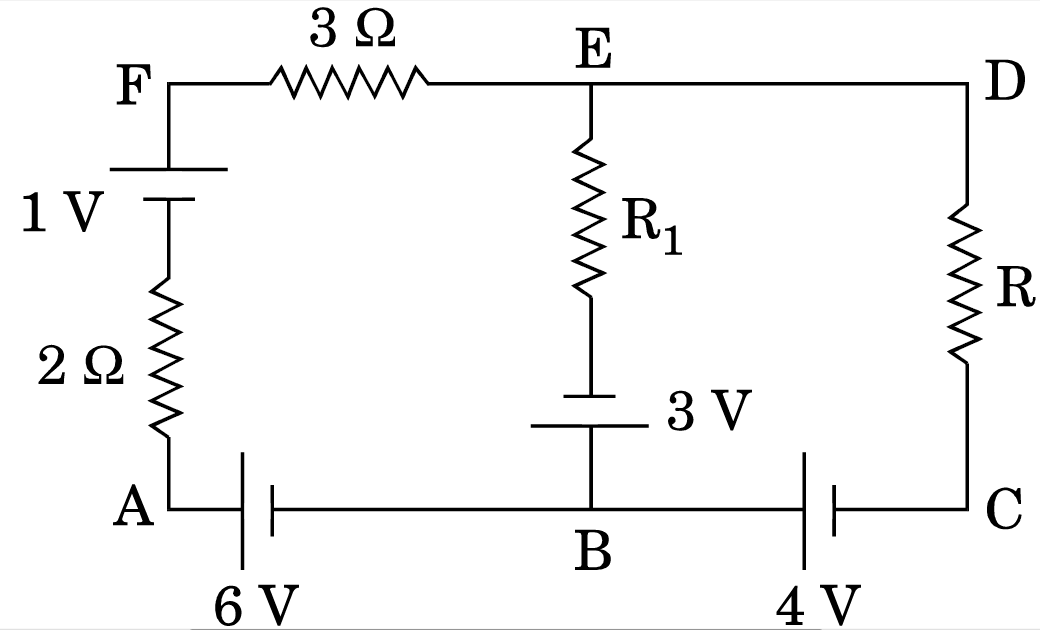
Use Kirchhoff ’s rules to determine the potential difference between the points A and D when no current flows in the arm BE of the electric network shown in the figure.
Answer the following question:
You have learnt that plane and convex mirrors produce virtual images of objects. Can they produce real images under some circumstances? Explain.
Explain : Why we can consider quantisation of charge for microscopic level but not for macroscopic level ?
Light is incident from glass $(\mu=1.5)$ to air. Sketch the variation of the angle of deviation $\delta$ with the angle of incident i for 0 < i < 90°.
Establish the relationship between the intensity $\overrightarrow{ E }$ of the electric field and the electric potential V.
A block of mass 2kg is pushed against a rough vertical wall with a force of 40N, coefficient of static friction being 0.5. Another horizontal force of 15N, is applied on the block in a direction parallel to the wall. Will the block move? If yes, in which direction? If no, find the frictional force exerted by the wall on the block.