Question
Explain : Why we can consider quantisation of charge for microscopic level but not for macroscopic level ?

Answer

►The size of e is, however, very small because at the macroscopic level, we deal with charges of a few $\mu C$.
►At this scale the fact that charge of a body can increase or decrease in units of $e$ is not visible.
►In this respect, the particle nature of the charge is lost and it appears to be continuous. This situation can be compared with the geometrical concepts of points and lines. A dotted line viewed from a distance appears continuous to us but is not continuous in reality. As many points very close to each other normally give an impression of a continuous line, many small charges taken together appear as a continuous charge distribution.
►At the macroscopic level, one deals with charges that are enormous compared to the magnitude of charge $e$. Since $e=1.6 \times 10^{-19} C$, a charge of magnitude, say $1 \mu C$, contains something like $10^{13}$ times the electronic charge.
►At this scale, the fact that charge can increase or decrease only in units of $e$ is not very different from saying that charge can take continuous values.
►Thus, at the macroscopic level, the quantisation of charge has no practical consequence and can be ignored. However, at the microscopic level, where the charges involved are of the order of a few tens or hundreds of e, i.e., they can be counted, they appear in discrete lumps and quantisation of charge cannot be ignored.

Need a full question paper?

Generate a complete, print-ready paper with questions like this in minutes — across 16+ boards, with answer keys.

Start Generating Free

Similar questions

Sketch the magnetic field lines for a current-carrying circular loop near its centre. Replace the loop by an equivalent magnetic dipole and sketch the magnetic field lines near the centre of the dipole. Identify the difference.
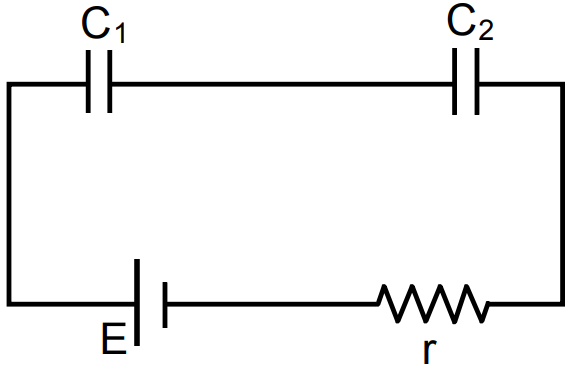
Consider the situation shown in figure. The switch is closed at t = 0 when the capacitors are uncharged. Find the charge on the capacitor $C_1$ as a function of time t.
A nearsighted person cannot clearly see beyond 200cm. Find the power of the lens needed to see objects at large distances.
Explain the lateral shift for a ray refracted from a glass slab with parallel sides.
Given a uniform electric field$\overrightarrow{\text{E}}: 4 \times 10^3  \hat{i}$ N/C, find the flux of this field through a square of 5cm on a side whose plane is parallel to the y-z plane. What would be the flux through the same square if the plane makes a $30^{\circ}$ angle with the x-axis?
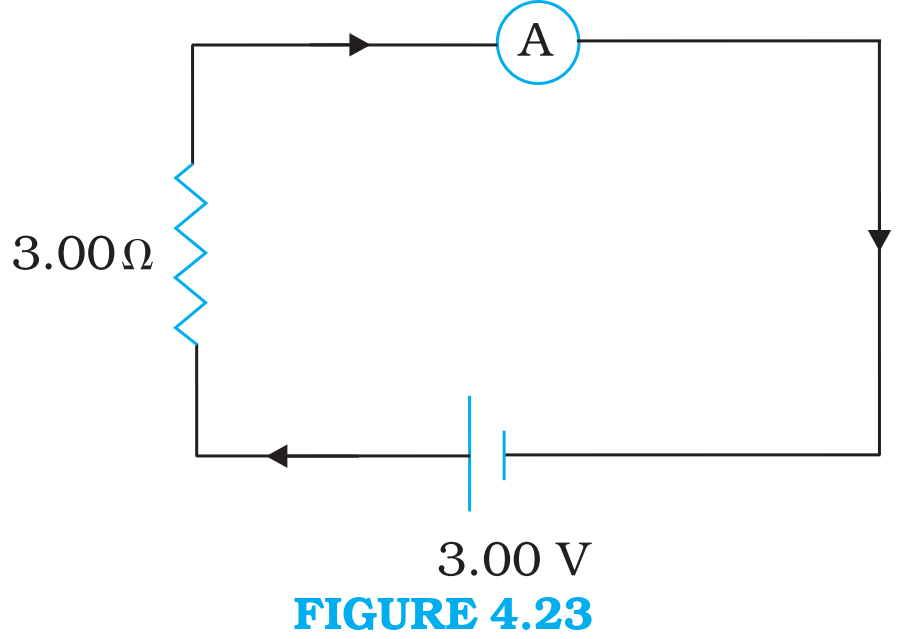
In the circuit (Fig. 4.23) the current is to be measured. What is the value of the current if the ammeter shown (a) is a galvanometer with a resistance $R_G=60.00 \Omega$; (b) is a galvanometer described in (a) but converted to an ammeter by a shunt resistance $r_s=0.02 \Omega$; (c) is an ideal ammeter with zero resistance?
Image
Define the term 'Half-life' of a radioactive substance. Two different radioactive substances have half-lives $T_1$ and $T_2$ and number of undecayed atoms at an instant, $\mathrm{N}_1$ and $\mathrm{N}_2$, respectively. Find the ratio of their activities at that instant.
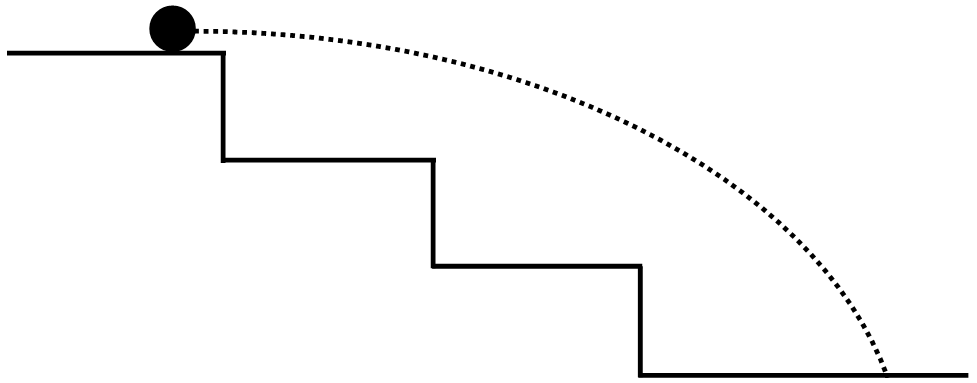
A staircase contains three steps each 10cm high and 20cm wide (figure). What should be the minimum horizontal velocity of a ball rolling off the uppermost plane so as to hit directly the lowest plane?
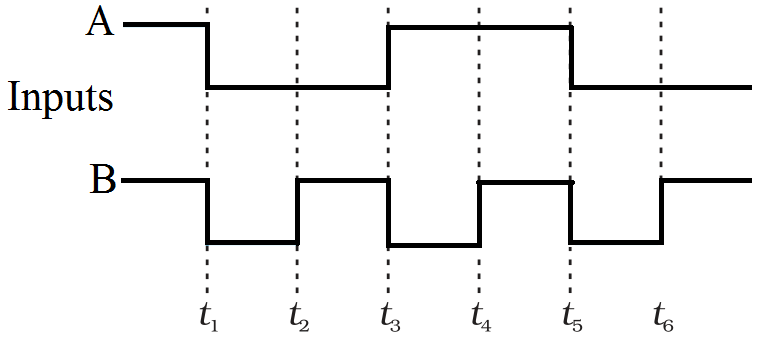
The given inputs A and B are fed to 2-inputs NAND gate. Draw the output waveform of the gate.
Spring fitted doors close by themselves when released. You want to keep the door open for a long time, say for an hour. If you put a half kg stone in front of the open door, it does not help. The stone slides with the door and the door gets closed. However, if you sandwitch a 20g piece of wood in the small gap between the door and the floor, the door stays open. Explain why a much lighter piece of wood is able to keep the door open while the heavy stone fails.