Question
Explain nuclear energy.

Answer

Image

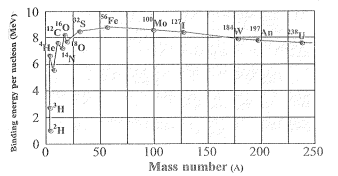
The curve of binding energy per nucleon versus mass number A is shown in figure.
The binding energy per nucleon is nearly constant ( 8 MeV ) in the region between $A =30$ to $A =170$.
For the lighter nuclei region $A <30$ and for the heavier nuclei region $A >170$ the binding energy per nucleon is less than 8.0 MeV .
If nuclei with less total binding energy transform to nuclei with greater binding energy there will be a net energy release.
"When a heavy nucleus decays into two or more intermediate mass fragments, then the total binding energy increases. Energy is released during this process. This process is called nuclear fission".
→"When two or more light nucleus fuse into heavier nucleus then also the total binding energy increases. Due to this energy is realeased during this process. This process is called nuclear fusion".
Exothermic chemical reactions underlie conventional energy sources such as coal or petroleum. Here the energies involved are in the range of electron volts. On the other hand, in a nuclear reaction, the energy release is of the order of MeV .
Thus for the same quantity of matter, nuclear sources produce a million $\left(10^6\right)$ times more energy than a chemical source.
For example :
Fission of 1 kg of uranium generates $10^{14} J$ of energy compare it with burning of 1 kg of coal that give $10^7 J$.

Need a full question paper?

Generate a complete, print-ready paper with questions like this in minutes — across 16+ boards, with answer keys.
Start Generating Free

Similar questions

A wire forming a loop is dipped into soap solution and taken out so that a film of soap solution is formed. A loop of $6.28\ cm$ long thread is gently put on the film and the film is pricked with a needle inside the loop. The thread loop takes the shape of a circle. Find the tension in the thread. Surface tension of soap solution $= 0.030\ N/m$.
An $\alpha$-particle moving with initial kinetic energy $K$ towards a nucleus of atomic number $Z$ approaches a distance $d$ at which it reverses its direction. Obtain the expression for the distance of closest approach $d$ in terms of the kinetic energy of $\alpha$-particle $K$.
The north pole of a magnet is brought down along the axis of a horizontal circular coil. As a result, the flux through the coil changes from 0.35 weber to 0.86 weber in an interval of half a second. Find the average emf induced during this period. Is the induced current clockwise or anticlockwise as you look into the coil from the side of the magnet?
Draw equipotential surface due to the following :(i) Any electric dipole(ii) Two identical positive charges separated by some distance.
Answer the following questions: The angle subtended at the eye by an object is equal to the angle subtended at the eye by the virtual imae produced by a magnifying glass. In what sense then does a magnifying glass provide angular magnification?
Water flows through a horizontal tube as shown in If the difference of heights of water column in the vertical tubes is $2\ cm,$ and the areas of cross-section at $A$ and $B$ are $4\ cm^2$ and $2\ cm^2$ respectively, find the rate of flow of water across any section.
Two conducting spheres of radii $R_1$ and $R_2$ are kept widely separated from each other. What are their individual capacitances? If the spheres are connected by a metal wire, what will be the capacitance of the combination? Think in terms of series$-$parallel connections.
The electric field intensity and electric potential at a point due to a point charge are 30 Newton/ Coulomb and 15 Joule/Coulomb respectively. Find (i) the distance of the charge from the observation point and (ii) the magnitude of the charge.
A monochromatic light source of frequency $ 6\times10^{14} $ Hz emitts $ 2\times10^{-3} $ Joule energy per second. Calculate the number of photons emitted by the source per second.
  1. Find the first excitation potential of $He^+$ ion.
  2. Find the ionization potential of $Li^{++}$ ion.