Question 12 Marks
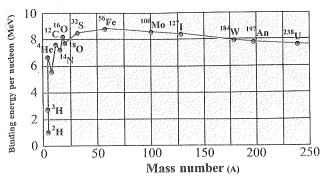
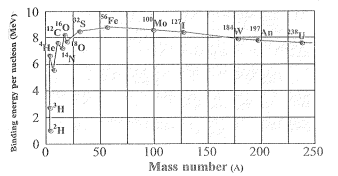
What is mass defect? Explain binding energy of the nucleus and the binding energy per nucleon.
Explain binding energy of nucleus.
Explain binding energy of nucleus.
Answer
View full question & answer→$\rightarrow$ The nucleus is made up of neutrons and protons.
Therefore, it may be expected that the mass of the nucleus is equal to the total mass of its individual protons and neutrons.
$\rightarrow$ But the nuclear mass $M$ is found to be always less than the total mass of its individual protons and neutrons.
$\rightarrow$ For example :
${ }_8 O ^{16}$, a nucleus which has $8$ neutrons and $8$ protons.
Mass of $8$ neutrons $=8 \times 1.00866 u$
Mass of $8$ protons $=8 \times 1.00727 u$
Mass of $8$ electrons $=8 \times 0.00055 u$
$\rightarrow$ Therefore, the expected mass of ${ }_8 O ^{16}$ nucleus
$=(8 \times 1.00866+8 \times 1.00727)$
$=8(1.00866+1.00727)$
$=8 \times 2.01593 u$
$=16.12744 u$
$\rightarrow$ The atomic mass of ${ }_8 O ^{16}$ found from mass spectroscopy experiments is seen to be $15.99493 u$
$\rightarrow$ Subtracting the mass of $8$ electrons $(8 \times 0.00055 u=0.0044 u)$ from this we get the experimental mass of ${ }_8 O ^{16}$ nucleus to be $15.99053 u$.
$\rightarrow$ Thus, the mass of the ${ }_8 O ^{16}$ nucleus is less than the total mass of its constituents by
$(16.12744-15.99053)=0.13691 u \text {. }$
$\rightarrow$ "The difference in mass of a nucleus and its constituents, $\Delta M$ is called the mass defect" and is given by
$\Delta M =\left[ Z m_p+( A - Z ) m_n\right]- M$
Where$, Z =$ number of protons
$A - Z = N =$ neutron number
$m_p-$ mass of proton
$m_n-$ mass of neutron
$M -$mass of a nucleus
$\rightarrow$ The energy equivalent to this mass defect is called the binding energy of nucleus.
$\therefore$ Binding energy $E _b=\Delta M c^2$
Therefore, it may be expected that the mass of the nucleus is equal to the total mass of its individual protons and neutrons.
$\rightarrow$ But the nuclear mass $M$ is found to be always less than the total mass of its individual protons and neutrons.
$\rightarrow$ For example :
${ }_8 O ^{16}$, a nucleus which has $8$ neutrons and $8$ protons.
Mass of $8$ neutrons $=8 \times 1.00866 u$
Mass of $8$ protons $=8 \times 1.00727 u$
Mass of $8$ electrons $=8 \times 0.00055 u$
$\rightarrow$ Therefore, the expected mass of ${ }_8 O ^{16}$ nucleus
$=(8 \times 1.00866+8 \times 1.00727)$
$=8(1.00866+1.00727)$
$=8 \times 2.01593 u$
$=16.12744 u$
$\rightarrow$ The atomic mass of ${ }_8 O ^{16}$ found from mass spectroscopy experiments is seen to be $15.99493 u$
$\rightarrow$ Subtracting the mass of $8$ electrons $(8 \times 0.00055 u=0.0044 u)$ from this we get the experimental mass of ${ }_8 O ^{16}$ nucleus to be $15.99053 u$.
$\rightarrow$ Thus, the mass of the ${ }_8 O ^{16}$ nucleus is less than the total mass of its constituents by
$(16.12744-15.99053)=0.13691 u \text {. }$
$\rightarrow$ "The difference in mass of a nucleus and its constituents, $\Delta M$ is called the mass defect" and is given by
$\Delta M =\left[ Z m_p+( A - Z ) m_n\right]- M$
Where$, Z =$ number of protons
$A - Z = N =$ neutron number
$m_p-$ mass of proton
$m_n-$ mass of neutron
$M -$mass of a nucleus
$\rightarrow$ The energy equivalent to this mass defect is called the binding energy of nucleus.
$\therefore$ Binding energy $E _b=\Delta M c^2$