Bihar BoardEnglish MediumSTD 12 SciencePhysicsNUCLEI2 Marks
Question
Explain nuclear energy.
✓
Answer
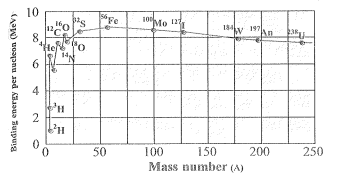
→The curve of binding energy per nucleon versus mass number A is shown in figure. →The binding energy per nucleon is nearly constant ( 8 MeV ) in the region between $A =30$ to $A =170$. →For the lighter nuclei region $A <30$ and for the heavier nuclei region $A >170$ the binding energy per nucleon is less than 8.0 MeV . →If nuclei with less total binding energy transform to nuclei with greater binding energy there will be a net energy release. →"When a heavy nucleus decays into two or more intermediate mass fragments, then the total binding energy increases. Energy is released during this process. This process is called nuclear fission". →"When two or more light nucleus fuse into heavier nucleus then also the total binding energy increases. Due to this energy is realeased during this process. This process is called nuclear fusion". →Exothermic chemical reactions underlie conventional energy sources such as coal or petroleum. Here the energies involved are in the range of electron volts. On the other hand, in a nuclear reaction, the energy release is of the order of MeV . → Thus for the same quantity of matter, nuclear sources produce a million $\left(10^6\right)$ times more energy than a chemical source. → For example : → Fission of 1 kg of uranium generates $10^{14} J$ of energy compare it with burning of 1 kg of coal that give $10^7 J$.
Need a full question paper?
Generate a complete, print-ready paper with questions like this in minutes — across 16+ boards, with answer keys.
A short bar magnet placed with its axis at $30^{\circ}$ with a uniform external magnetic field of 0.25 T experiences a torque of magnitude equal to $4.5 \times 10^{-2} J$. What is the magnitude of magnetic moment of the magnet?