Electric Current Through Conductors — Physics STD 11 Science — Question
Maharashtra BoardEnglish MediumSTD 11 SciencePhysicsElectric Current Through Conductors4 Marks
Question
Explain parallel combination of resistors.
✓
Answer
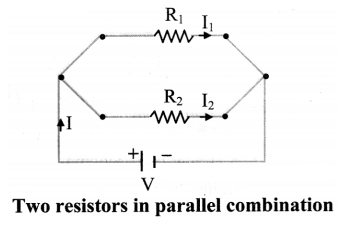
$i$. In parallel combination, the resistors are connected in such a way that the same voltage is applied across each resistor.
$ii$. A number of resistors are said to be connected in parallel if all of them are connected between the same two electrical points each having individual path.
$iii.$ In parallel combination, the total current $I$ is divided into $I,$ and $I2$ as shown in the circuit diagram.
$iv$. Since voltage $V$ across them remains the same,
$I=I_1+I_2$
where $I_1$ is current flowing through $R_1$ and $I_2$ is current flowing through $R_2$.
$v$. When Ohm's law is applied to $R_1$,
$V=I_1 R_1$
i.e. $I_1=\frac{V}{R_1}$
When Ohm's law applied to $R_2,$
$V=I_2 R_2$
i.e., $I_2=\frac{V}{R_2}$
vi. Total current is given by,
$I = I _1+ I _2$
$\therefore I =\frac{V}{R_1}+\frac{V}{R_2}$
$[$From $(1)$ and $(2)]$
Since, $I=\frac{V}{R_p}$
$\therefore \frac{V}{R_p}=\frac{V^{R_p}}{R_1}+\frac{V}{R_2}$
$\therefore \frac{1}{R_p}=\frac{1}{R_1}+\frac{1}{R_2}$
Where, $R_p$ is the equivalent resistance in parallel combination.
$vii. \ $If $' n\ '$ number of resistors $R_1, R_2, R_3$, $\qquad$
$R_n$ are connected in parallel, the equivalent resistance of the combination is given by
$\frac{1}{R_p}=\frac{1}{R_1}+\frac{1}{R_2}+\frac{1}{R_3} \ldots \ldots \ldots \ldots+\frac{1}{R_n}=\sum_{i=1}^{ i = n } \frac{1}{ R }$
Thus, when a number of resistors are connected in parallel, the reciprocal of the equivalent resistance is equal to the sum of the reciprocals of individual resistances.
Need a full question paper?
Generate a complete, print-ready paper with questions like this in minutes — across 16+ boards, with answer keys.